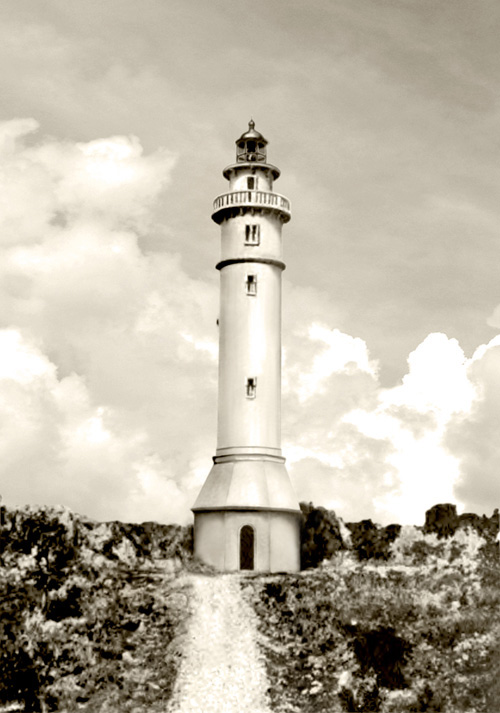
Maniguin Island Lighthouse
It was supposed to be magnificent. The Spanish Government had drawn up plans for a second-order masonry lighthouse on Maniguin Island, a structure worthy of the grand Maritime Lighting program that was illuminating the Philippine Archipelago in the final decades of the 19th century. The design echoed the Cape Melville Lighthouse -- massive, ornate, built to impress as much as to guide. But Spain lost the Philippines before a single stone was laid, and the Americans who inherited those blueprints had different ideas about how to light a 42-kilometer stretch of open water between Culasi and the Cuyo East Passage.
Hammerhead in the Sulu Sea
Maniguin Island -- also called Maningning Island, or more colloquially Hammerhead Island for its shape -- sits far from the coast of Antique province, alone in the waters where the Sulu Sea meets its shipping lanes. The island is an exercise in contrasts: a narrow ridge at its southern end rises 33.5 meters, while the rest barely clears 4.5 meters above the waterline, low and wooded and unremarkable except for the coral reefs that fringe it, dropping away steeply into deep water. Ships navigating the Cuyo East Passage needed a reliable mark here, a fixed point of light where the sea offered none.
Concrete Instead of Stone
When American engineers surveyed the island in 1904, they scrapped the Spanish plans entirely. Economy and speed replaced grandeur. For the first time anywhere in the Philippines, reinforced concrete would replace masonry in a lighthouse tower. The budget was set at 60,000 pesos. A construction party -- two Americans, one Spanish mason, and 40 Filipino laborers -- left Manila on December 29, 1904, bound for this speck of land in the open sea. By March 1905, local hires had swelled the crew to 106. A sloop named Jervey ferried workers and fresh water back and forth across the miles of open ocean.
By April 1, 1905, a temporary white light was burning from the island's highest point, 40 meters above the water, visible for 21 kilometers in clear weather. It was a placeholder, a lens lantern doing the work while the real tower rose below it. The iron staircase arrived from Hong Kong in August. By year's end, the tower had reached its balcony, the cistern was finished, and the dwelling foundations were in place. The following year, the fourth-order light was lit for the first time.
The Priest and the Pragmatist
What made Maniguin significant was not its beauty but its efficiency. Every previous American lighthouse in the Philippines had depended on Spanish-era materials or Spanish-drafted plans. Maniguin was the first station built from scratch under purely American supervision, and the results vindicated the new approach: faster construction, higher standards, lower costs. The round cylindrical concrete tower with its gallery on top lacked the romance of the original Spanish design, but it did exactly what it needed to do -- throw light across dark water for ships threading through the passage toward the Sulu Sea.
Abandoned Light
The lighthouse stood for more than a century. Then the Philippine Coast Guard moved on. A new white tower, solar-powered and modern, now stands a short distance from the original, doing the same job with different technology. The American-built concrete tower -- the one that proved reinforced concrete could work for Philippine lighthouses, the one raised by 106 laborers on a remote coral island -- has been abandoned. Its gallery still faces the horizon. The Cuyo East Passage still carries ships south into the Sulu Sea. But the light that guided them for generations no longer burns, replaced by a quiet hum of solar panels and a newer beacon that owes its existence to the concrete experiment that came before.
From the Air
Located at 11.60°N, 121.70°E on Maniguin Island, roughly 43 km off the coast of Culasi, Antique province. The island is visible as a small wooded landform with a narrow ridge at its southern end. The lighthouse tower and newer replacement are on the southeastern point. Nearest significant airport is Kalibo International Airport (RPVK), approximately 140 km to the east. Best viewed at 2,000-3,000 ft for island detail. The Cuyo East Passage shipping lane runs alongside.