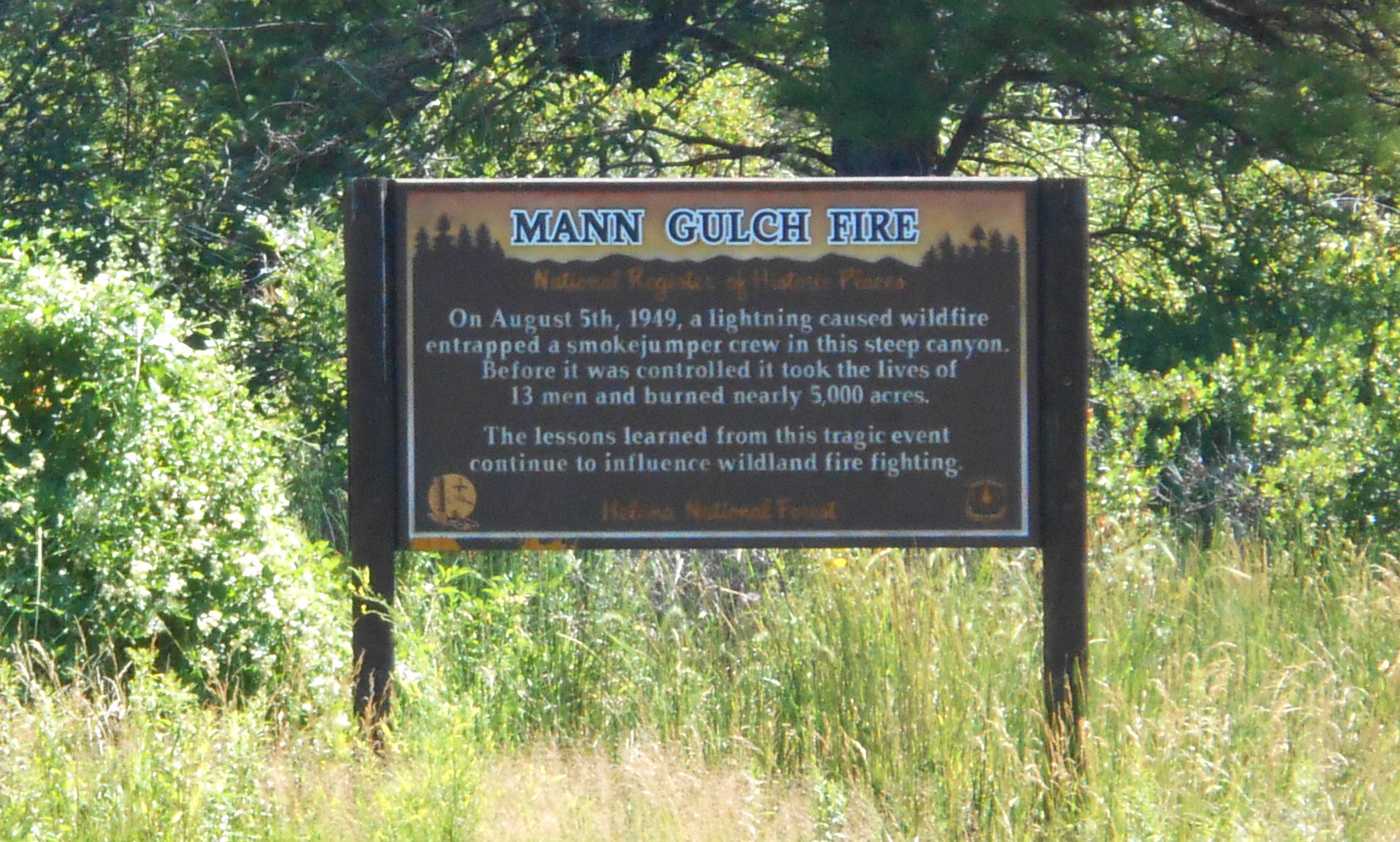
Mann Gulch Fire
Wagner Dodge struck a match and lit the grass at his feet. Behind him, a wall of flame raced uphill at impossible speed. His fifteen-man smokejumper crew had parachuted into Mann Gulch just hours before, and now the fire they came to fight was about to kill them. Dodge dropped into the ashes of his escape fire and pressed his face to the blackened earth as the inferno roared past. He would survive. Thirteen of his companions would not. The Mann Gulch fire of August 5, 1949, became one of the deadliest days in American firefighting history, and its legacy still shapes how wildland firefighters train, communicate, and survive.
Fifteen Men and a Burning Ridge
The fire was spotted around noon by James Harrison, a twenty-year-old college student working as a fire prevention guard at Meriwether Canyon Campground. Harrison had been a smokejumper the previous summer but quit because of the danger. Now, alone, he fought the flames for four hours before help arrived. A Douglas DC-3 called Miss Montana carried fifteen smokejumpers from Hale Field in Missoula to reinforce him. One jumper got sick during the turbulent flight and returned with the plane. The remaining fifteen parachuted into the top of the gulch, their equipment scattered by violent winds. Their only radio was destroyed when its parachute failed to open.
A Fire That Runs Uphill
Fire danger that day registered 74 out of 100. The south-facing slope above Mann Gulch pitched at angles up to 76 percent, covered in dry grass that had not seen meaningful rain in weeks. Wind blew uphill, in the same direction the men would try to flee. These factors combined into a perfect engine of destruction. Foreman Dodge led his crew downhill toward the Missouri River, planning to use it as a safe refuge. Then he saw the fire had crossed below them, cutting off their escape. The flames were advancing faster than men could run. Dodge turned his crew back uphill, racing the fire toward the ridge.
The Escape Fire
With flames less than a hundred yards behind, Dodge did something no one expected. He stopped, struck a match, and set fire to the grass in front of him. The technique, known as an escape fire, creates a burned-out zone where flames cannot follow. Dodge shouted for his men to join him in the ashes. None did. They kept running. The main fire caught and passed around Dodge's position, picking him up and shaking him, as one account put it, like a dog with a bone. He survived with minor burns. Walter Rumsey and Robert Sallee, the youngest on the crew at seventeen, escaped by finding a crack in the rocks and crawling through to the ridge. The other thirteen, including Harrison the fire guard, were fatally burned.
Thirteen Crosses Above Cold Waters
Memorial crosses now mark where each man fell on that steep hillside. In 2001, the cross for David Navon was replaced with a Star of David, honoring his Jewish faith. Folk singer James Keelaghan wrote a song from Dodge's perspective called Cold Missouri Waters, describing thirteen crosses high above the cold Missouri waters. The song has been covered by artists including Cry Cry Cry, and it was revived as a tribute to the nineteen firefighters who died in Arizona's Yarnell Hill Fire in 2013. Miss Montana, the DC-3 that delivered the crew, was restored and still flies from Missoula. On August 5, 2019, the seventieth anniversary, she flew over Mann Gulch and dropped wreaths for the thirteen lost.
Lessons Burned Into Memory
The Forest Service transformed its firefighting protocols after Mann Gulch. The Ten Standard Firefighting Orders and Eighteen Situations That Shout Watch Out became mandatory training. Yet the lessons were not learned deeply enough. Similar tragedies occurred in Arizona's 1990 Dude Fire, killing six, and Colorado's 1994 South Canyon Fire, killing fourteen. These failures led to LCES: Lookouts, Communications, Escape Routes, Safety Zones. Norman Maclean, the author of A River Runs Through It, spent years researching Mann Gulch for his posthumous book Young Men and Fire, which won the 1992 National Book Critics Circle Award. The site was added to the National Register of Historic Places in 1999. What happened there continues to teach firefighters that when the mountain turns against you, sometimes the only way out is through fire itself.
From the Air
Mann Gulch lies at 46.88N, 111.90W within the Gates of the Mountains Wilderness in Helena National Forest. The steep, V-shaped gulch opens to the Missouri River and is accessible primarily by boat or on foot. From the air at 4,000-6,000 feet AGL, the terrain that trapped the smokejumpers becomes clear: the south-facing slope rises sharply, and the narrow canyon funnels wind uphill. Helena Regional Airport (KHLN) is approximately 20 nautical miles south. The memorial crosses on the hillside are not visible from standard cruising altitude, but the landscape speaks volumes about why fire moves so fast through terrain like this.