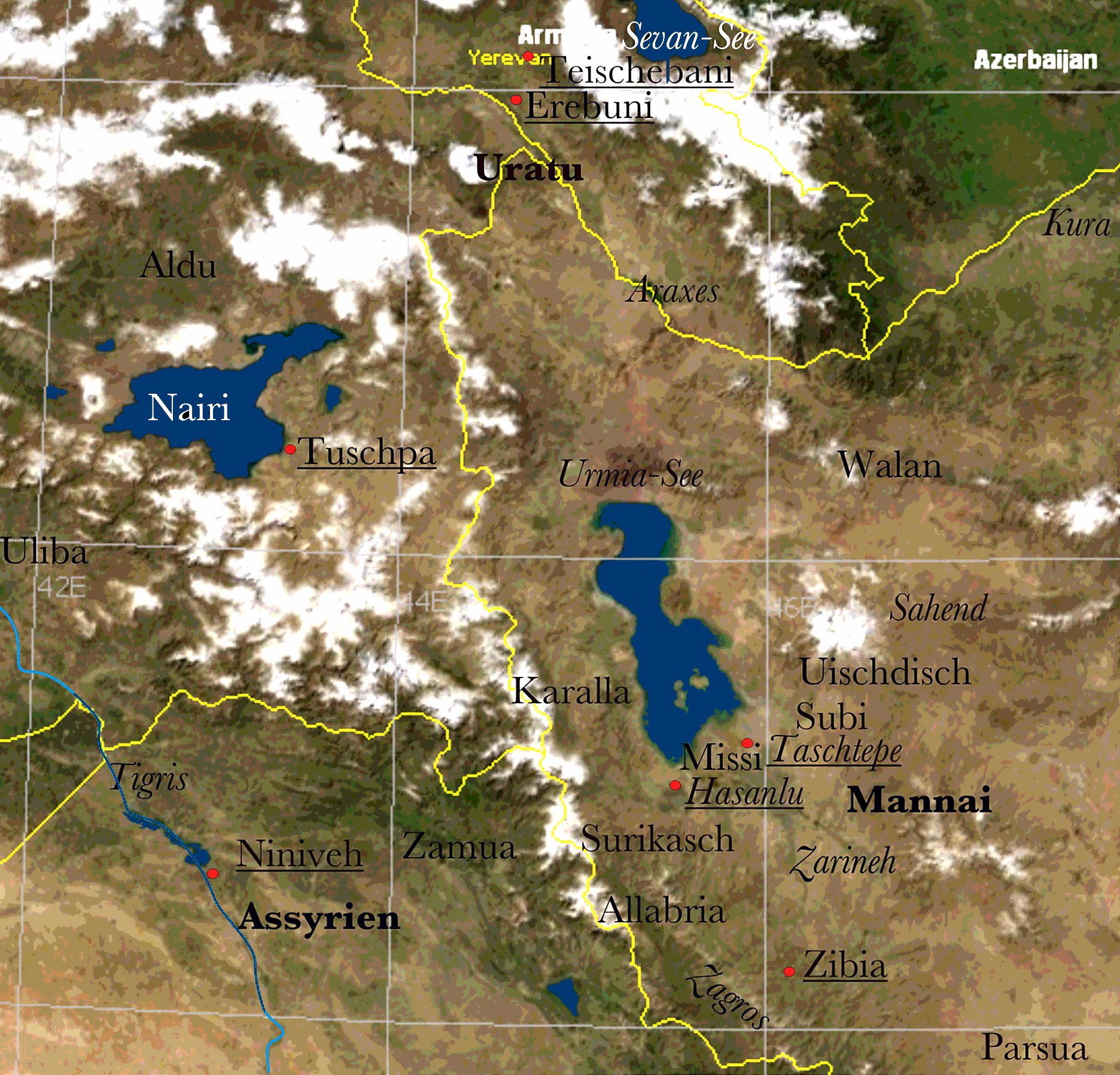
Mannaea
The prophet Jeremiah called them Minni. The Assyrians knew them as Mannai, the people of the land of Manna. For three centuries, from roughly 850 to 616 BC, their kingdom occupied some of the most contested terrain in the ancient world -- the hills and valleys south and east of Lake Urmia in northwestern Iran, precisely where the ambitions of Assyria and Urartu collided. Today almost nothing stands above ground to mark them. But in cuneiform tablets, in the ruins of fortified cities, and in the very name "Armenia" itself, Mannaea persists.
Between the Empires
Geography made Mannaea both powerful and precarious. Positioned along the northeastern frontier of the Neo-Assyrian Empire, with the kingdom of Urartu pressing from the north, the Mannaeans became expert practitioners of survival diplomacy. They shifted allegiances as conditions demanded -- ally to Assyria one decade, adversary the next. Their capital, the fortified city of Izirtu near modern-day Saqqez, anchored a state with regional governors, a tributary economy, and an aristocracy powerful enough to limit the king's authority. By the 820s BC, Mannaea had grown into a significant regional power. The Mannaeans bred cattle and horses, practiced irrigation, and built cities meant to withstand siege. When open war erupted between Assyria and Urartu in the mid-8th century BC, the Mannaeans seized the moment and expanded their territory, reaching their zenith under King Iranzu around 725 BC.
A Language Without a Family
Who were the Mannaeans? The question has nagged scholars for over a century. Assyrian and Urartian texts record their personal and place names, and the evidence suggests the ruling class spoke an isolated language belonging to neither the Semitic nor Indo-European families. Some researchers have proposed a connection to Urartian, part of the Hurro-Urartian language group. But a 2022 genetic study of individuals from the nearby site of Hasanlu complicated the picture. The ancient DNA revealed Y-chromosome haplogroups linked to Yamnaya steppe ancestry -- but distinct from the markers associated with Indo-Iranian speakers. Instead, the genetic profile showed affinities with Bronze Age populations of the Armenian Highlands. The finding raises the possibility that these people spoke something related to Armenian, or perhaps a language entirely their own that left no descendants at all.
Cimmerians, Scythians, and the Fall
The 7th century BC brought a cascade of catastrophes. In 716 BC, Sargon II of Assyria had already seized Izirtu and stationed troops in nearby Parsua, turning Mannaea into a breeding ground for the war horses Assyria craved. Then came the Cimmerians -- nomadic warriors who, according to Assyrian inscriptions, originally set out from a homeland in "the midst of Mannai." By 679 BC, these raiders had migrated east and west of the kingdom, leaving destruction in their wake. King Ahsheri managed to enlarge Mannaea's territory even while paying tribute to Assyria, but a crushing Assyrian defeat around 660 BC triggered internal revolt that consumed the kingdom until his death. The Scythians dealt further blows. Ahsheri's successor Ualli allied with Assyria against the rising Medes, but it was a losing bet. When the Neo-Assyrian Empire began to devour itself in civil war after Ashurbanipal's death in 627 BC, the Medes broke free and turned their attention to Mannaea. At the battle of Qablin in 616 BC, the combined Assyrian-Mannaean force fell to the Babylonians. The frontiers lay open. Between 615 and 611 BC, the Medes absorbed what remained of the Mannaean kingdom.
What Remains
Mannaea left no literary tradition, no monumental inscriptions in its own language. What survives comes through the voices of its conquerors and competitors. The excavation of Hasanlu, begun in 1956, uncovered a fortified city destroyed violently around 800 BC -- warriors found where they fell, still clutching weapons. The site of Qalaichi has been more directly linked to the Mannaeans through a stela bearing the kingdom's name. Glazed bricks from Bukan hint at artistic traditions that blended Assyrian and local styles. In the Bible, Jeremiah invokes Minni alongside Ararat and Ashkenaz as future destroyers of Babylon. Some scholars have even theorized that the name "Armenia" derives from the Akkadian "HAR Minni" -- the mountains of Minni. If so, the Mannaeans left their deepest mark not in stone but in the very word for the land that swallowed them.
From the Air
Coordinates: 36.84N, 45.96E, near modern Saqqez in Iran's Kurdistan Province, south of Lake Urmia. The ancient Mannaean heartland spans the hilly terrain visible between Lake Urmia to the north and the Zagros Mountains to the south. From cruising altitude, the distinctive blue expanse of Lake Urmia serves as the primary landmark. Nearest major airport: Urmia Airport (OITR), approximately 130 km north. Tabriz International Airport (OITT) lies about 200 km northeast. The terrain is mountainous with elevations between 1,200 and 2,500 meters.