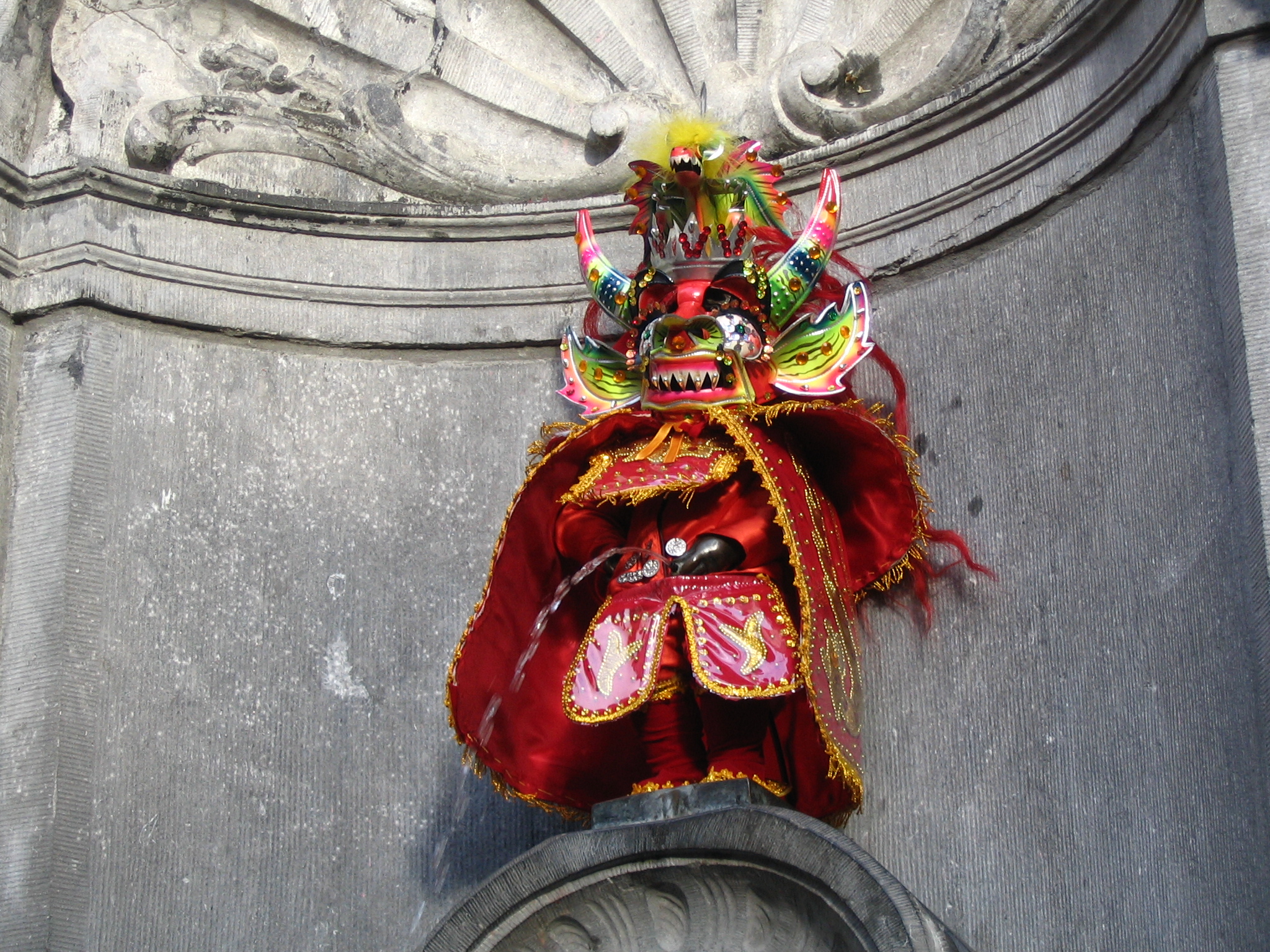
Manneken Pis
He is fifty-five and a half centimeters tall, made of bronze, and not actually old. The one you see on the corner of the Rue du Chene and the Rue de l'Etuve is a 1965 replica - the original was stolen, broken into pieces, dumped in a canal, and now lives behind glass at the Brussels City Museum. He has been called the oldest bourgeois of Brussels. He has more than a thousand outfits. He has been kidnapped by French grenadiers, decorated by Louis XV, hijacked by Antwerp students, and was once temporarily switched off in 2025 to mark World Continence Week. There is a small museum dedicated entirely to his wardrobe. The official name in both French and Dutch is Manneken Pis, and almost everything about him is a perfect Brussels joke.
A Fifteenth-Century Boy
The earliest mention of him is in a Brussels municipal document from 1451-52, a record of the water lines feeding the city's public fountains. He was already a fountain then, already a small boy, already urinating into a stone basin. We have only schematic glimpses of that first stone figure - a corner of a Braun and Hogenberg map, a detail in a 1616 painting by Denis Van Alsloot showing him dressed as a shepherd for the Ommegang procession. In 1619 the city commissioned a replacement. The Brabantine sculptor Jerome Duquesnoy the Elder cast a new bronze figure that probably went into place in 1620 - a chubby boy with curly hair, looking down at his work with the unbothered concentration only toddlers and emperors can summon. The fountain played a real role in the city's water supply for centuries. People came with jugs. When the bombardment of Brussels by Louis XIV's army damaged the pipes in 1695, a contemporary pamphlet recorded that he was already an object of glory appreciated by all and renowned throughout the world. Above the restored statue someone carved a line in Latin from the Psalms: The Lord placed me on a stone base, and now I raise my head above my enemies.
Two Legends, Both Excellent
Two stories explain how he got there. The first involves Duke Godfrey III of Leuven, a two-year-old lord whose troops were fighting at Ransbeek in 1142. To rally the soldiers, someone hung the infant duke in a basket from an oak tree above the battle. The little duke rose up in his basket and urinated on the enemy, who lost. The street where Manneken Pis stands is still called Rue du Chene - Oak Tree Street - in memory of that tree. The second legend is set during a fourteenth-century siege of Brussels. Attackers had placed explosive charges against the city walls. A little boy named Julianske was spying on them, noticed the burning fuse, and put it out the only way a boy his age can. The city was saved. Both legends are charming, both probably postdate the statue, and both miss the obvious point - that the people of Brussels have always preferred their civic symbols small, naked, and uninterested in dignity.
Stolen, Smashed, Rescued
He has been stolen, or nearly so, at least seven times. In 1745 English soldiers reportedly took him; he ended up in the town of Geraardsbergen, which has its own competing Manneken Pis and an ongoing feud about which is older. (Geraardsbergen's was cast in 1459 to replace a stolen lion's-head spout. Brussels' first version dates from before 1451. Both currently on display are replicas.) In 1747 French grenadiers tried to take him. The people of Brussels were furious enough that King Louis XV, hoping to defuse the situation, gave him a gold-embroidered brocade gown, the right to carry a sword, and the Cross of Saint Louis. That gown still survives in the City Museum - the oldest costume in his collection. In 1817 a freed convict named Antoine Licas stole him and broke the statue into eleven pieces. The pieces were reassembled, used to cast a mold, and the new statue went up screwed onto a copper base marked 1620 - REST 1817. Two more attempted thefts in 1955 and 1957. In 1963, Antwerp students from De Wikings hijacked him for five days as a charity stunt. Then in 1965 the worst theft of all: the statue was broken, only the feet and ankles remained. The body was recovered from the Charleroi Canal in 1966 by divers sent by an Antwerp magazine. After that, the original went behind museum glass. The Compagnie des Bronzes cast the working replica that has stood in the niche ever since.
A Thousand Costumes
He had five costumes in 1756. By 1994 he had more than four hundred. By 2016, more than nine hundred and fifty. In 2018, fashion designer Jean-Paul Lespagnard created the thousandth. Since 2017 they have been displayed in a dedicated museum a few doors down called GardeRobe MannekenPis. The costume changes happen on a published schedule, often accompanied by a brass band, sometimes by the Order of the Friends of Manneken Pis - a society founded in 1954 to preserve the traditions. He has been Dracula, Mickey Mouse, Santa Claus, a Bolivian Diablada dancer, a saxophonist for the 200th birthday of Adolphe Sax, and a burgomaster from the Seven Noble Houses of Brussels. On certain folk holidays he is hooked up to a keg of beer instead of water, and passersby get free cups. In 2018 a city technician discovered he had been leaking 1,000 to 2,500 liters of drinking water per day for years - a problem that turned into a sustainability story when a recirculating system was installed.
A National Personality
Brussels has two related concepts that Manneken Pis embodies completely. The first is belgitude - a self-deprecating, slightly absurdist Belgian self-image, allergic to grandeur. The second is zwanze - the very specific Brussels strain of folk humor that takes a small naked toddler urinating in a corner and makes him the official mascot of a national capital. He has a female counterpart, Jeanneke Pis, added in 1987 in a nearby alley. He has a dog version, Het Zinneke, added later. In 2019, the Brussels edition of Monopoly censored him with swimming trunks, under pressure from Hasbro. The reaction in Brussels was the only reaction it could have been: people thought it was funny. Souvenir shops on the Rue de l'Etuve sell him in brass, in fiberglass, in Belgian chocolate, as ashtrays and corkscrews. Tens of thousands of tourists arrive every year expecting something monumental, and find instead a small bronze boy doing what small bronze boys do, surrounded by waffle stalls. They leave smiling. That is the joke, and the joke is the point.
From the Air
Located at 50.84N, 4.35E, in the heart of central Brussels about five minutes' walk southwest of the Grand-Place. From altitude, the surrounding cityscape includes the Grand-Place, the Brussels Town Hall spire, and the dense medieval street grid of the Ilot Sacre. Nearest airport is Brussels (EBBR), about 12 km northeast. Charleroi (EBCI) lies 45 km south.