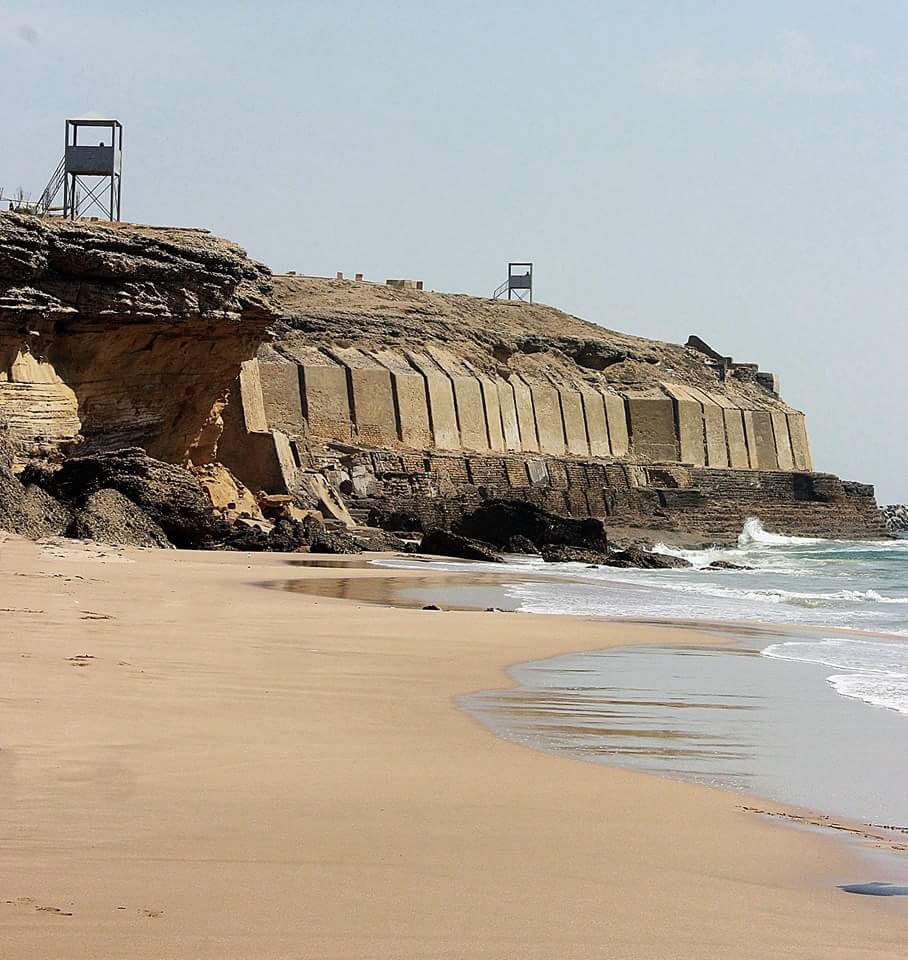
Manora, Karachi
Nearchus, the admiral who commanded Alexander the Great's naval fleet in the fourth century BCE, described a hilly island he called Morontobara. Colonial historians identified it as Manora, the rocky peninsula that guards the entrance to Karachi Harbour. Twenty-three centuries later, the island Nearchus sailed past is no longer an island at all. Natural silting has connected it to the mainland by a 12-kilometer sand bridge called Sandspit, but Manora still performs the duty it has always held: standing watch over Karachi's waters.
Fort Against Pirates
The Talpur dynasty built Manora Fort in 1797 to protect a harbour that handled trade with Oman and Bahrain. Qasimi pirates threatened and sometimes raided Karachi Harbour in the early nineteenth century, and the fort's cannons were meant to discourage them. Whether the piracy was as widespread as claimed has been debated by historians; some argue the accounts were exaggerated by the East India Company as justification for seizing control of the Persian Gulf region. Regardless, the fort stood as the harbour's primary defense until February 1839, when HMS Wellesley anchored off Manora and opened fire. British troops storming the fort reportedly found it defended by four or five men who had no functioning guns. The fortress fell almost without resistance.
Light on the Arabian Sea
In 1888, the old fort was largely demolished and the battery reinforced. The following year, the Manora Point Lighthouse was completed, designed by Canadian engineer Alain-Chartier-de-Lotbiniere Joly de Lotbiniere. Rising 38 meters, it remains one of Pakistan's tallest lighthouses. The Ottoman admiral Seydi Ali Reis had mentioned Manora in his 1554 book Mir'at ul Memalik. The British historian John Eliot argued that Manora and parts of Karachi constituted the ancient city of Debal, conquered by Muhammad bin Qasim in 711 CE. Layers of history accumulate here like the silt that turned the island into a peninsula.
Naval Base and Beach Resort
After Pakistan's independence, Manora became a principal base for the Pakistan Navy, with berths for warships along the eastern edge of the peninsula. It has been governed as a military cantonment, though the opening of Jinnah Naval Base at Ormara, 250 kilometers away, has drawn roughly half the vessels elsewhere. The peninsula's other identity is recreational. Manora's sandy beaches extend along Sandspit and merge with Hawkes Bay Beach several kilometers to the west. In October 2021, the Sindh government opened the Manora Beach Resort after investing 650 million rupees in infrastructure including driveways, restaurants, a golf course, and watersports facilities.
Where the Peelu Trees Hold the Shore
Manora's coast is protected by Peelu trees, Salvadora persica, whose root systems anchor the soil against erosion from the Arabian Sea. Mangrove forests border the western bay of the harbour, and the peninsula hosts a diverse population of about 4,273 residents including Sindhis, Punjabis, Kashmiris, Pakhtuns, Balochis, and Bohris among others. St. Paul's Church and the Varun Dev Temple stand within sight of each other, artifacts of a religiously diverse community that has persisted on this narrow strip of land. From Alexander's fleet to the Pakistan Navy, from Talpur cannons to tourist resorts, Manora continues to be the hinge on which Karachi's relationship with the sea turns.
From the Air
Located at 24.80N, 66.967E at the southern entrance to Karachi Harbour. The Manora Point Lighthouse (38 meters tall) is a visible landmark from the air. The 12-km Sandspit sand bridge connecting Manora to the mainland is clearly distinguishable from altitude. Pakistan Navy vessels may be visible along the eastern shore. Jinnah International Airport (OPKC) is approximately 20 km to the northeast. Hawkes Bay Beach extends to the west.