Manseibashi Station
Train enthusiasts call it "the phantom station." Riders on Tokyo's Ginza Line pass through a stretch where the tunnel ceiling rises unexpectedly, the walls widen for a moment, and then the space contracts again. Most passengers never notice. But those who look up are glimpsing the bones of Manseibashi Station, a ghost from 1912 that refuses to fully disappear. Perched on the south bank of the Kanda River, just steps from the neon chaos of Akihabara Electric Town, this forgotten stop on the Chuo Main Line spent decades as Tokyo's most elegant ruin before finding an unlikely second life as a shopping destination built inside its own skeleton.
An Architect's Dress Rehearsal
When Manseibashi Station opened on April 1, 1912, it was the eastern terminus of the Chuo Main Line, a grand gateway into the capital. Its designer, Tatsuno Kingo, gave it the same red-brick European grandeur he would later refine for Tokyo Station, which opened two years later in 1914. Tatsuno drew inspiration from Amsterdam Centraal, and the result was a station that looked more like a European palace than a Japanese commuter stop. A bronze statue of Russo-Japanese War hero Takeo Hirose stood before its entrance, greeting passengers with military formality. For seven years, Manseibashi served as the line's proud endpoint. But Tokyo's rail network was expanding fast, and by 1919 the line had been extended further east. The station was no longer a terminus, just another stop along the way.
Earthquake, Fire, and Slow Erasure
The Great Kanto Earthquake of 1923 leveled Manseibashi's elegant red-brick facade. Unlike Tokyo Station, whose imported English steel framing allowed it to survive, Manseibashi was destroyed and never rebuilt to its former splendor. A simpler structure replaced it, but the station's days were already numbered. When the Chuo Line was extended across the Kanda River to Kanda Station in 1931, Manseibashi closed as a railway stop. A subway station of the same name on the Ginza Line lingered until 1943 before it too shut down. The physical traces remained, though: the brick arches beneath the elevated tracks, the staircases leading to platforms where no one waited, the slightly taller tunnel ceiling underground where Ginza Line trains still rush through without stopping.
The Red Bricks Breathe Again
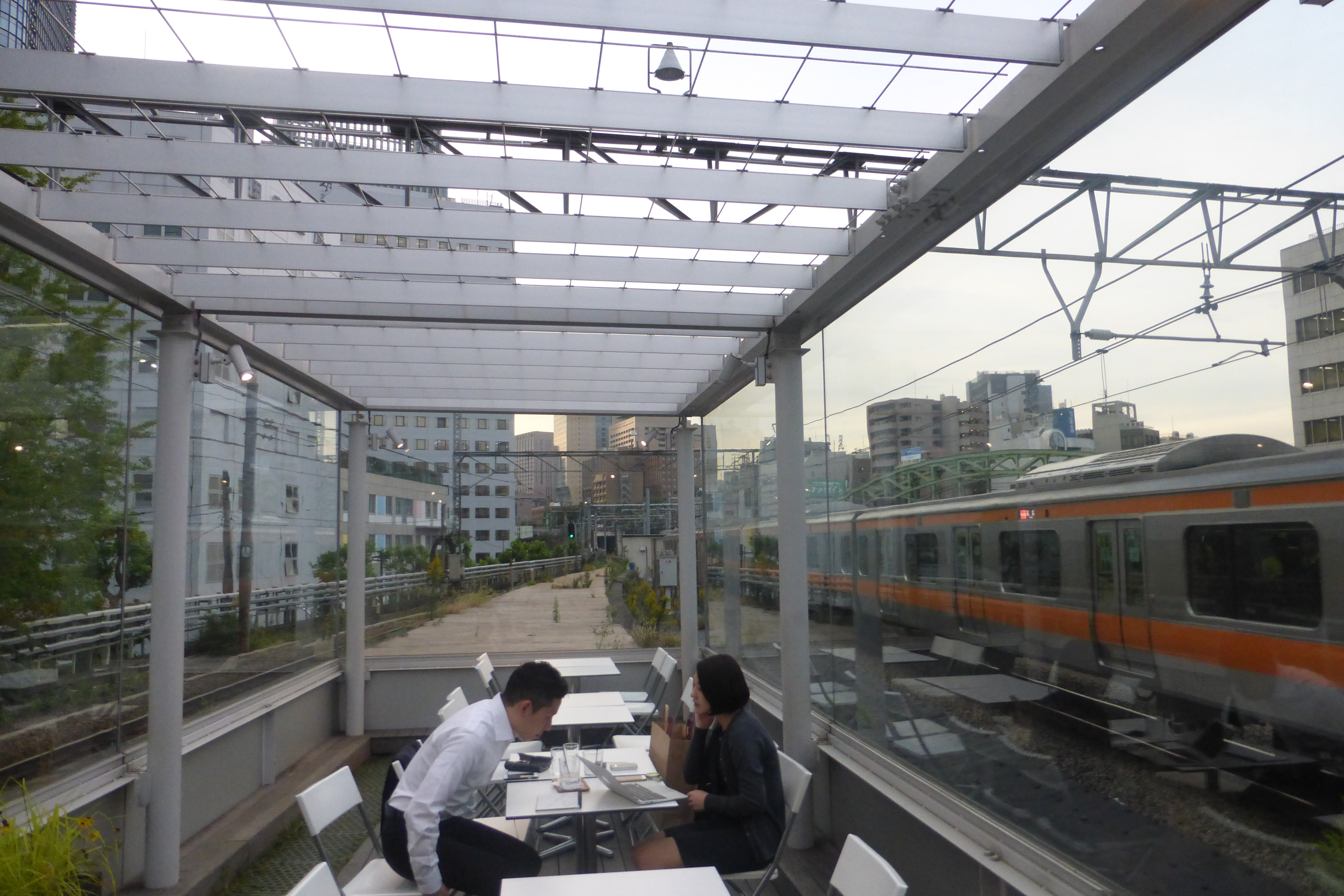
For decades, Manseibashi existed in limbo, neither fully abandoned nor put to new purpose. Then in September 2013, JR East completed a transformation that embraced the ghost rather than exorcising it. The renovation, called mAAch ecute Kanda Manseibashi, turned the brick-arched viaduct into a corridor of cafes, boutiques, and gallery spaces. The original 1912 staircases were preserved and incorporated into the design. Most remarkably, the old platform itself became "Platform 2013," an open deck where visitors sit in a glass-walled cafe and watch Chuo Line trains thunder past at eye level, close enough to feel the wind. The concept was a "station salon" that honored the rhythmic arches and warm brick textures of the original structure while filling them with contemporary life.
Between Worlds
Manseibashi occupies a peculiar geographic and cultural borderland. To the north across the bridge lies Akihabara, Tokyo's famous electronics and anime district, pulsing with otaku energy. To the south stretches the quieter Kanda neighborhood, home to old bookshops and curry houses. The Kanda River flows between them, and the Manseibashi bridge that gives the station its name connects these two very different Tokyos. The station itself embodies this in-between quality: it is historical yet modern, a ruin turned retail, a place where trains still pass but never stop. For the observant visitor, it is a rare chance to stand inside the layered archaeology of a city that rebuilds itself relentlessly, one of the few places where Tokyo's past is not bulldozed but woven into its present.
From the Air
Located at 35.697N, 139.770E in central Tokyo's Chiyoda Ward, along the Kanda River. The station sits between Ochanomizu and Kanda stations on the JR Chuo Line. From the air, look for the elevated rail viaduct crossing the river near Akihabara's dense electronics district. Nearest airports: Tokyo Haneda (RJTT, 15 km south) and Tokyo Narita (RJAA, 60 km east). Best viewed at low altitude; the brick arches are visible along the elevated track structure. The area is extremely dense urban terrain with no nearby general aviation fields.