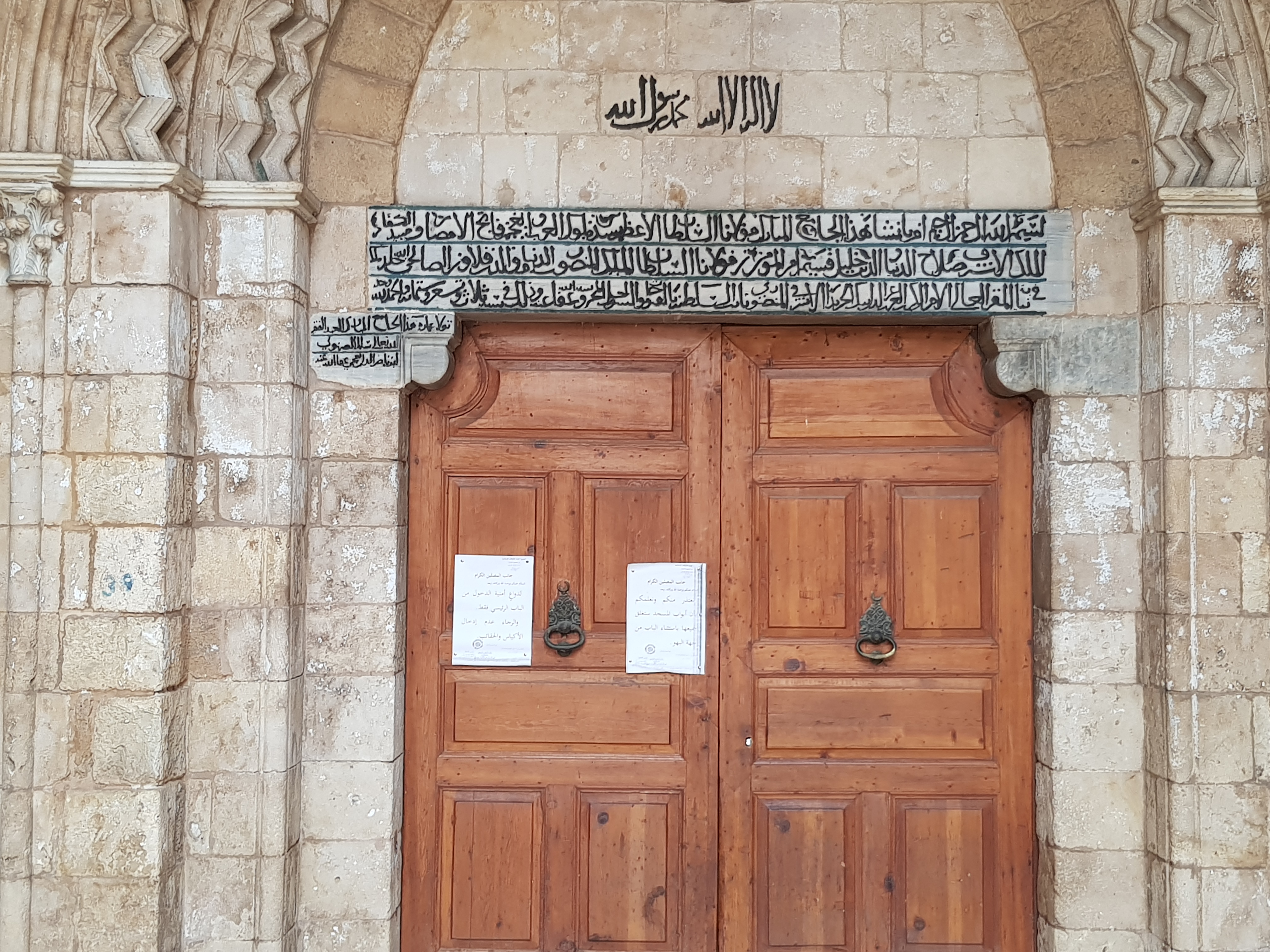
Mansouri Great Mosque
Step through the main entrance of the Mansouri Great Mosque and you walk through two civilizations at once. The rectangular doorway is framed by arches with alternating plain and zigzag stone moldings, resting on slender white marble colonnettes. Behind them, a row of spiky quatrefoil rosettes decorates the inner archway. These rosettes have no precedent in Islamic decorative tradition. They are Norman, introduced to the Levant by the Crusaders, and they survive here because the Mamluks who built this mosque in the 1290s chose to keep the entrance of the church they had torn down.
Conquest Written in Stone
The mosque takes its name from al-Mansur Qalawun, the Mamluk sultan who conquered Tripoli from the Crusaders in 1289, leveling the old Frankish city in the process. His sons completed the work: Sultan al-Ashraf Khalil began construction in 1294, and Sultan al-Nasir Muhammad added the courtyard arcades in 1314. This was the first major building erected in Mamluk Tripoli, a deliberate statement that the new rulers intended to rebuild the city on their own terms. Six madrasas rose around the mosque during the Mamluk period, creating an entire educational quarter at the foot of the citadel. The mosque's main entrance and its square-towered minaret are the only surviving fragments of the Crusader Church of St. Mary, which stood near the base of the hill before the earthquakes of 1170 and 1201 and Qalawun's siege left it in ruins.
Where Lombardy Meets the Levant
The minaret has puzzled scholars since the nineteenth century. Four levels high, with arched windows multiplying as it rises, the tower looks less like anything from the Islamic world and more like a Christian bell tower from northern Italy. French diplomat Melchior de Vogue and Swiss historian Max van Berchem both noted its resemblance to the Lombard campaniles of Italy, and the consensus is that it belonged to the original Crusader church. An octagonal section topped by a conical dome was added later, grafting an Islamic silhouette onto a European skeleton. Inside the mosque, the blending continues. The prayer hall stretches 51.5 meters along the qibla wall, divided into two aisles by six massive piers. Thirteen bays are covered by simple cross-vaults; the fourteenth, directly before the mihrab, is crowned by a small dome. The wooden minbar beside it, donated by Amir Qaratay in 1326, is carved with intricate geometric patterns that rank among the finest examples of Mamluk woodwork in Lebanon.
The Room of the Noble Relic
In 1891, Ottoman Sultan Abdul Hamid II sent a remarkable gift to the people of Tripoli: a hair from the beard of the Prophet Muhammad, preserved in a golden box. The relic was originally intended for the Hamidy Mosque, which had just been restored, but was placed instead in the Mansouri Great Mosque because of its larger size and central location. A specially built room within the mosque, called the Room of the Noble Relic, now serves as a small religious museum. The relic draws visitors on the last Friday of Ramadan and on the Prophet's birthday, occasions when the golden box is displayed and the room fills with the quiet intensity of devotion. Other Islamic historical objects share the space, but it is the hair that anchors the room's significance, a tangible thread connecting modern Tripoli to the earliest days of Islam.
Resistance and Renewal
The mosque's role extended well beyond worship. During the French Mandate period, it served as a gathering point for non-violent resistance movements against colonial authority, its courtyard and prayer hall becoming spaces of political organization as well as prayer. Two granite columns stand to the right of the main entrance, remnants from classical antiquity that appear to serve no structural or decorative purpose. Similar orphaned columns appear at the nearby Taynal Mosque and the Madrasa Saqraqiyya, as though Tripoli's builders could not bring themselves to discard the fragments of civilizations that came before. In a city where Norman rosettes adorn Islamic arches and a Lombard bell tower calls Muslims to prayer, even the leftover columns seem to belong.
From the Air
Located at 34.435°N, 35.843°E in the historic center of Tripoli, Lebanon, in the an-Nuri neighborhood on the left bank of the Kadisha River, at the foot of the Citadel hill. The prominent minaret is visible from above the old city. Tripoli Air Base lies 3 km north. Best viewed at 2,000-4,000 ft AGL to appreciate the mosque's relationship to the citadel and the surrounding Mamluk quarter.