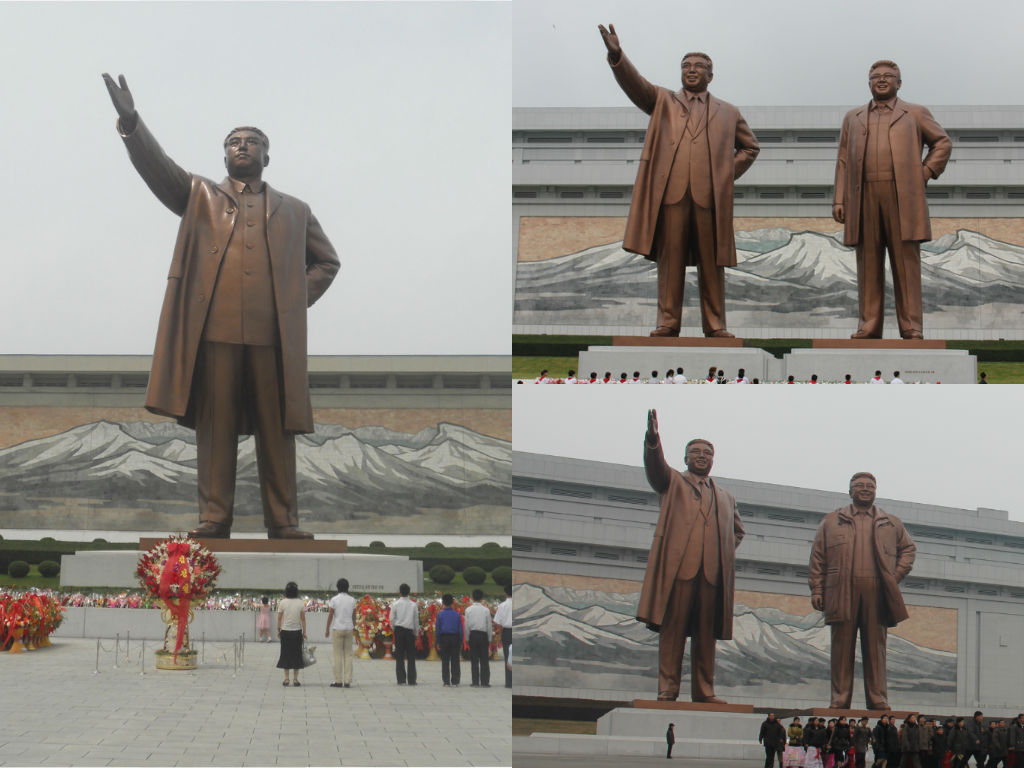
Mansudae Grand Monument
In 1977, the statue was covered in gold leaf. It did not stay that way. When Chinese leader Deng Xiaoping visited Pyongyang and saw the gilded monument to Kim Il Sung gleaming atop Mansu Hill, he expressed pointed displeasure at how Chinese foreign aid was being spent. The gold was quietly removed. This anecdote -- a rare moment of external pressure penetrating North Korea's carefully managed image -- says as much about the Mansudae Grand Monument as any description of its dimensions. The monument exists to project absolute power, but even absolute power has its awkward moments.
The Great Leader, Alone and Then Accompanied
Kim Jong Il commissioned the monument in April 1972 to celebrate his father Kim Il Sung's 60th birthday. The original statue stood alone -- a single bronze figure of the Great Leader overlooking the capital from the slopes of Mansu Hill. It remained solitary for nearly four decades. After Kim Jong Il's death in 2011, a second statue was erected beside his father's. At the same time, the original statue was quietly altered: Kim Il Sung's youthful features were aged to show him as an older statesman, his Mao suit was swapped for a Western-style suit, and a smile was added to his face. Kim Jong Il's statue initially wore a long coat before being changed to his signature parka. South Korean sources estimated the second statue cost $10 million, funded in part by mandatory $150 donations from North Korean workers stationed overseas.
229 Figures on the Hillside
The two leaders do not stand alone on the hill. Flanking the central statues are two sculptural groups comprising 229 figures in total -- soldiers, workers, and farmers depicted in poses of revolutionary struggle and socialist construction. Behind the statues rises the wall of the Korean Revolution Museum, covered with a massive mosaic mural depicting Mount Paektu, the mountain sacred to Korean identity and central to the Kim family's founding mythology. The sheer scale of the ensemble transforms Mansu Hill from a natural landmark into a political stage set. Designed by the state-run Mansudae Art Studio -- which also exports monumental sculptures to countries across Africa and Southeast Asia -- the complex is a masterclass in the architecture of authority.
Bowing and Photographing
All visitors, both foreign and domestic, are expected to bow before the statues. North Korean citizens are required to bring flowers. Foreigners are offered the option but understand that declining would be conspicuous. Photography follows strict rules: images must capture the statues in their entirety. Close-up photographs of any part of the leaders' likenesses are forbidden, a regulation that extends the regime's control over representation down to the angle of a tourist's camera. Satellite images from 2024 showed construction activity around the statues -- cranes, canopies, and maintenance crews performing cleaning, polishing, rust removal, and upgrades to the lightning rods and the sound system that plays solemn music around the clock. A hydraulic elevator system in a tunnel beneath the statues also received attention, a reminder that even monuments to eternity require upkeep.
The View from Mansu Hill
Standing before the monument and looking south across the Taedong River, the Monument to Party Founding is visible on the opposite bank -- its hammer, sickle, and calligraphy brush rising in deliberate symmetrical alignment with the statues on Mansu Hill. This axis across the center of Pyongyang symbolizes the Kim dynasty's unbroken line. The cityscape was designed so that these monuments speak to each other across the water, forming a dialogue in stone and bronze that reinforces the same message from every vantage point. It is monumental architecture in the truest sense: buildings designed not merely to impress but to construct an entire worldview.
From the Air
The Mansudae Grand Monument is located at 39.032°N, 125.753°E on Mansu Hill in central Pyongyang. The two large bronze statues and flanking sculptural groups are visible from the air, set against the Korean Revolution Museum building. The monument is directly across the Taedong River from the Monument to Party Founding. Nearest airport: Pyongyang Sunan International Airport (ZKPY/FNJ). North Korean airspace is heavily restricted.