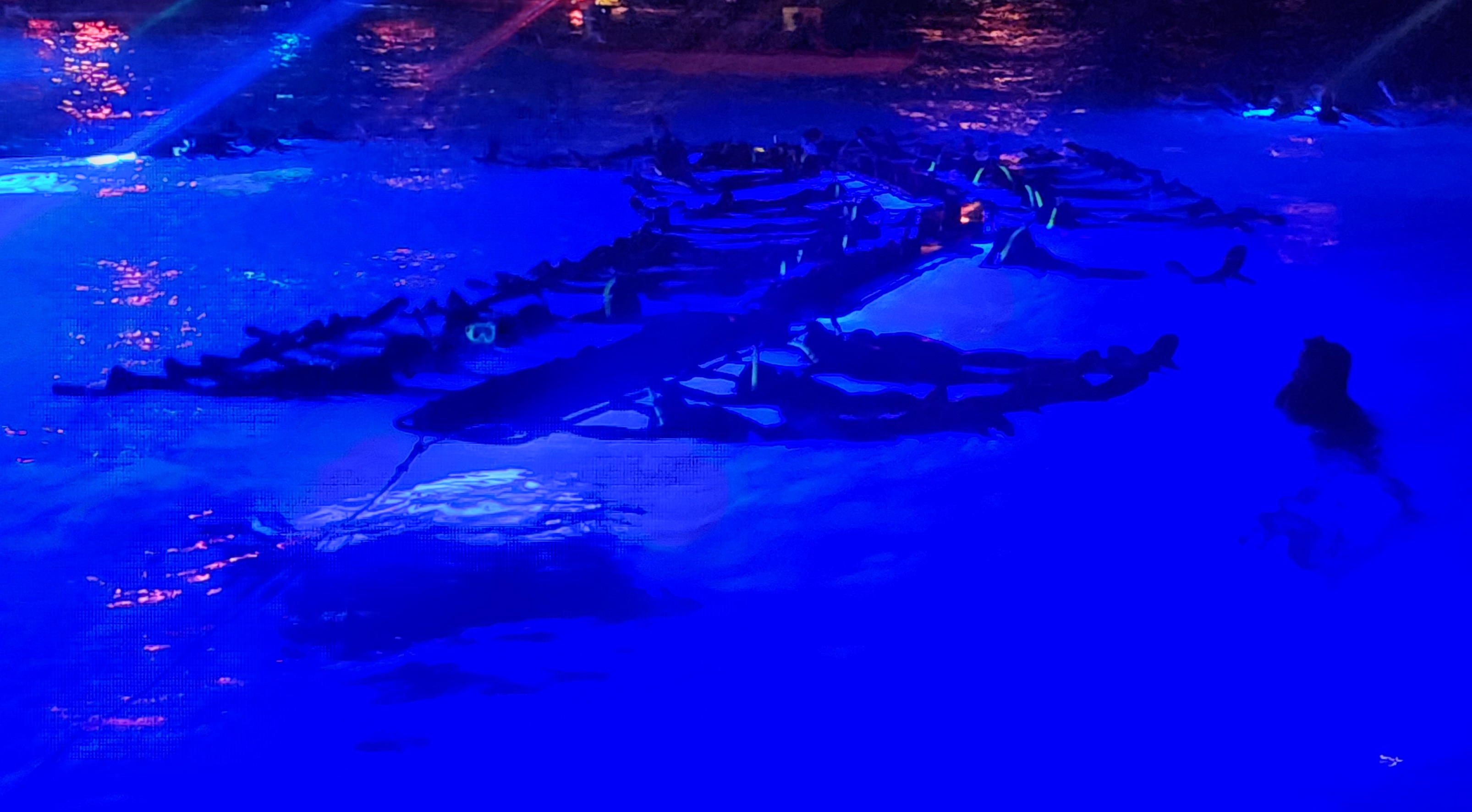
Manta Ray Night Dive
The lights go into the water, and the plankton come to the lights. Then the manta rays come to the plankton. It sounds simple -- and it is, which is what makes the Kona manta ray night dive one of the most accessible and astonishing wildlife encounters on Earth. Off the western coast of Hawaii's Big Island, where the volcanic shore drops steeply into deep Pacific water, divers kneel on the sandy bottom and aim their flashlights upward while snorkelers float at the surface shining theirs down. The beams create a glowing column that draws millions of microscopic organisms, and the manta rays arrive to feed -- banking and rolling through the light with their vast mouths open, wing tips brushing within inches of the humans watching.
Campfire in the Sea
The technique is called "bonfire" or "campfire" diving, and it works because manta rays are filter feeders. They have no interest in the divers. What draws them is the dense concentration of plankton that gathers in artificial light, the same way moths swarm a porch lamp. On a strong plankton night, a dozen or more mantas may appear, their wingspans reaching up to 16 feet, their gill rakers straining the water as they execute slow barrel rolls through the illuminated column. On lean nights, no mantas come at all. The variable is entirely ecological -- the density of plankton in the water column on any given evening. Divers learn to read the conditions: warm, still water tends to hold more plankton, and the weeks around the full moon can be particularly productive as lunar tides concentrate the organisms near shore.
Three Spots Along the Kona Coast
The dive happens at several established sites along the Big Island's western shore. The southernmost, known as Manta Village, sits in front of the Sheraton Kona Resort at Keauhou Bay, on the site of the former Kona Surf Hotel that closed in 2002. Farther north, Garden Eel Cove -- officially Hoona Bay -- lies just off Keahole Point, near the Kona International Airport. Its name comes from the colonies of garden eels that inhabit the sandy bottom. The third popular site spreads between Kawaihae Harbor and the Kohala resort coast. For decades before dive operators formalized the experience in 1992, travelers simply watched manta rays from the restaurants and balconies of coastal hotels like the Mauna Kea Beach Hotel, where the animals fed in the glow of the building's exterior lights. The dive industry turned a dining-room spectacle into an underwater encounter.
The Conservation Equation
Popularity creates a paradox: the more people want to see the mantas, the more carefully the encounter must be managed to avoid harming them. Manta rays are fragile creatures. Their gill plates, valued in some traditional medicine markets across the Pacific, have made them targets for fishing in other parts of their range. In Hawaiian waters, local organizations have taken a protective stance. The Manta Pacific Research Foundation conducts ongoing research, identifying individual mantas by the unique spot patterns on their bellies and tracking their movements along the coast. PADI's Project AWARE and the Ocean Recreation Council of Hawaii have established guidelines that dive operators enforce: no touching the animals, no chasing them, no blocking their feeding paths. The rules exist because the encounter depends on the mantas choosing to come. If the experience becomes stressful, the animals simply stop showing up.
After Dark, Underwater
What makes the Kona night dive singular is not just the mantas but the inversion it creates. Diving at night is inherently disorienting -- the reef vanishes beyond the reach of a flashlight, depth perception warps, and the ocean feels immeasurably larger than it does by day. Adding manta rays to this darkness transforms it. The animals are so large and so close that they fill the diver's visual field, their white ventral surfaces catching the light as they turn. Garden eels retreat into the sand at the divers' approach. Hawaiian turkeyfish drift along the reef edge. Heller's barracuda hang motionless in the beam. But the mantas are the event -- ancient filter feeders performing their nightly routine, indifferent to the ring of humans holding lights below. PADI has called Kona's manta ray night dive one of the best things you can do underwater, and divers who have experienced it tend to agree without qualification.
From the Air
The manta ray night dive sites are located along the Kona (western) coast of Hawaii's Big Island, centered near 19.733°N, 156.057°W at Garden Eel Cove, just south of Keahole Point and the Kona International Airport (PHKO). From the air, the Kona coast is the dry, lava-covered western shore of the Big Island, visually distinct from the lush windward side. The airport and its runway are prominent landmarks near the dive site. Sites extend south to Keauhou Bay and north toward Kawaihae Harbor. Best viewed at low altitude over the coast at dusk when dive boat lights may be visible on the water.