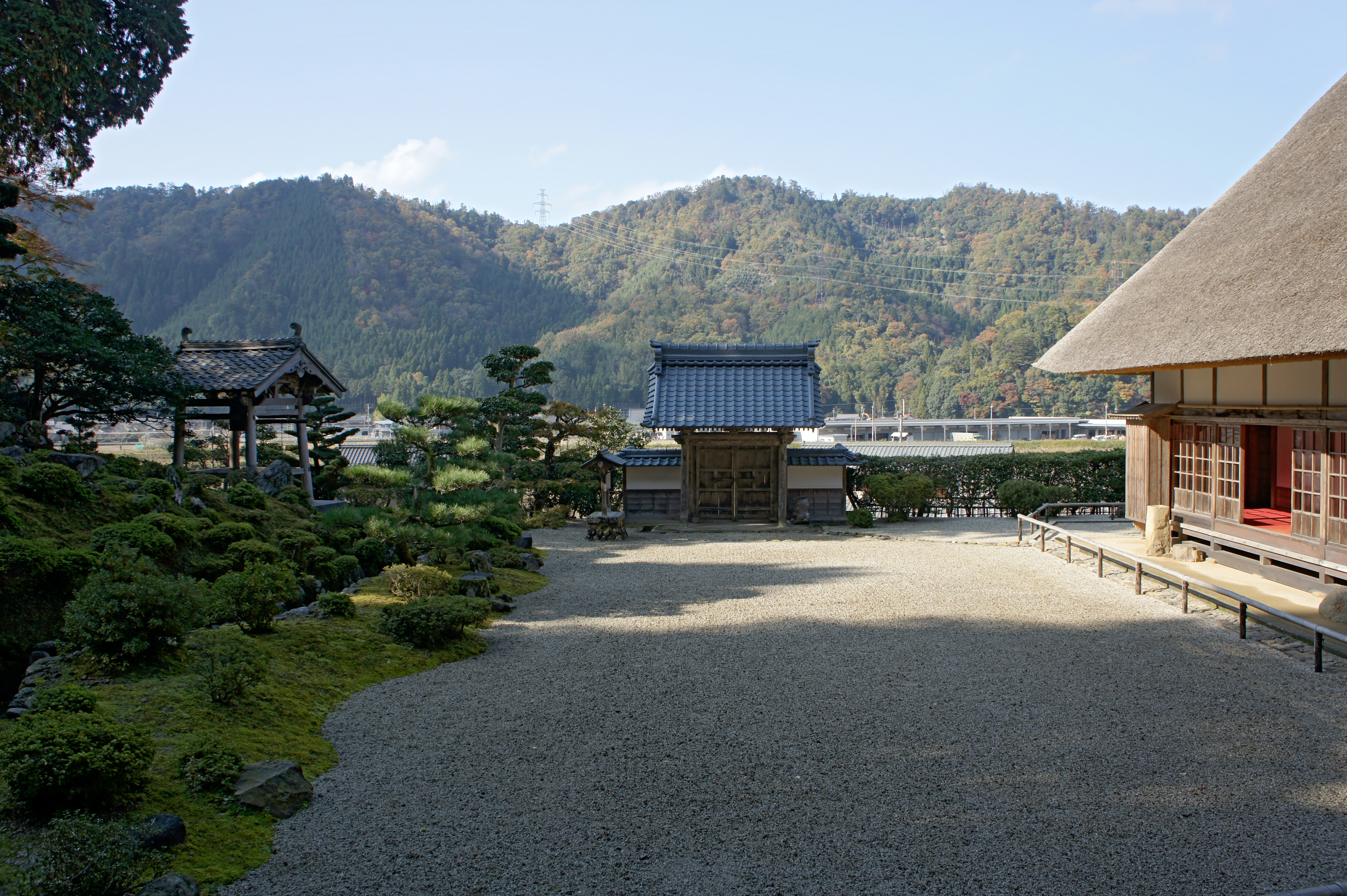
Mantoku-ji
In 1544, the warlord Takeda Nobutomo granted a small mountain temple in Wakasa Province an extraordinary charter: it would serve as a sanctuary for women fleeing abusive husbands. Centuries before any modern legal framework for domestic violence existed, Mantoku-ji offered refuge. That the temple still stands today in the city of Obama, Fukui Prefecture, its garden a nationally designated Place of Scenic Beauty and its art collection spanning a thousand years of Japanese Buddhist tradition, is a testament to the quiet persistence of places that serve purposes larger than worship.
Seven Centuries of Reinvention
Mantoku-ji's origins are older than its documented history. The temple first appears in records from 1265, though its foundation is believed to be much earlier. Originally belonging to the Tendai sect, the temple converted to the Shingon sect during the Ōan period, between 1368 and 1374. Its name changed too, the current designation Mantoku-ji dating only from its restoration in 1602, after the temple was destroyed during the battles of the Genki period in the early 1570s. The most dramatic transformation came in 1677, when Sakai Tadanao, the daimyo of Obama Domain under the Tokugawa shogunate, ordered the temple relocated entirely, moving it from its original site on the banks of the Otonashi River to its present position in the mountains above Obama. Each reinvention layered new meaning onto the old foundations.
Sanctuary in the Sengoku
During the Sengoku period, Japan's era of warring states, the Takeda clan sponsored Mantoku-ji. The charter granted by Takeda Nobutomo in 1544 established the temple as a refuge for women who were abused by their husbands, a role known in Japanese Buddhist tradition as a kakekomi-dera or "running-in temple." These sanctuaries provided one of the few legal avenues available to women in feudal Japan who wished to escape violent marriages. That a warlord in the midst of Japan's most chaotic century would formalize such a protection speaks to the complex relationship between military power and religious mercy that defined the period. The charter preceded the temple's destruction during the Genki-era conflicts by only a few decades, but the institution's protective role survived its physical rebuilding.
Treasures Across the Centuries
Mantoku-ji houses three Important Cultural Properties of Japan, each from a different era. The oldest is the temple's honzon, a seated statue of Amida Nyorai standing 141.5 centimeters tall, carved during the late Heian period and designated an Important Cultural Property in 1913. From the Kamakura period comes a hanging scroll depicting Miroku Bosatsu seated on a lotus throne in meditation, holding a small pagoda, measuring 93.1 by 52.7 centimeters and designated in 1901. A second Kamakura-era hanging scroll shows Fudo Myoo standing with three attendants, 113.7 by 61.2 centimeters, designated in 1985. Together these works span roughly four centuries of Japanese Buddhist art, from the refined elegance of late Heian sculpture to the more vigorous, emotionally direct painting of the Kamakura period.
The Garden and the Ancient Maple
The Japanese garden at Mantoku-ji covers 1,500 square meters and blends elements of a dry rock garden with pond and tree arrangements. Created in 1677 when the temple was relocated to its mountain site, the garden is considered a typical example of early Edo period design. It was designated a national Place of Scenic Beauty on 25 March 1932. Within the garden stands the temple's most remarkable living treasure: the Oyama Momiji, a Japanese maple with an estimated age of over 500 years and a trunk circumference of 3.6 meters at its base. The tree has been protected as a National Natural Monument since 6 June 1931. In autumn, the Oyama Momiji turns the garden into a blaze of crimson that draws visitors from across the region, its canopy arching over the rocks and ponds like a living roof of fire.
A Mountain Temple in Obama
Obama is a small coastal city on Wakasa Bay, far from the tourist circuits of Kyoto and Nara but rich in historical depth. The city once served as the administrative center of Obama Domain and a key port on the Sea of Japan coast. Mantoku-ji sits in the mountains above the city, reached by narrow roads that wind through cedar forest. The temple belongs to the Koyasan Shingon sect, one of the major schools of Japanese esoteric Buddhism tracing its lineage to the monk Kukai and the monastery complex on Mount Koya. In this quiet setting, the temple continues its centuries-old role as a place of contemplation, its art and garden offering visitors a compressed encounter with a thousand years of Japanese spiritual and aesthetic tradition.
From the Air
Located at 35.47°N, 135.79°E in the mountains above the city of Obama, Fukui Prefecture, on the coast of Wakasa Bay. The temple compound is nestled in forested mountains and is not easily visible from high altitude, but the city of Obama and its harbor on Wakasa Bay serve as landmarks. Best viewed at 2,000-4,000 feet approaching from the coast. Nearest airports: RJNF (Fukui Airport, approximately 60 km north), RJOY (Maizuru, approximately 40 km southwest), and RJBB (Kansai International, approximately 140 km south).