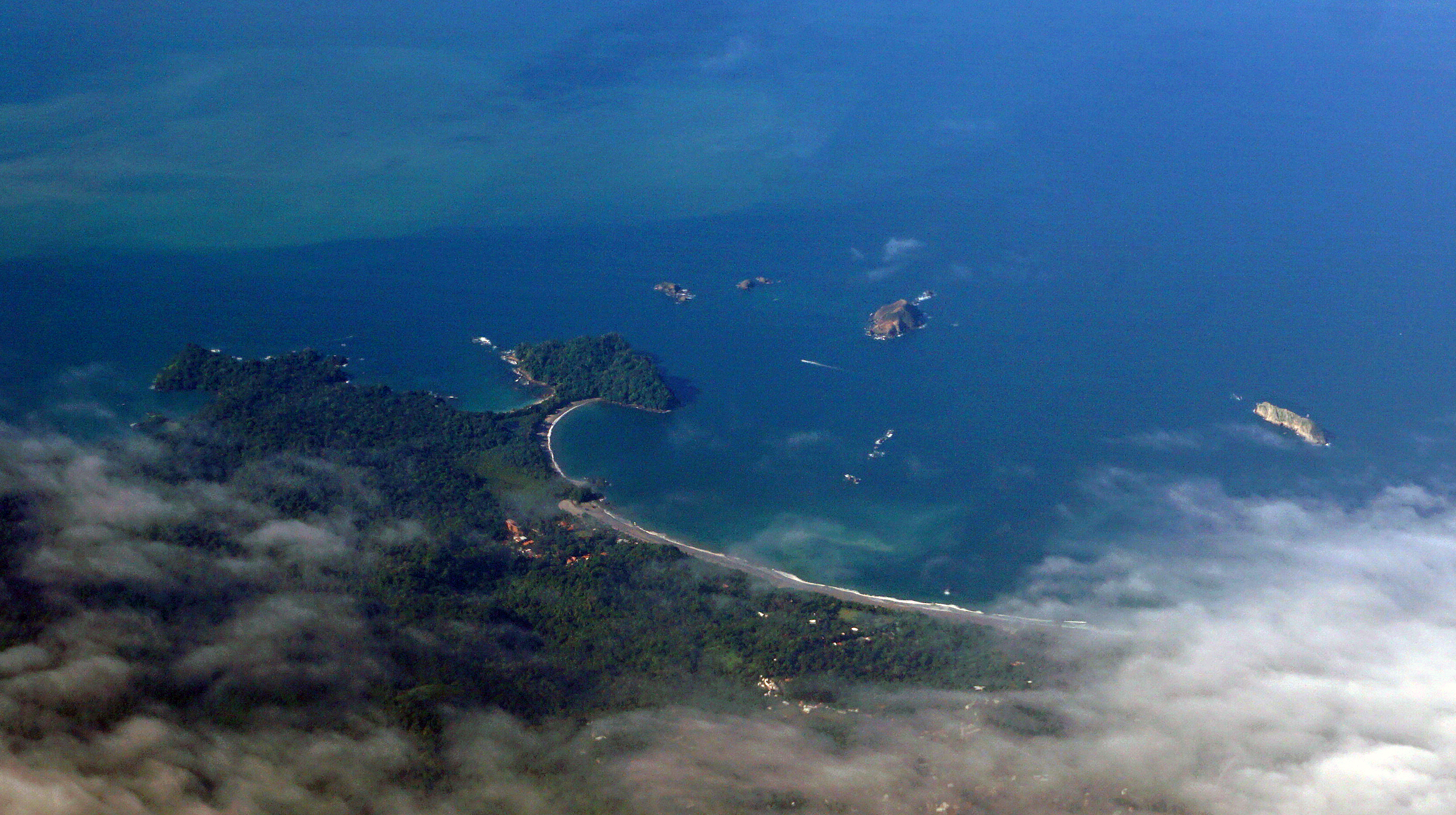
Manuel Antonio National Park
The white-faced capuchin monkey has learned to unzip backpacks. Not metaphorically -- literally. At Manuel Antonio National Park, the capuchins watch you eat, calculate when you look away, and make their move. Park signs warn visitors in English. Guards will eject anyone who feeds the animals. Yet the monkeys keep winning, because 150,000 visitors a year keep bringing food, and the capuchins have had since 1972 to perfect their technique. It is a fitting introduction to Costa Rica's smallest, most popular, and most contested national park: a place where nature refuses to behave as a backdrop and insists, emphatically, on being a participant.
A Peninsula That Was an Island
Manuel Antonio sits on the Central Pacific coast, south of the port town of Quepos. The park's most striking geographic feature is Punta Catedral, a forest-covered peninsula that was once a freestanding island. Over centuries, sedimentation built a sandy strip connecting it to the mainland -- a geological phenomenon called a tombolo. The result is a pair of crescent beaches on either side of the land bridge: Playa Espadilla Sur and Playa Manuel Antonio, both consistently ranked among Costa Rica's most beautiful. The topography beyond the beaches is rugged, with slopes exceeding 20 percent and altitudes ranging from sea level to 160 meters. Small islands dot the coast just offshore, all part of the park's protected territory. Forbes named it one of the world's 12 most beautiful parks in 2011, a claim that draws both pride and eyerolls from Costa Ricans who have been visiting since long before the magazine noticed.
Small Park, Big Census
At roughly 1,983 hectares, Manuel Antonio is Costa Rica's smallest national park. Its biodiversity does not seem to know this. Researchers have documented 352 bird species, 109 mammal species, and 346 plant species within its borders. Toucans, pelicans, ospreys, and kingfishers work the canopy and shoreline. Iguanas and lizards are everywhere. The mammal list includes raccoons, coatis, agoutis, two-toed and three-toed sloths, and four monkey species: capuchin, squirrel, howler, and the endangered titi monkey, also known as the Central American squirrel monkey. During the dry season, from December through March, animals move toward the beaches in search of food, making them easier to spot. In the wet season, trails turn to mud and crowds thin, but the forest erupts in its most vivid green.
The Hustle at the Gate
Getting into Manuel Antonio requires navigating a gauntlet that has its own ecosystem. The park limits simultaneous visitors to 600 on weekdays and 800 on weekends, and tickets must be purchased online the day before. Entry costs $18 for foreigners. Outside the gate, guides with tripod-mounted spotting scopes offer their services for $25-35 per person -- and they are worth it, because a sloth can be sleeping six feet from a trail sign and you will walk right past it. The guides are required to speak English. What they cannot control is the road from Quepos, a hilly stretch of blind corners where Costa Rican driving habits meet tourist rental cars. The park closes before dark, but walking back to a hotel along unlit, unpaved roads in the rain is an adventure the brochures skip.
Thieves, Poisons, and Crocodiles
Manuel Antonio keeps visitors honest about the reality of tropical nature. On the beach, manchineel trees -- locally called manzanillo -- line the sand's edge with glossy green leaves and small apple-like fruit. Every part of the tree is toxic. The milky sap causes blistering burns on contact with skin, and standing under a manchineel during rain can cause the same reaction as water drips through the canopy carrying the irritant. In the water, it is not unheard of for a crocodile to appear among swimmers. The coatis, relatives of the raccoon, are charming and photogenic right up to the moment they rifle through your belongings while you swim. And the capuchins, of course, run their own operation. None of this is dangerous if you respect the animals and the environment. Manuel Antonio is not a zoo with beaches. It is a wild place that tolerates visitors, on its own terms.
Beyond the Park Boundary
The village of Manuel Antonio has grown up around the park's fame, and the after-dark atmosphere reflects an American party-town energy that sits uneasily with the daytime eco-tourism. Pickpocketing is common. Everything is negotiated. But the surrounding region has its own draws. Quepos, eight kilometers north, is one of Costa Rica's premier sportfishing ports, with sailfish and marlin caught on most outings. The road from San Jose winds through cloud forests, mountain ridges, and river valleys -- a three-hour drive that deserves its own story. Halfway along, the bridge over the Tarcoles River offers a view straight down to dozens of basking crocodiles, a free roadside attraction that draws as many cameras as the park itself. Snorkeling at Playa Manuel Antonio reveals coral reefs in silky white sand. From the air, the park is a green knuckle of forest gripping the coastline, the tombolo of Punta Catedral clearly visible as a sandy thread stitching island to mainland.
From the Air
Located at 9.38N, 84.14W on Costa Rica's Central Pacific coast, south of Quepos. From altitude, the park is identifiable by the distinctive tombolo of Punta Catedral -- a forested peninsula connected to the mainland by a narrow sandy strip, creating twin crescent beaches. The coastline is rugged and green, with small offshore islands visible. Quepos and its port are 8 km to the north. Nearest airport: Quepos La Managua (MRQP). The road from San Jose via Jaco is visible winding through the coastal mountains. At lower altitudes, the contrast between the park's dense canopy and the developed tourist area outside the boundary is striking.