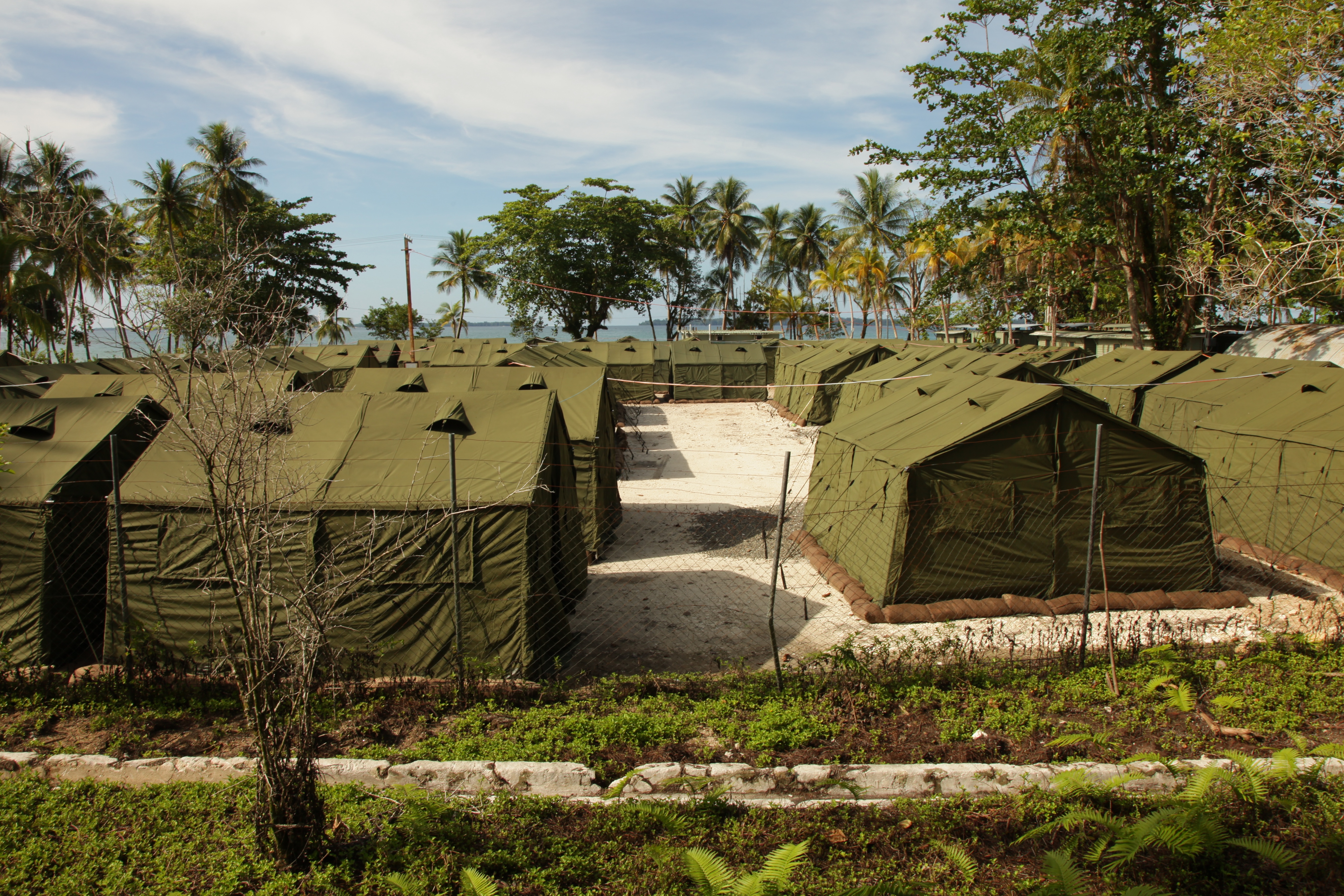
Manus Regional Processing Centre
Behrouz Boochani wrote his first book on a phone he had to hide. The Kurdish-Iranian journalist had fled Iran, crossed by boat from Indonesia toward Australia, and ended up here - on a remote Papua New Guinea island he had never asked to see. For six years he sent WhatsApp messages in Farsi to a translator friend in Sydney, thousands of them, building a memoir one fragment at a time. When No Friend But the Mountains won Australia's top literary award in 2019, its author was still on Manus. The phone had outlasted the silence Australia had tried to enforce.
How the Men Got Here
The first asylum seekers arrived on Manus in November 2012 under an Australian policy that would reach full force the following year. Anyone who reached Australian waters by boat would be transferred offshore - to Manus or to Nauru - and resettled elsewhere, never in Australia. The people who came were overwhelmingly men, though the earliest years included families and children. They came from Iran, Afghanistan, Sri Lanka, Sudan, Pakistan, Somalia, Myanmar. Many had fled wars, religious persecution, or political imprisonment. The peak population reached 1,353 in January 2014. At that point, hope was still a reasonable word to use. Few of the men knew they would be held, in one form or another, for years - some for nearly a decade.
The Night of February 17, 2014
Reza Barati was twenty-three years old, a Kurdish-Iranian who had been an architecture student before he fled. On the night of February 17, 2014, during a protest inside the compound, local guards and expatriate security staff entered the detainee area. Barati was beaten to death. Two men - a Salvation Army worker and a PNG local employed by G4S - were later convicted of his murder. Other men, including expatriate guards identified by detainees, were never charged. Sixty-two other detainees were injured that night. In a class action that settled in 2017 for 70 million Australian dollars, the Commonwealth admitted no liability. Barati's name is one readers of this story should know. So are the others: Hamid Kehazaei, who died in 2014 of treatable sepsis after delayed care. Kamil Hussain, drowned on a day trip. Faysal Ishak Ahmed, who collapsed after months of reported illness. Hamed Shamshiripour, Rajeev Rajendran, Salim, Sayed Mirwais Rohani - each a person, each with a family still waiting somewhere for news.
Living Inside a Closed Story
Journalists were rarely allowed on Manus, and workers who spoke about what they saw risked two-year prison sentences under the 2015 Border Force Act. So the men became the journalists. Boochani filed stories to The Guardian by phone. Abdul Aziz Muhamat, a Sudanese Zaghawa man, recorded more than four thousand voice messages that became a podcast called The Messenger. Boochani co-directed a documentary, Chauka, Please Tell Us the Time, shot entirely on a smartphone over six months. Artist Hoda Afshar photographed the men in collaborations they staged themselves. In 2019 Aziz won the Martin Ennals Award, the human rights equivalent of a Nobel, while technically still a detainee. Documentation became the only way to remain a person the outside world could see.
The Siege
When the PNG Supreme Court ruled the detention unconstitutional in 2016, the facility's future became a question of logistics rather than law. On October 31, 2017, authorities posted a notice during the night: the centre would close that evening. Power, water, and food supply would cease. Nearly six hundred men refused to leave, fearing violence from local residents outside the gates. They dug wells. They rationed what they had. For twenty-three days they held the abandoned compound while Boochani and others streamed photos and updates to the world. On November 22, PNG police moved in. More than three hundred men were removed by force to transit accommodation in Lorengau. Twelve Australians of the Year had already issued a joint protest. The UN High Commissioner for Refugees called the policy an indictment of Australia's international obligations.
What Came After
Some men were resettled - to the United States under a bilateral deal, to Canada, to New Zealand, to Switzerland where Aziz received asylum. Boochani himself flew to New Zealand in 2019 and eventually won permanent residency there. Others were transferred to Port Moresby. A small number went home. By late 2021 Australia formally ended its support and handed the remaining men to the PNG government. As recently as 2024, around ninety asylum seekers in Port Moresby faced eviction over unpaid rent, years after being promised resolution. Jaivet Ealom, a Rohingya man who escaped detention and reached Canada, published a memoir titled Escape from Manus. Rohingya refugee or Kurdish poet, each of the men detained here carried the same unfinished question into whatever came next: how do you begin a life after years of waiting to be given one back.
From the Air
The former detention facility was located at the Lombrum Naval Base on Los Negros Island, part of the Manus Island group in the Admiralty Islands. Coordinates approximately 2.04 S, 147.37 E. Nearest airport is Momote (ICAO: AYMO), a WWII-era airstrip still in operation. The site is visible as a coastal compound area within the naval base complex, adjacent to the wartime anchorage of Seeadler Harbor. Flight altitudes above 5,000 feet provide a view of the full harbor and Los Negros Island in clear tropical weather.