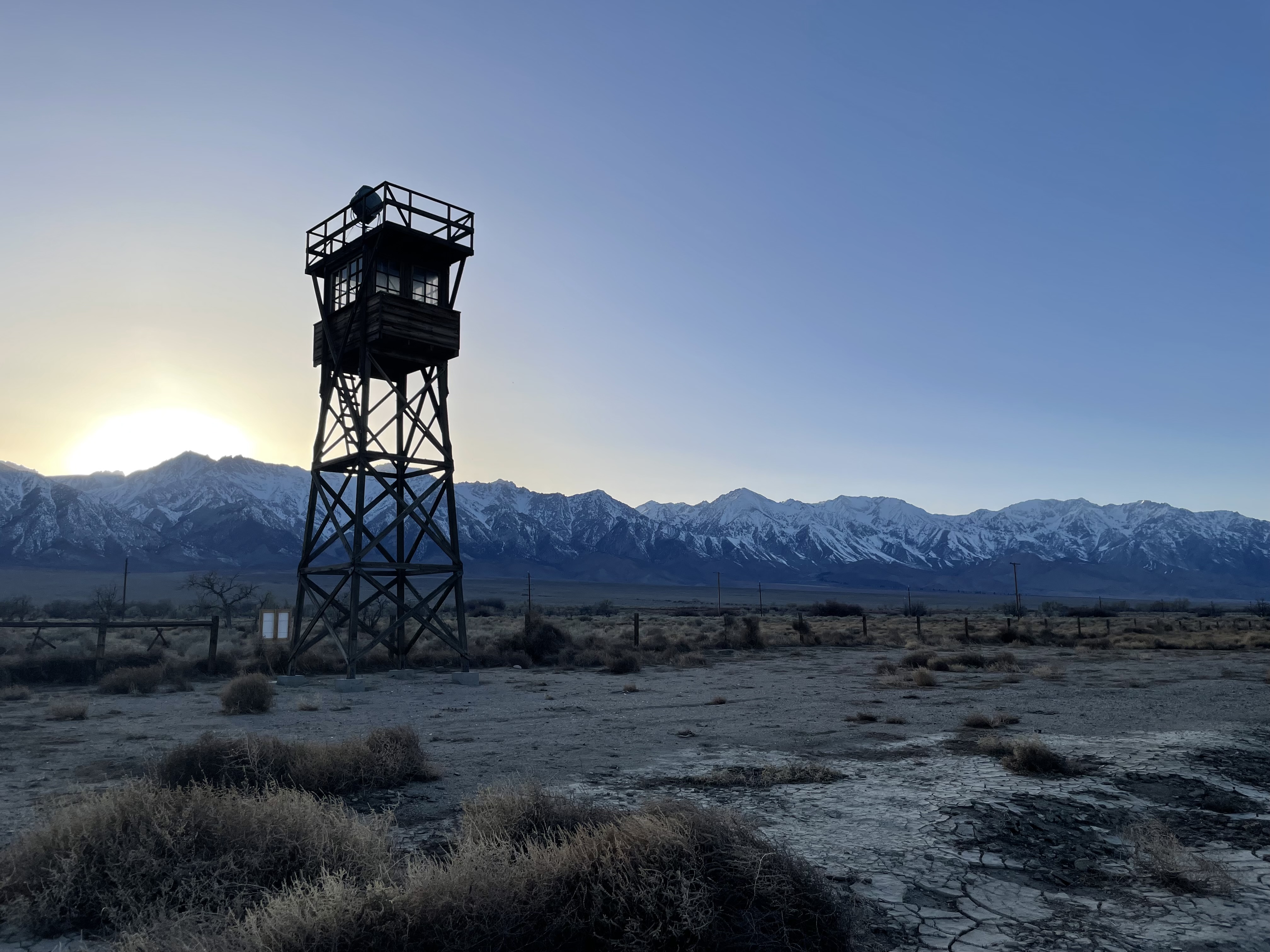
Manzanar
In the months after Pearl Harbor, fear and racism combined to produce one of the greatest civil liberties violations in American history. On February 19, 1942, President Franklin Roosevelt signed Executive Order 9066, authorizing the military to exclude any persons from designated areas. Within weeks, approximately 120,000 Japanese Americans - two-thirds of them U.S. citizens - were forcibly removed from their homes on the West Coast and imprisoned in ten 'relocation centers' scattered across remote regions of the country. Manzanar, in California's Owens Valley, was among the first to open and the best known. For three years, families lived behind barbed wire in tar-paper barracks, guarded by armed soldiers in watchtowers, guilty of nothing except their ancestry. They built communities, schools, and gardens in the desert. They endured with dignity what their own government inflicted upon them. Manzanar stands today as a national historic site - a place to remember both the injustice committed and the resilience of those who survived it.
The Removal
The attack on Pearl Harbor unleashed a wave of anti-Japanese hysteria on the West Coast. Newspapers demanded action against the 'enemy in our midst.' Politicians warned of sabotage and invasion. Military commanders, citing national security, advocated mass removal despite the FBI's assessment that Japanese Americans posed no significant threat. The Supreme Court would later uphold the exclusion orders in the infamous Korematsu decision, though the justices possessed evidence - suppressed by government lawyers - proving the military necessity argument was fabricated. Beginning in March 1942, Japanese Americans received days or sometimes hours to dispose of their property and report to assembly centers - often racetracks or fairgrounds where they lived in horse stalls while permanent camps were constructed. They were allowed to bring only what they could carry. Businesses, farms, and homes were sold at devastating losses or simply abandoned. Entire communities - first, second, and third generation Americans - vanished from the West Coast.
Life Behind Wire
Manzanar opened on March 21, 1942, in the Owens Valley at the foot of the Sierra Nevada. The setting was starkly beautiful - snow-capped mountains rising above the desert - but the conditions were harsh. Temperatures ranged from over 100 degrees in summer to below freezing in winter. Dust storms swept through the camp, penetrating the poorly constructed barracks. Families were assigned to single rooms measuring 20 by 25 feet, furnished with cots, blankets, and a single light bulb. Bathrooms, laundry facilities, and dining halls were communal. Privacy was nearly impossible. Yet the prisoners - they called themselves inmates, rejecting the government's euphemism of 'evacuees' - built a functioning community. They established schools, churches, newspapers, and sports leagues. They created elaborate gardens in the alkaline soil. They maintained their dignity in the face of systematic humiliation.
Resistance and Loyalty
The camps were not passive. At Manzanar, tensions over collaboration with the War Relocation Authority erupted in the 'Manzanar Riot' of December 1942, when military police fired into a crowd, killing two inmates. Throughout the camp system, inmates resisted through work slowdowns, protests, and refusal to cooperate with the government's loyalty questionnaire - a humiliating document that asked whether they would forswear allegiance to the Japanese emperor (implying they had such allegiance) and whether they would serve in U.S. armed forces. Answering 'no-no' brought transfer to the high-security camp at Tule Lake. Yet thousands of Japanese Americans volunteered for military service from behind barbed wire. The 442nd Regimental Combat Team, composed largely of Japanese Americans, became the most decorated unit in U.S. military history. They fought for a country that had imprisoned their families.
Redress and Memory
The camps closed in 1945. Inmates returned to find their former lives destroyed - property lost, communities scattered, neighbors hostile. Many never spoke of their imprisonment, carrying the shame and trauma in silence for decades. The redress movement, led by a new generation of Japanese Americans, gradually built support for acknowledgment and compensation. In 1976, President Ford formally rescinded Executive Order 9066. In 1983, a commission concluded that the internment resulted from 'race prejudice, war hysteria, and a failure of political leadership.' In 1988, President Reagan signed the Civil Liberties Act, apologizing on behalf of the nation and providing $20,000 to each surviving internee. The apology came forty years late, but it came. Manzanar was designated a National Historic Site in 1992, ensuring that the story would be preserved for future generations.
Visiting Manzanar
Manzanar National Historic Site lies along U.S. Highway 395 in the Owens Valley, between Lone Pine and Independence, California. The interpretive center, housed in the restored high school auditorium, provides context through exhibits, photographs, and oral histories of survivors. The eight-hundred-acre site preserves remnants of the camp: foundation outlines, the camp cemetery, the reconstructed mess hall and guard tower, and the elaborate rock gardens inmates created from the desert stones. The sentry post at the entrance remains standing. An auto tour route connects key locations throughout the site. The annual Manzanar Pilgrimage, held on the last Saturday in April since 1969, draws thousands of former inmates, their descendants, and supporters for a day of remembrance. The Sierra Nevada rises magnificently to the west; the view has not changed since 1942. Manzanar reminds visitors that constitutional rights can be suspended in moments of fear, and that vigilance is the price of liberty.
From the Air
Located at 36.73°N, 118.15°W in the Owens Valley, eastern California. From altitude, Manzanar appears as a flat area at the base of the eastern Sierra Nevada, with the reconstructed guard tower and buildings visible near Highway 395. Lone Pine lies 6 miles south; the Alabama Hills and Mount Whitney are visible to the southwest. The nearest commercial airport is Inyokern (IYK), 70 miles south.