Maple Leaf (Shipwreck)
Somewhere beneath the muddy waters of the St. Johns River, just west of Jacksonville's Mandarin neighborhood, a steamship has been keeping secrets since 1864. The Maple Leaf went down in minutes after striking a Confederate torpedo on April 1 of that year, carrying with her the personal belongings of three Union infantry regiments. For 120 years, seven feet of river mud sealed those possessions in an airless tomb so effective that when divers finally reached the cargo holds in the 1980s, they found leather still supple, cloth still intact, and letters still legible. The wreck produced the largest single collection of Civil War artifacts in the world.
From the Great Lakes to War
The Maple Leaf began life far from any battlefield. Launched in 1851 from the Marine Railway Yard in Kingston, Upper Canada, the 181-foot side paddlewheel steamship was built as a freight and passenger vessel for the Great Lakes trade. She was a sturdy workhorse of the inland waterways, measuring 25 feet at the beam and displacing 398 tons. When the Civil War broke out, the Union Army needed transport ships, and the Maple Leaf was chartered into military service. She carried Union troops southward to Virginia and then deeper into the theater of war. By early 1864, the Maple Leaf was running supply routes along the St. Johns River in northeastern Florida, ferrying troops and their baggage between Union-held positions.
Sixty Seconds in the Dark
The night of April 1, 1864, brought no warning. The Maple Leaf was steaming up the St. Johns River near Mandarin Point when her bow struck a Confederate torpedo, a barrel-sized device with tapered wooden points that floated just below the surface. The explosion ripped through the forward deck and tore the starboard side open. Four soldiers died in the blast. The vessel sank rapidly, settling into the river bottom in about twenty feet of water. Stowed in her cargo holds was the baggage and camp equipage of the 112th New York, the 169th New York, and other Union regiments. Trunks packed with clothing, personal letters, photographs, musical instruments, and civilian souvenirs acquired during campaigns in Virginia and South Carolina all went down with the ship. A screw steamer dispatched on April 2 to assess the damage found Captain Henry W. Dale's vessel a total loss.
The River's Time Capsule
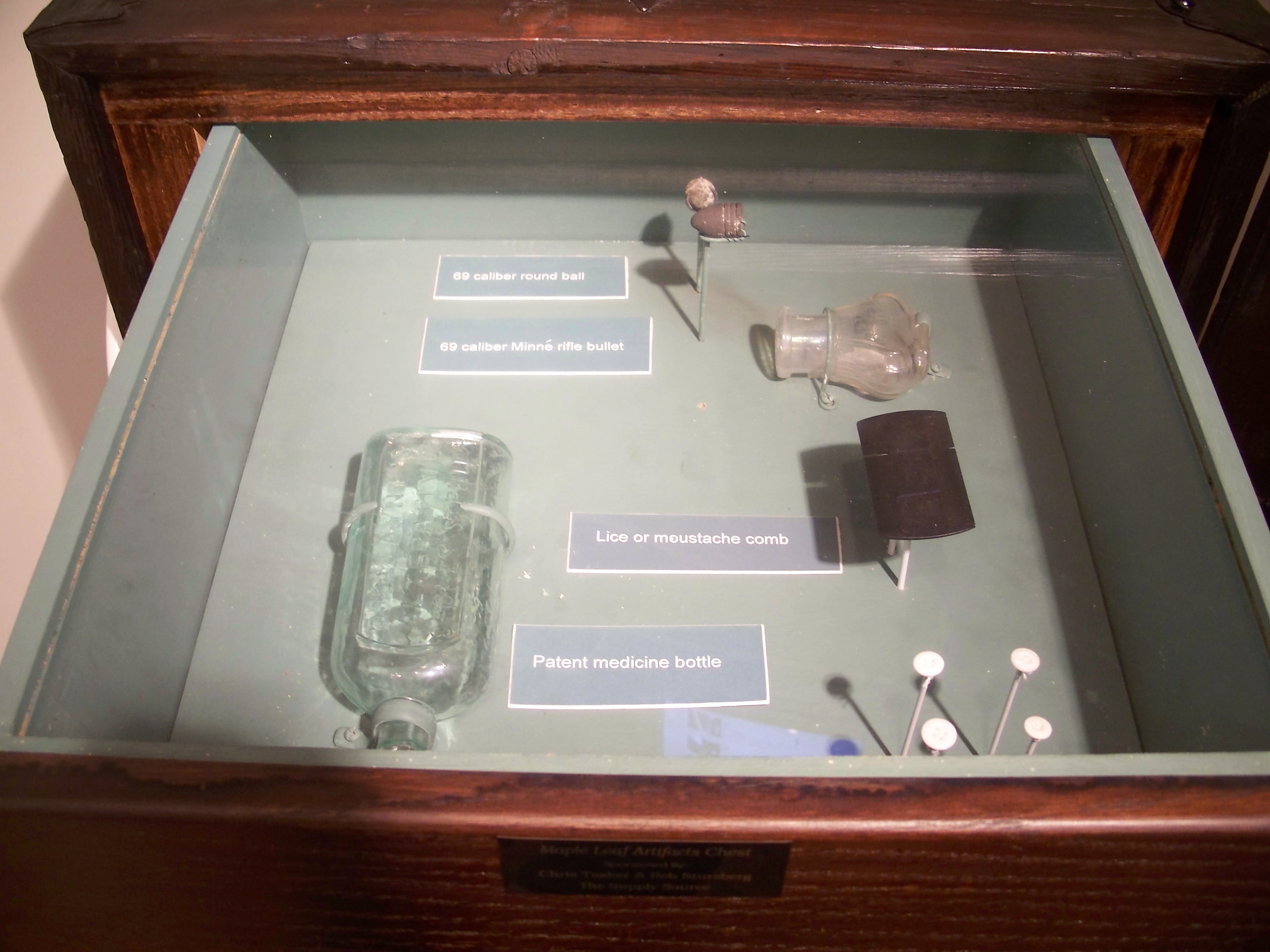
The St. Johns River did what no museum could have done. Silt quickly buried the wreck, and the anaerobic environment beneath the mud preserved organic materials that would have decayed anywhere else. When the U.S. Army Corps of Engineers cleared the shipping channel in the 1880s, they removed everything above the main deck, but the cargo holds below remained untouched. The wreck lay forgotten until 1984, when Keith Holland and the St. Johns Archaeological Expeditions rediscovered the site. Over a ten-day excavation in 1989, the team recovered more than 3,000 individual artifacts from the holds. The haul was extraordinary: soldiers' uniforms with buttons still attached, rubber blankets, leather haversacks, toothbrushes, pocket watches, Bibles, and personal letters that had survived more than a century underwater. The collection now resides at the Jacksonville Museum of Science and History, offering an intimate window into the daily lives of Civil War soldiers that no battlefield monument can match.
Landmark Under the Current
On October 12, 1994, the Maple Leaf wreck site was designated a National Historic Landmark, the first historic site to receive that distinction in all of Duval County. The designation recognized not only the remarkable preservation of the vessel but also its significance as a mid-19th century Great Lakes steamer and the most important Civil War-era shipwreck yet discovered. The hull remains virtually intact below the line cleared by the Corps of Engineers, buried under river sediment at Smithsonian trinomial site 8DU8032. A National Historic Landmark plaque marks the location at 30 degrees 19.461 minutes North, 81 degrees 39.683 minutes West. The wreck site is protected but invisible from the surface: the river here looks no different from any other stretch of the St. Johns. The real drama lies below, where the Maple Leaf continues to hold whatever artifacts still remain in her unopened compartments, waiting in the dark.
From the Air
The Maple Leaf wreck site lies in the St. Johns River at approximately 30.324N, 81.661W, west of the Mandarin neighborhood in southeastern Duval County, Florida. The wreck is not visible from the air as it sits beneath the river surface under sediment, but the location is near the distinctive bend in the St. Johns River at Mandarin Point. Jacksonville International Airport (KJAX) is approximately 15 nm to the north. Jacksonville Executive at Craig Airport (KCRG) is about 8 nm to the east. Cecil Airport (KVQQ) lies roughly 15 nm to the southwest. Best viewed at 1,000-2,000 ft AGL to identify the Mandarin Point area along the river.