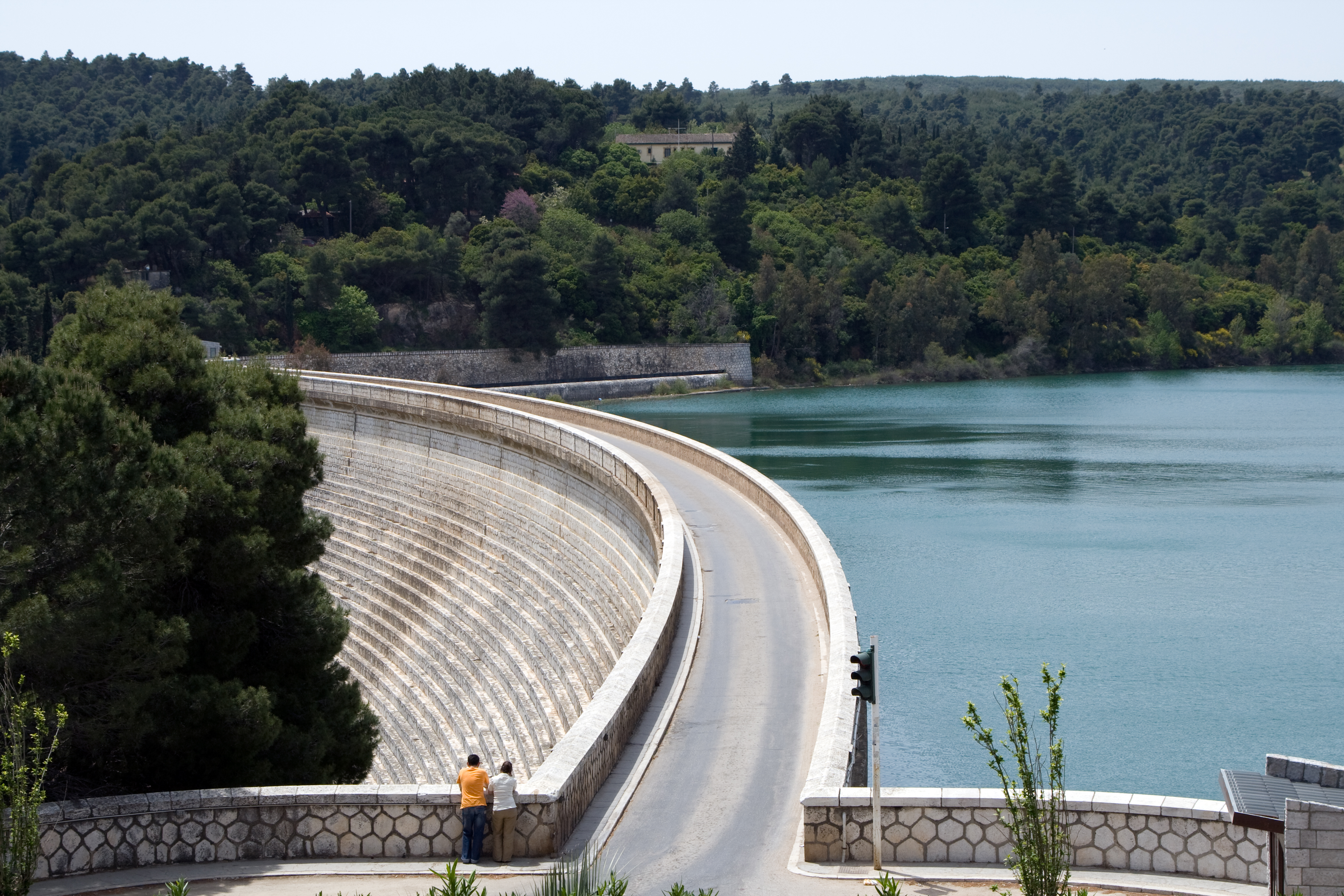
Marathon Dam
When the engineers of Ulen & Company finished building the Marathon Dam in 1929, they faced its outer wall in marble from the Pentelic quarries - the same rose-white stone the Athenians had used to build the Parthenon nearly twenty-five centuries earlier. The choice was deliberate. This was the dam that would supply Athens with drinking water, ending a chronic shortage that had nearly broken the modern city. It needed to look the part. The American firm faced the downstream side in classical marble, built a small temple-like pavilion at one end, and produced what is still one of the only marble-clad dams in the world. The reservoir behind it, Lake Marathon, sits a few kilometers upstream from the plain where Greeks defeated Persians in 490 BC. Symbolism does not get more direct.
A City Doubled, A City Thirsty
Athens in the 1920s was drowning in people. After the disastrous Greco-Turkish War of 1919-1922 and the population exchange mandated by the 1923 Treaty of Lausanne, an estimated 1.3 million Greek refugees were forced out of Asia Minor and Eastern Thrace and resettled in Greece. Athens absorbed an enormous share. The city's population doubled between 1920 and 1928, and the existing water supply - dating largely to Hadrianic Roman aqueducts and a few nineteenth-century improvements - simply could not keep up. People queued at public taps. Disease followed thirst. The Marathon Dam had been proposed in 1918, then quashed in 1920 by Prime Minister Dimitrios Gounaris on legal grounds (no public bidding), then revived in 1923 as the only realistic answer. The five-volume engineering report called it 'the optimal solution' and 'the last recourse'.
An American Contract
On December 22, 1924, the Greek government signed a contract with Ulen & Company of New York - a firm that specialized in turnkey water and rail projects across the eastern Mediterranean and Latin America. Ulen brought ten million dollars of financing, more than the entire National Bank of Greece could muster at the time. The contract covered everything: the dam, the reservoir, a 21.5-kilometer pipeline, a water treatment plant at Galatsi, and the Boyati Tunnel - a 13.4-kilometer bore through the hills delivering 500 liters per second to the thirsty city. Construction began in October 1926, when Prime Minister Alexandros Zaimis laid the foundation stone in person, with the Cretan statesman Eleftherios Venizelos in attendance. The work took three years. The dam was finished in 1929 and remained the sole source of municipal water for Athens until 1959.
The Dam Itself
Strip away the marble facing and you find a gravity dam: 54 meters tall, 285 meters long, 28 meters thick at the base. It holds back 41 million cubic meters of water at full capacity, of which 34 million can actually be drawn down. The reservoir spreads across 2.45 square kilometers with a maximum depth equal to the dam height. Annual rainfall in the surrounding 118-square-kilometer drainage basin averages 580 millimeters, and the dam captures most of the runoff. The spillway is an uncontrolled chute at the southern abutment, designed to discharge 520 cubic meters per second in a flood event. By international standards Marathon is an average-sized dam - it would not stand out in the inventory of any major water authority - but in 1929 Greece, in a country still recovering from war and forced migration, it was a triumph of engineering and finance.
The First Reservoir Earthquakes
Soon after Lake Marathon began filling, geologists noticed something unusual: small earthquakes in the area, clustered around the reservoir, in a region that had not previously been seismically notable. These tremors became the first scientifically documented case of reservoir-induced seismicity - the now-known phenomenon in which the weight of impounded water and the lubrication of underlying rock by infiltrating water can trigger seismic events on previously stable faults. The Marathon observations were studied for decades and helped establish a research field that grew enormously after the disastrous Koyna Dam earthquake in India in 1967. A modest dam in Attica turned out to have changed not just the water supply of a capital, but how engineers everywhere now think about big reservoirs.
Walking the Crest
Today the Marathon Dam is one of several reservoirs supplying greater Athens, but it is the only one where you can walk across the crest and look down at marble cladding more familiar from temple architecture. A small pavilion at the eastern end - sometimes mistaken by tourists for an ancient ruin - is a 1929 evocation of a classical tholos. The lake behind reflects pine-forested hills. Below the dam, the Charadros river flows toward the Marathon plain, where 192 Athenian soldiers are buried under a tumulus that still rises from the coastal flats. Ancient and modern symbols sit a few kilometers apart. The water that runs from Athenian taps in 2026 began as snowmelt and rain falling on the same hills the Persians sailed past two and a half millennia ago.
From the Air
Located at 38.1669°N, 23.9053°E, 8 km west of the modern town of Marathon and 45 km northeast of Athens. Cruising 4,000-7,000 ft offers views of Lake Marathon nestled in pine-covered hills, the Marathon plain to the east, and the Aegean coast. Nearest airport: Athens International (LGAV) about 30 km south. The reservoir is recognizable by its distinctive curved marble dam face.