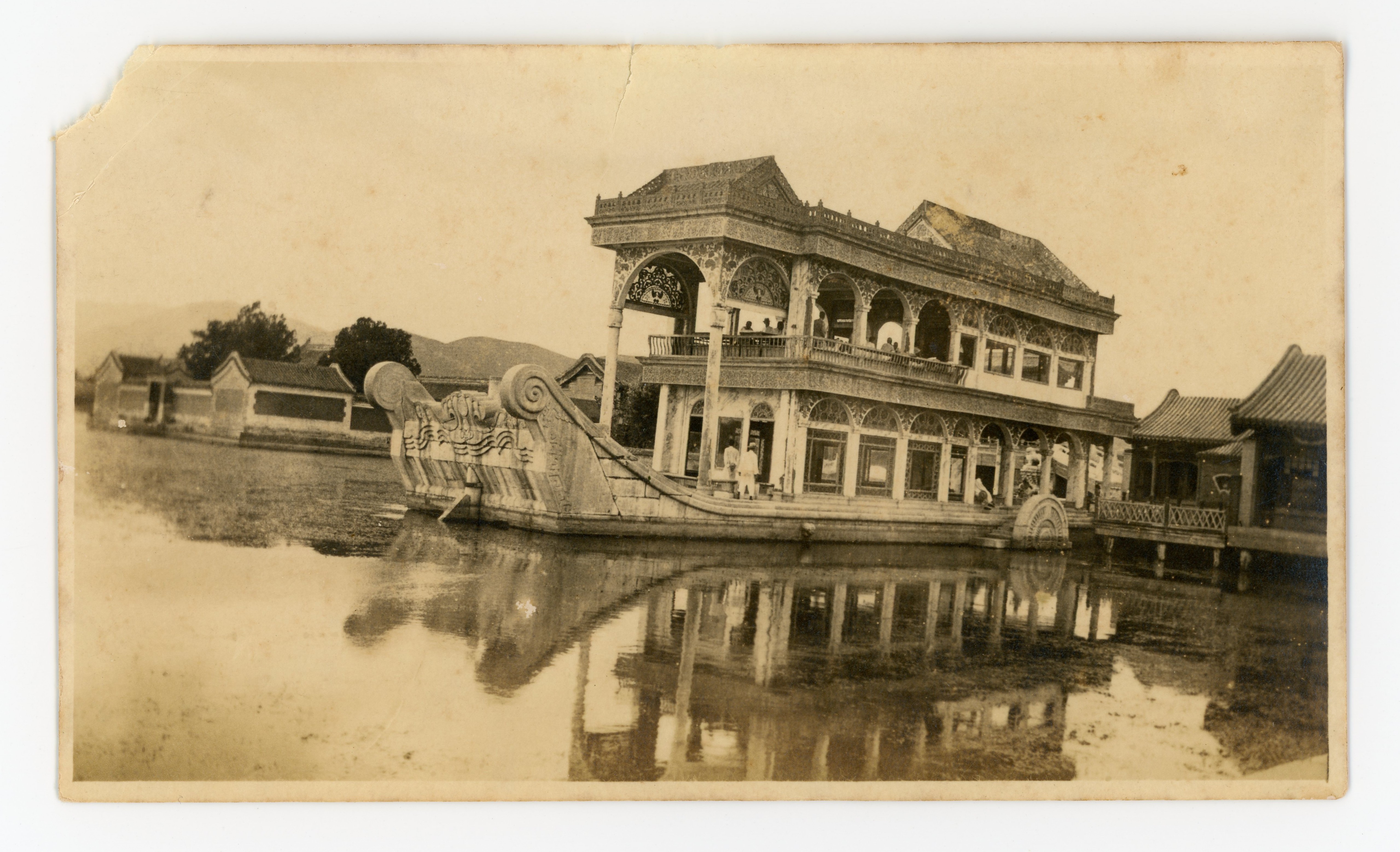
Marble Boat
It cannot sail. It was never meant to. The Marble Boat -- officially the Boat of Purity and Ease -- sits permanently moored on the northwestern shore of Kunming Lake at Beijing's Summer Palace, 36 meters of carved stone shaped to resemble a vessel. The Qianlong Emperor had it built in 1755, and his intended symbolism was clear: a stone boat cannot sink, and therefore the dynasty it represents is unsinkable. History, of course, had other plans. The boat's most enduring association is not with imperial permanence but with the naval budget that Empress Dowager Cixi is said to have embezzled to rebuild it.
A Metaphor in Stone
The original Marble Boat was erected during the height of the Qianlong Emperor's reign, a period of territorial expansion and cultural flowering that represented the Qing dynasty at its most confident. The structure consisted of a base of massive stone blocks supporting a wooden superstructure designed in traditional Chinese style. Its position on the lakeshore, near the western end of the Long Corridor, placed it at the terminus of one of the palace's primary architectural sequences. The Qianlong Emperor, steeped in the symbolism that pervaded every aspect of imperial design, likely chose the boat form as an auspicious emblem. In Chinese political philosophy, the people are the water and the ruler is the boat -- a metaphor that cuts both ways, since water can also capsize what it carries.
Cixi and the Navy's Money
The Summer Palace was devastated by Anglo-French forces during the Second Opium War in 1860, and the Marble Boat was damaged along with everything else. When Empress Dowager Cixi ordered the palace rebuilt in the 1880s, the Marble Boat was reconstructed with a Western-style superstructure featuring stained glass windows and paddle-wheel ornaments -- a curious fusion of Chinese base and European top that reflected the era's uneasy encounter with Western influence. The reconstruction became infamous because of where the money came from. Prince Chun, controller of the Admiralty, reportedly diverted naval modernization funds to pay for Cixi's palace project. The prince owed his position to Cixi, who had adopted his eldest son and placed him on the throne as the Guangxu Emperor. In that web of obligation, he saw no choice but to comply.
The Cost of a Stone Boat
The diversion of naval funds has become one of the most frequently cited explanations for China's disastrous defeat in the First Sino-Japanese War of 1894-1895, when the Japanese navy destroyed China's Northern Fleet. Whether the embezzlement was as decisive as popular memory holds is debated by historians, but the symbolism is irresistible: a stone boat that could not move, paid for with money meant for real ships that could. The Marble Boat became a kind of anti-monument, remembered not for what the Qianlong Emperor intended it to mean -- dynastic permanence -- but for what Cixi made it represent: imperial vanity at the expense of national defense.
Permanence at the Water's Edge
Today the Marble Boat stands where it has always stood, on the quiet northwestern shore of Kunming Lake. Visitors reach it at the end of a walk along the Long Corridor, emerging from the painted stories of Chinese mythology into the open light of the lakeshore. The Western-style superstructure, with its stained glass and decorative columns, looks improbable atop the Chinese stone base, a visual record of the cultural collisions of the late 19th century. The lake laps against stone that the Qianlong Emperor placed there in 1755. Willows overhang the shore. The boat that cannot sail remains the most paradoxical structure in the Summer Palace -- a monument to stability that became a symbol of decline, an anchor of stone in a world that was already moving on.
From the Air
Located at 40.00N, 116.26E on the northwestern shore of Kunming Lake within the Summer Palace. From the air, the Marble Boat appears as a small structure extending into the lake from the western end of the Long Corridor. Kunming Lake is the large body of water dominating the Summer Palace grounds, with Longevity Hill rising on the northern shore. Beijing Capital International Airport (ZBAA) is approximately 30 km northeast.