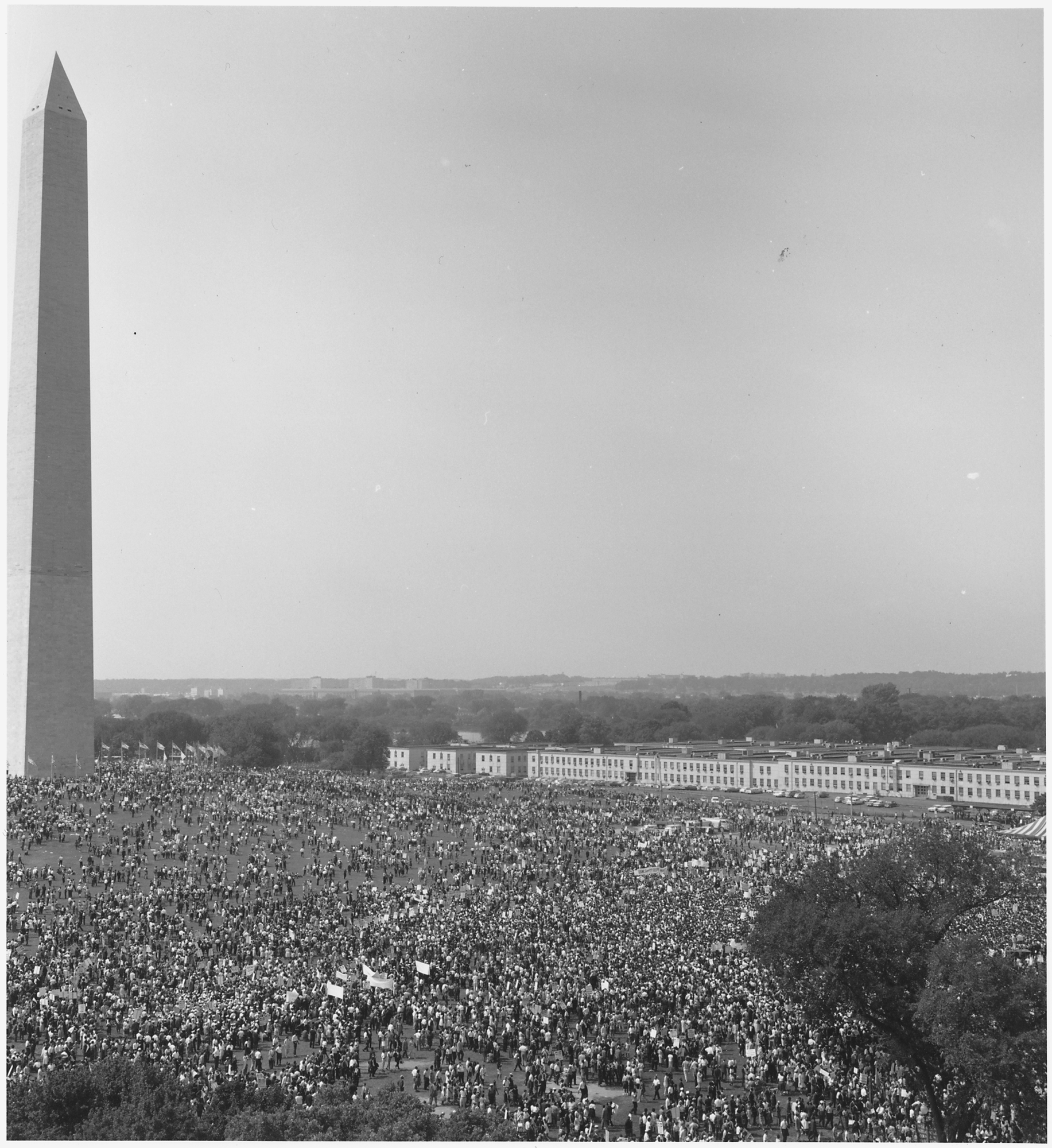
March on Washington
The logistics alone were staggering: 21 chartered trains, 30 special buses from a single city block in Harlem, 40 separate chartered planes, and an estimated 250,000 people converging on the Lincoln Memorial on a single August afternoon. Bayard Rustin, the organizational genius behind the March on Washington for Jobs and Freedom, had exactly two months to pull it off. On August 28, 1963, he did -- orchestrating the largest political rally for human rights the United States had ever seen, a day that would reshape the nation's conscience and accelerate the passage of landmark civil rights legislation.
The Architect Nobody Saw
The march was the brainchild of A. Philip Randolph, the 74-year-old president of the Brotherhood of Sleeping Car Porters, who had first proposed a march on Washington back in 1941 to protest discrimination in the defense industry. President Roosevelt headed off that march with an executive order, but Randolph never abandoned the idea. Two decades later, he found his partner in Bayard Rustin, a brilliant tactician who had studied Gandhi's methods in India. Together they assembled an unprecedented coalition: the NAACP, the Urban League, the Southern Christian Leadership Conference, the Student Noncommittent Coordinating Committee, and labor organizations led by Walter Reuther of the United Auto Workers, the highest-ranking white organizer of the march. An estimated 75 to 80 percent of the marchers were Black, but the crowd's diversity was itself a statement.
Speeches at the Temple Steps
The program unfolded on the steps of the Lincoln Memorial, Abraham Lincoln's marble gaze at the speakers' backs. Representatives from each sponsoring organization took the podium -- ten in all, dubbed the Big Ten. Floyd McKissick read James Farmer's speech because Farmer had been arrested during a protest in Louisiana; Farmer wrote that demonstrations would not stop "until the dogs stop biting us in the South and the rats stop biting us in the North." John Lewis, just 23 years old and representing SNCC, delivered a fiery address that had been toned down at the insistence of other leaders. Notably, no woman gave an official speech. Josephine Baker spoke during preliminary events, and Daisy Bates addressed the crowd briefly during a tribute, but women who had risked everything for the movement were sidelined from the main program.
The Dream That Traveled by Television
Martin Luther King Jr. spoke last. His prepared text was strong but measured, and then Mahalia Jackson, standing nearby, called out: "Tell them about the dream, Martin!" What followed was a departure from the written page and into oratory that would define a century. "I have a dream that my four little children will one day live in a nation where they will not be judged by the color of their skin but by the content of their character." Over 500 cameramen, technicians, and correspondents from the major networks broadcast the speech live, making it one of the first political events shaped by television's reach. President Kennedy watched from the White House and was deeply impressed. That evening, the march leaders met him at 5 p.m. for a discussion about proposed civil rights legislation.
What the March Built
The march is credited with helping pass the Civil Rights Act of 1964 and setting the stage for the Voting Rights Act of 1965. But its legacy was contested from the start. Malcolm X dismissed it as "a picnic" and "a circus," arguing that white participation had diluted the movement's urgency. Organizers Randolph and Rustin themselves abandoned their belief in the effectiveness of marching on Washington. King maintained faith that action in the capital could work but concluded that future efforts needed to address economic injustice more directly, leading him to plan the Poor People's Campaign in 1967-1968. The march also generated anniversary events every five years, and at the 50th anniversary in 2013, President Barack Obama conferred a posthumous Presidential Medal of Freedom on Bayard Rustin, finally giving the march's master organizer the public recognition he had been denied in life.
Footprints on the Mall
Stand on the steps of the Lincoln Memorial today and the view stretches east across the Reflecting Pool toward the Washington Monument and the Capitol dome beyond. On that August day in 1963, every inch of this vista was filled with humanity. Nan Grogan Orrock, a student at Mary Washington College who attended, described the sensation: "It was like being part of a glacier. You could feel the sense of collective will and effort in the air." The march demonstrated something that statistics and legislation could not -- the visual power of a quarter-million people standing together in shared purpose. The National Mall, designed as a monumental stage for democratic expression, fulfilled that purpose as never before.
From the Air
Located at 38.889N, 77.050W at the Lincoln Memorial on the National Mall, Washington, D.C. The mall stretches east from the Lincoln Memorial past the Reflecting Pool and Washington Monument toward the U.S. Capitol. From the air, the long rectangular green of the Mall is one of the most recognizable landmarks in the world. Best viewed from 3,000-5,000 feet AGL approaching from the west along the Potomac River. Nearby airports: KDCA (Ronald Reagan Washington National, 3nm south), KIAD (Washington Dulles, 22nm west), KBWI (Baltimore-Washington International, 28nm northeast). Caution: Heavily restricted airspace including P-56 (White House/Capitol) and the DC SFRA/FRZ.