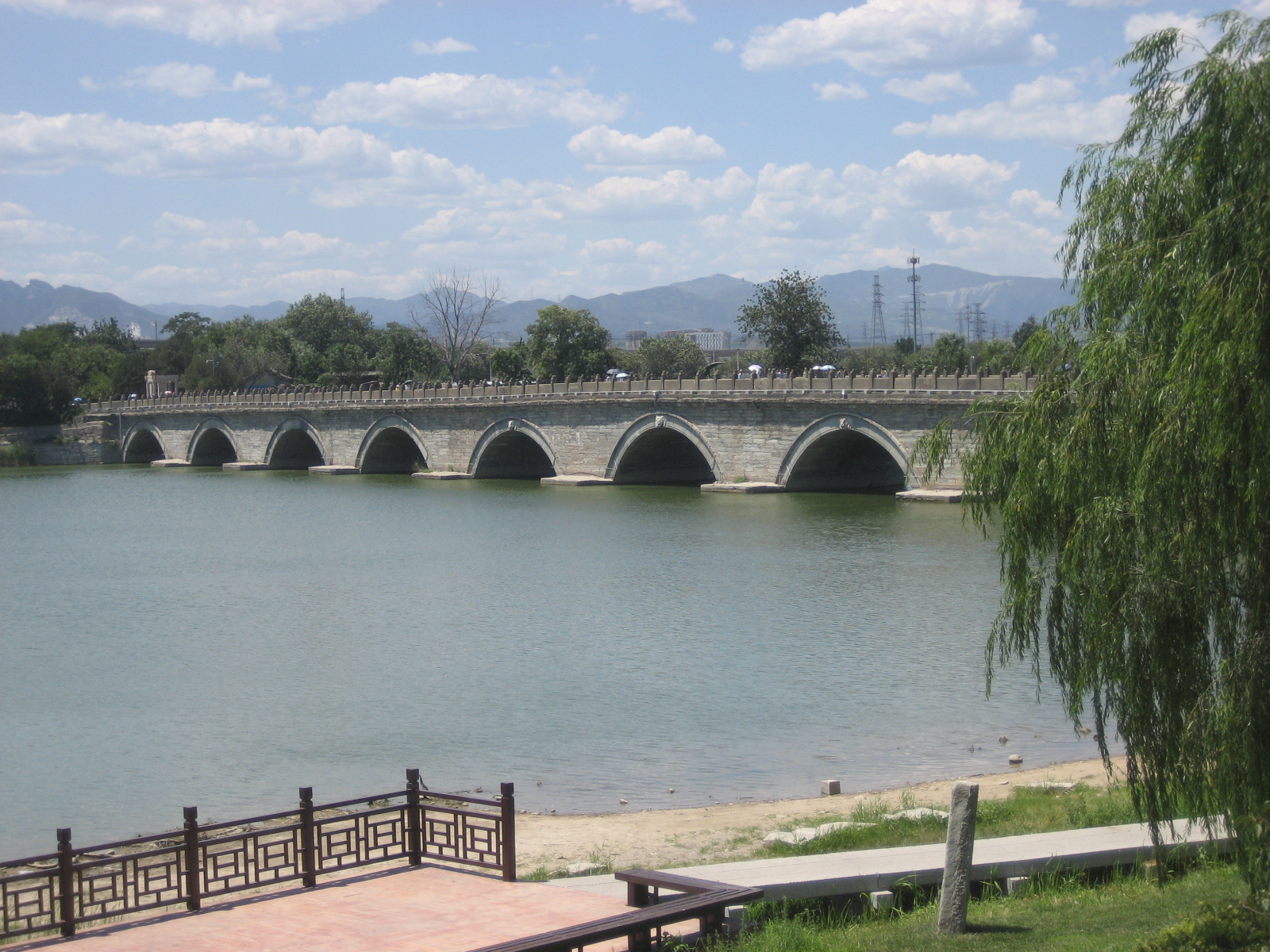
Marco Polo Bridge
Try to count the lions. Generations of investigators have tried, and the results range from 482 to 501. The problem is not the counting itself but the lions' habit of hiding: smaller lions crouch on the heads, backs, bellies, and paws of larger ones, making any census an exercise in discovery. Originally there were 627, according to historical records. The survivors span dynasties, from rare Jin-era originals to the more common Ming and Qing replacements, each carved in a unique posture, no two alike across 266.5 meters of granite spanning the Yongding River in southwestern Beijing.
Built Between Emperors
Construction of the Marco Polo Bridge began in 1189, the final year of Emperor Shizong of Jin's reign, and was completed under his successor, Emperor Zhangzong, in 1192. The bridge crossed the Yongding River at a point that controlled the main approach to the Jin dynasty capital of Zhongdu from the southwest. Eleven segmental arches span the river, supported by ten piers, each protected by triangular iron pillars designed to deflect floodwater and ice. The engineering was sophisticated: the granite construction and the arch design distributed weight efficiently, allowing the bridge to carry traffic for centuries. When flooding damaged the structure, it was reconstructed under the Kangxi Emperor of the Qing dynasty in 1698, preserving the original form while renewing the fabric.
A Venetian's Praise
The bridge gained its Western name from Marco Polo, who described it during his travels through China in the 13th century. His account in "Il Milione" praised the bridge's beauty and engineering, and European readers came to know it simply as the Marco Polo Bridge. The Chinese structural engineer Mao Yisheng offered his own ranking: "The most ancient bridge in China is the Zhaozhou Bridge, the most splendid the Lugou Bridge, and the most elegant and artistic the Five-Pavilion Bridge." Four ornamental columns, each 4.65 meters high, and two white marble steles stand at the bridge's ends. One stele, mounted on a stone tortoise, records the Kangxi Emperor's 1698 reconstruction. The other bears calligraphy by the Qianlong Emperor reading "Morning moon over Lugou" -- a reference to the famous view of dawn light reflected in the river beneath the arches.
From Stone to Asphalt and Back
After the Communist takeover of China in 1949, the ancient bridge was decked in asphalt and pressed into service as a motor vehicle route. By 1971, traffic had grown heavy enough to require the construction of a New Marco Polo Bridge about one kilometer to the south. When even that proved insufficient, a third bridge carrying the Jingshi Expressway was built alongside in 1985. With vehicular traffic shifted to the newer crossings, the original bridge was finally closed to motor vehicles. A restoration in 1986 stripped away the asphalt, revealing the granite surface beneath and returning the bridge to something closer to its medieval appearance. The sequence -- ancient bridge paved over, then relieved of duty, then restored -- mirrors the broader pattern of Chinese heritage conservation.
Stone Witness
The bridge's most famous moment came not from its beauty but from violence. On 7 July 1937, the Marco Polo Bridge incident marked the beginning of the Second Sino-Japanese War. Fighting erupted between Chinese and Japanese forces at and around the bridge, a skirmish that escalated into eight years of devastating conflict. In 1987, the bridge was renovated and a war museum was built nearby to commemorate the anniversary. Today the bridge serves as both architectural monument and memorial, a place where the precision of 12th-century engineering and the chaos of 20th-century warfare coexist in the same stone. The lions still guard the railings, their expressions ranging from fierce to playful, each one carved at a different moment in Beijing's long history and all of them watching the river flow.
From the Air
Located at 39.85N, 116.21E, the Marco Polo Bridge crosses the Yongding River in Fengtai District, southwestern Beijing. The 266.5-meter granite bridge with its eleven arches is a recognizable landmark from lower altitudes. Two modern bridges (the New Marco Polo Bridge and the Jingshi Expressway bridge) run parallel nearby. Wanping Fortress is immediately adjacent. Beijing Capital International Airport (ZBAA) is approximately 45 km northeast. Beijing Daxing International Airport (ZBAD) is about 40 km south-southeast.