Marcus Garvey Park
Fifth Avenue splits in two at 120th Street. The boulevard that defines Manhattan wealth and aspiration simply cannot continue straight through this block -- a massive knuckle of Manhattan schist, ancient bedrock pushed skyward, refuses to yield. This is Marcus Garvey Park, where twenty acres of geology have been quietly shaping the course of New York history for centuries. Long before the Dutch arrived, long before the grid was imposed on Manhattan's hills and hollows, the Lenape people used this high ground as a lookout over the entire island.
Snake Hill's Many Lives
The Dutch called it Slang Berg -- Snake Hill -- for the reptiles that nested in its cleft rocks and underbrush. During the American Revolution, Hessian soldiers mounted a battery here to command the mouth of the Harlem River, the elevation giving them a clear field of fire across the surrounding terrain. When the city set aside 20 acres as a public square in 1839, it was partly pragmatic: the rugged topography stood directly in the path of Fifth Avenue's northward march, and no amount of civic ambition could flatten it. Mount Morris Square opened on December 1, 1840, named for the newly elected mayor, though the hill's older, wilder identity lingered in local memory for decades.
The Last Watchtower Standing
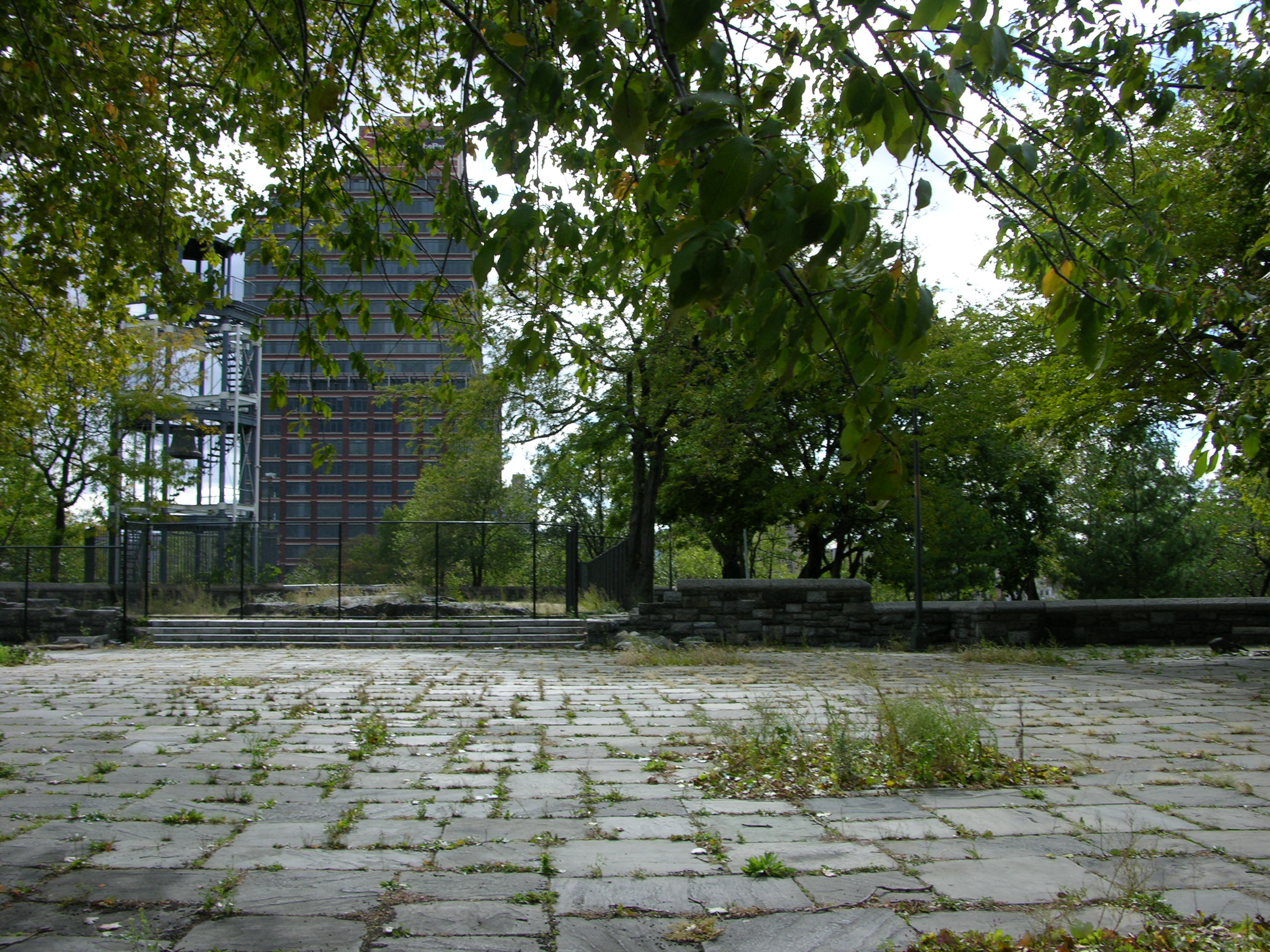
At the park's summit, on an artificial plateau locals call The Acropolis, stands a 47-foot cast-iron tower fitted with a 10,000-pound bell. Designed by Julius H. Kroehl and erected between 1855 and 1857, the Harlem Fire Watchtower is the sole survivor of eleven such structures once scattered across the city. In an era of wooden buildings and volunteer brigades, observers climbed these towers to scan the skyline for smoke. The bell would ring out the alarm, and the nearest company would respond. The other ten towers have all been demolished, but this one endures -- designated a city landmark in 1967 and added to the National Register of Historic Places in 1976, its bell still suspended in the ironwork, silent but intact.
A Park Renamed, A Movement Honored
By 1970, the park sat at the center of a neighborhood in transformation. Activist groups including the Community Thing proposed renaming it for Marcus Garvey -- publisher, journalist, entrepreneur, and founder of the Universal Negro Improvement Association. That August, more than 1,000 people gathered in the park for a Marcus Garvey Day celebration, and the New York Times noted residents were already calling it Garvey Memorial Park. The City Council made it official in 1973, the same vote that renamed Welfare Island as Roosevelt Island. The renaming was more than symbolic. Garvey had championed Black self-determination and economic independence, and placing his name on this prominent Harlem landmark affirmed the community's ownership of its own public spaces.
Music in the Park, From Croquet to Jazz
Music has echoed through these twenty acres since the beginning. The Parks Department promoted concerts here as early as 1872, and when the park was landscaped in 1869, the New York Times predicted that "croquet playing, decent picnic parties, and a band of music will attract not only the inhabitants of Harlem, but those of New-York." That prediction proved modest. The park became home to the Richard Rogers Amphitheater and a venue for the Charlie Parker Jazz Festival, drawing crowds who sprawl across the lawns while some of the finest musicians in the world play beneath the trees. The Pelham Fritz Recreation Center serves the neighborhood year-round, and in summer, the swimming pool on the park's north side fills with children whose laughter carries up the hill to the silent watchtower above.
Bedrock and Memory
The schist outcropping at Marcus Garvey Park is the same ancient stone that anchors Manhattan's skyscrapers -- the geological backbone that makes the island's skyline possible. Here, though, the rock breaks through the surface, unbuilt and unbroken. Some of the original rusticated retaining walls from the 1869 landscaping still stand, their stonework cousin to the walls surrounding Central Park. The park was listed on the National Register of Historic Places in 2025, a recognition not just of the watchtower or the walls but of the layered history the entire site holds -- from Lenape lookout to Revolutionary battery to the living heart of Harlem. Walk the sloping paths to the summit, and you are climbing the same rock that the Lenape climbed, that the Hessians fortified, that Fifth Avenue could not conquer.
From the Air
Located at 40.804N, 73.943W in central Harlem, Manhattan. The park is a visible green rectangle interrupting the grid between 120th and 124th Streets, with Fifth Avenue splitting around it. The fire watchtower at the summit may be visible at lower altitudes. Nearest airports: KLGA (LaGuardia, 5nm east), KJFK (JFK, 13nm southeast), KEWR (Newark, 10nm southwest).