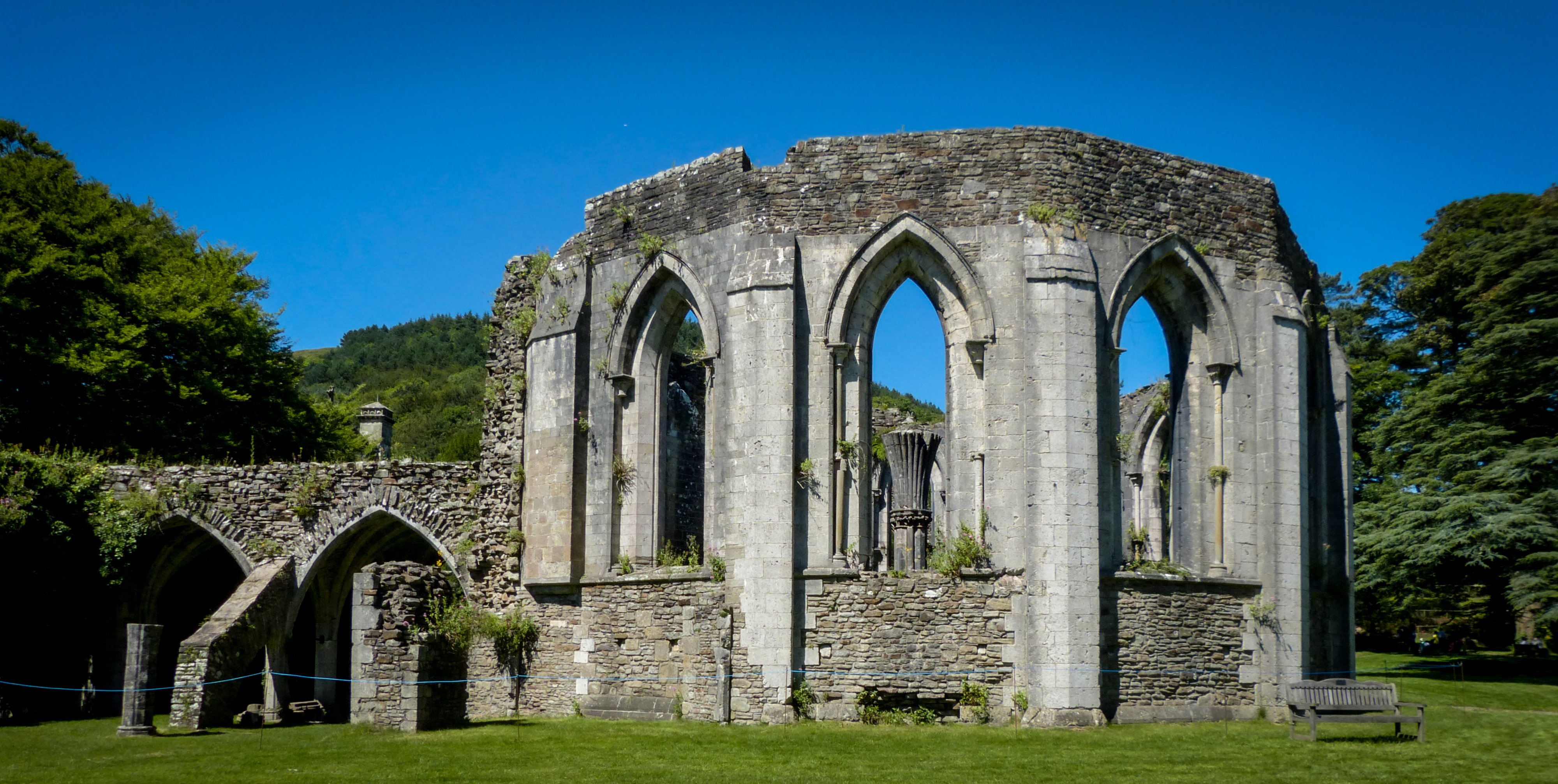
Margam Abbey
In 2020, an online vote organized by the Welsh Woodland Trust crowned a beech tree growing inside the ruined chapter house of Margam Abbey as Wales's Tree of the Year. The image captures the abbey's strange and beautiful condition: a living tree rooted in a roofless 13th-century polygon of stone, flourishing where monks once gathered to read their daily chapter. It is an accidental monument to the way Margam has always intertwined growth and decay, the sacred and the natural, the medieval past and the ongoing present.
Daughter of Clairvaux
Robert, Earl of Gloucester, founded Margam Abbey in 1147 as a daughter house of Clairvaux, the great Cistercian motherhouse in Burgundy. Early Christian crosses found nearby and conserved in the Margam Stones Museum suggest a Celtic monastic community had occupied the site long before the Normans arrived. The founding abbot, William of Clairvaux, established a community that would become one of the most important Cistercian houses in Wales. Its third abbot, Conan, earned praise from Giraldus Cambrensis and entertained the Archbishop of Canterbury, Baldwin of Forde, when he arrived to preach the Third Crusade in 1188. Conan also left a scholarly mark: he is credited with composing the chapter headings for St Bernard of Clairvaux's Sermons on the Song of Songs, a work that helped earn Bernard the title of Doctor of the Church.
Chronicles and Kings
The monks of Margam produced the Annales de Margan, a Latin chronicle spanning from the death of Edward the Confessor in 1066 to Henry III's quarrel with Hubert de Burgh in 1232. Drawing heavily on William of Malmesbury's history for its early entries, the chronicle also preserves tantalizing accounts: the purported discovery of King Arthur's bones and the alleged murder of Prince Arthur by King John. When Henry VIII dissolved the abbey in 1536, only twelve monks remained, but significant holdings of the monastery's library survived -- including the manuscript of the annals. Sir Rice Mansel purchased the property, and from the Mansel family it eventually passed to the Talbots, who built Margam Castle on the hillside above the ruins in the 19th century.
A Nave That Endures
While the cloister and chapter house fell into ruin after the dissolution, the abbey's nave never stopped serving its original purpose. It continues today as the Church of St Mary, an Anglo-Catholic parish church in the Church in Wales. The contrast between the intact nave -- still hosting three weekly services -- and the skeletal elegance of the surrounding ruins gives Margam its particular character. The twelve-sided chapter house, dating from the 13th century, stands open to the sky within the 840-acre Margam Country Park, alongside Margam Castle. Both the abbey church and the ruined chapter house hold Grade I listed status, as does the abbey undercroft beneath.
Where Ruin Meets Renewal
On a hill overlooking the abbey stands Capel Mair ar y Bryn -- the chapel of St Mary on the hill -- built so that monks tending flocks on the higher ground could fulfil their devotional obligations without descending to the main church. It is a small ruin, easy to miss, but it speaks to the practical piety that defined Cistercian life: faith and work interleaved, prayer fitted around the rhythms of agriculture. That same interleaving persists at Margam today, where a beech tree grows through the chapter house floor, sheep graze the country park, and the nave fills with voices each Sunday morning. The abbey was never fully abandoned; it simply shifted from one kind of living to another.
From the Air
Located at 51.56N, 3.73W on the outskirts of Port Talbot, south Wales. The abbey ruins and adjacent Margam Castle are visible within Margam Country Park. Best viewed at 2,000-3,000 ft. Nearest airport: Swansea (EGFH), approximately 10 nm west. The M4 motorway passes close by to the north, and the Port Talbot steelworks provide a distinctive visual reference to the east.