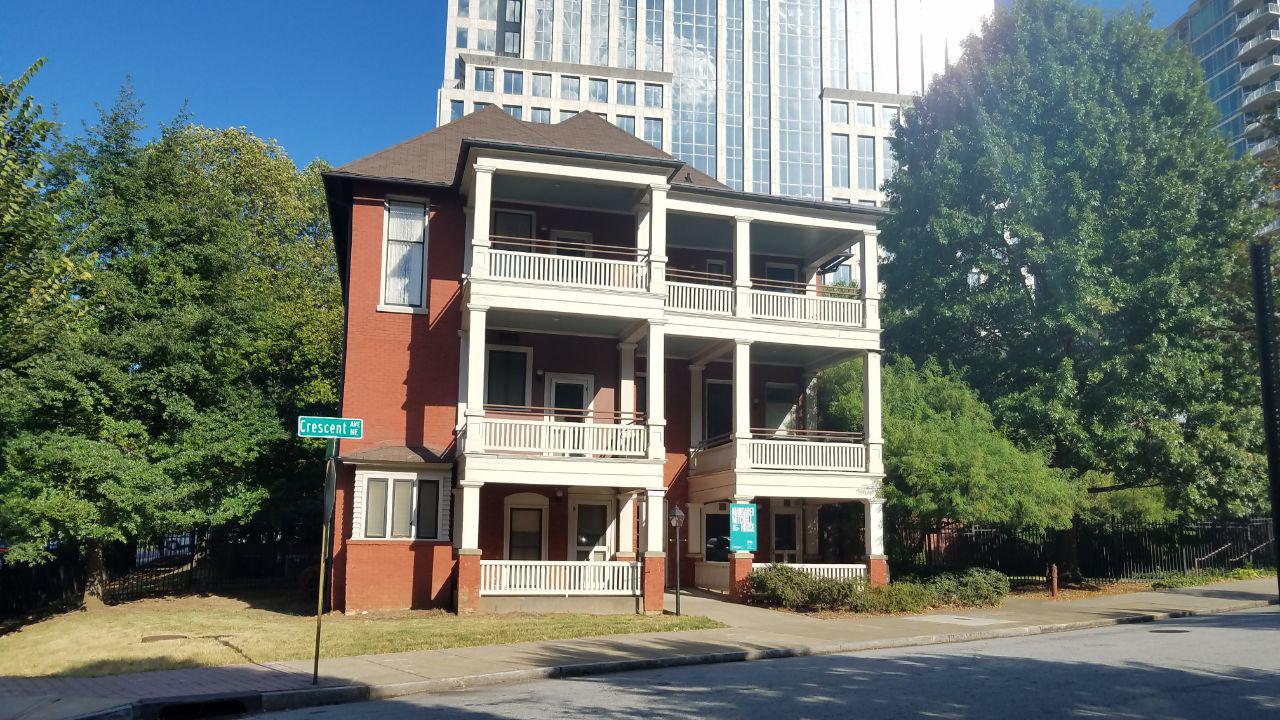
Margaret Mitchell House and Museum
Margaret Mitchell called it "the Dump." Apartment 1 on the ground floor of the Crescent Apartments at 979 Crescent Avenue in Midtown Atlanta was cramped, dim, and perpetually in decline. The building's owner had gone bankrupt. Maintenance had stopped. By 1931, only two of ten apartments were still occupied. But it was here, in this shabby ground-floor flat, that a young newspaper reporter with a bad ankle and a restless imagination sat down and wrote the novel that would become the best-selling American fiction of the twentieth century. Gone with the Wind poured out of "the Dump" between 1925 and 1932, and neither the apartment nor its author would ever be ordinary again.
From Parlor to Pulitzer
The house began life in 1899 as a single-family residence built by Cornelius J. Sheehan on what was then a fashionable stretch of Peachtree Street, addressed as 806 Peachtree. But Atlanta was growing fast, and commercial development swallowed the neighborhood within a decade. The original family decamped to Druid Hills in 1907. In the winter of 1913-14, the entire house was physically relocated to the rear of its lot, lifted onto a new basement story facing Crescent Avenue. By 1919, it had been carved into ten apartments. Margaret Mitchell and her husband John Marsh moved in when they married in July 1925, drawn by the location -- close to trolley lines, walking distance from her parents' house, and in the heart of Atlanta's largest business district outside downtown. Mitchell was recovering from a broken ankle that had ended her reporting career at the Atlanta Journal. With time on her hands and stacks of library books surrounding her, she began writing.
The Building Nobody Wanted
After the Marshes left in 1932, the Crescent Apartments limped along through the Depression and World War II, each decade stripping away another layer of dignity. Porches were removed in 1946. By the 1950s, the building was mostly vacant, its old apartments popular mainly with Georgia Tech students looking for cheap rent. A brief revival as the Windsor House Apartments in the 1960s gave way to final eviction in 1977, when a developer boarded it up, envisioning grand redevelopment plans that never materialized. His company went bankrupt in the late 1980s, having demolished dozens of neighboring historic buildings but leaving the old Crescent Apartments standing -- neglected, deteriorating, and set ablaze at least once by an unknown arsonist.
Twice Burned, Still Standing
In 1989, Mayor Andrew Young designated the building a city landmark, securing its legal protection. Restoration began with careful attention to the structure's layered history: the front was restored to its 1899 appearance, while the rear was returned to its look during Mitchell's residence. Then, in September 1994, a fire presumed to be arson destroyed much of the building. Daimler-Benz Corporation stepped in with $4.5 million to rebuild, motivated in part by plans to use the facility during the 1996 Summer Olympics in Atlanta. The restoration was nearly complete when, in May 1996 -- just 40 days before the Opening Ceremonies -- arsonists struck again. This second fire damaged or destroyed everything except Mitchell's own apartment. Insurance covered $2 million in further repairs, and the house was finally dedicated on May 16, 1997. It was added to the National Register of Historic Places in 1996.
A Story That Refuses to End
Today the Margaret Mitchell House stands at the heart of the Atlanta History Center's Midtown Campus. The museum's permanent exhibitions explore not just Mitchell's life and her Pulitzer Prize-winning novel, but the building's own improbable journey from single-family home to apartments to boarded-up ruin to twice-torched restoration project to beloved cultural landmark. Visitors walk through the ground-floor apartment where Mitchell spent seven years assembling and revising the manuscript she initially hid from friends. The building on Crescent Avenue has been a parlor, a rooming house, a student flophouse, a crime scene, and a phoenix. That it survives at all is a story as stubborn and dramatic as the one Mitchell wrote inside it.
From the Air
Located at 33.78N, 84.38W in Midtown Atlanta, Georgia, along Crescent Avenue near Peachtree Street between 10th and 14th Streets. The museum sits within the dense Midtown skyline. Nearby airports: KATL (Hartsfield-Jackson Atlanta International, 10nm south), KPDK (DeKalb-Peachtree, 9nm northeast), KFTY (Fulton County Airport-Brown Field, 10nm northwest). Best viewed at 2,000-3,000 ft AGL. Look for the Midtown high-rise cluster along Peachtree Street; the museum is on the west side of the corridor. The Atlanta History Center's Midtown Campus and Ansley Park neighborhood are nearby visual references.