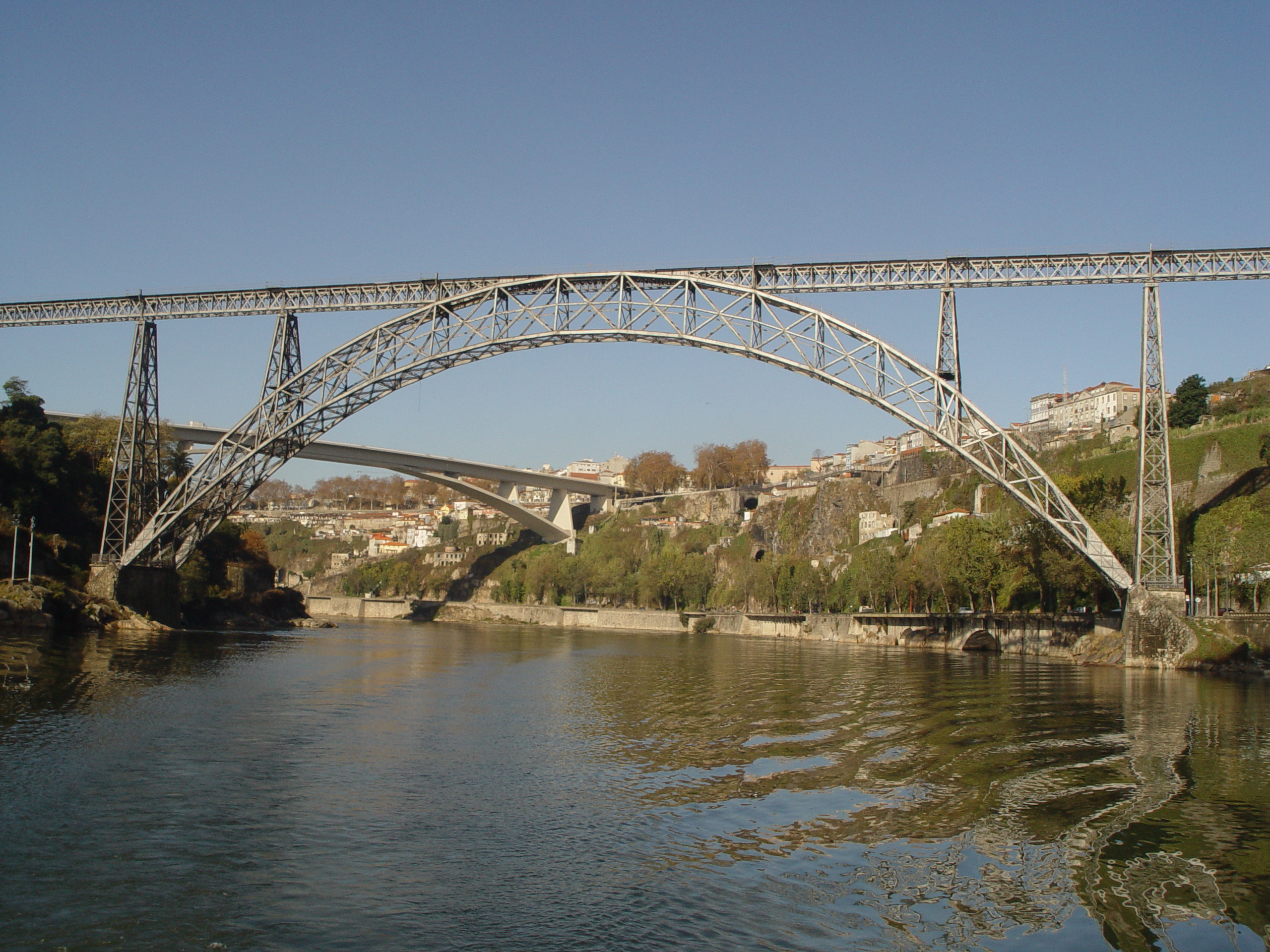
Maria Pia Bridge
Twelve years before the Eiffel Tower pierced the Paris skyline, Gustave Eiffel's company solved a different kind of engineering problem entirely. The Douro River at Porto runs fast and deep, swollen by floods that could reach twenty meters, its bed a shifting layer of gravel that made any foundation uncertain. Building piers in the water was out of the question. What Porto needed, and what Eiffel's firm delivered in 1877, was a single iron arch leaping 160 meters across the gorge without touching the river below. At the time it was completed, no arch bridge in the world had a longer span.
The Competition Nobody Expected Eiffel to Win
In 1875, the Royal Portuguese Railway Company announced a competition for a bridge to carry the Lisbon-to-Porto railway across the Douro. The technical challenge was immense: the previous record for an arch span belonged to James B. Eads' bridge over the Mississippi at St. Louis, at 158.5 meters. Porto needed to exceed that by a meter and a half. Four designs were submitted. Eiffel's proposal came in at 965,000 French francs, roughly two-thirds the cost of the nearest competitor. His company was relatively inexperienced, and a commission was appointed to vet their capability. The report came back favorable, though it emphasized the difficulty of the project. The real designer was likely Theophile Seyrig, Eiffel's business partner, who presented the technical paper on the bridge to the Societe des Ingenieurs Civils in 1878. At the 1878 World's Fair, Eiffel credited Seyrig and Henry de Dion with the calculations and drawings.
Iron Over Water
Construction began on January 5, 1876. Workers built the abutments, piers, and approach decking through the summer, finishing by September. Winter floods halted the work, and the most dramatic phase -- erecting the central arch span -- did not resume until March 1877. The technique involved building each half of the arch outward from the riverbanks, supported by temporary cables, until the two halves met in the middle. By October 28, 1877, the platform was in place. The completed bridge weighed 1,500 tonnes of wrought iron, its crescent arch spanning 353 meters in total with 60 meters clearance above the Douro. The double-hinged design allowed the arch to flex with temperature changes, a refinement that would influence bridge engineering for decades.
Mistaken Identity
Visitors to Porto regularly confuse the Maria Pia Bridge with the more famous Dom Luis I Bridge, which sits just one kilometer downstream. The similarity is not accidental -- Theophile Seyrig, who likely designed the Maria Pia, went on to design the Dom Luis I after parting ways with Eiffel. The newer bridge, completed in 1886, has two decks instead of one, carrying both road traffic and, on its upper level, pedestrians and eventually the Porto Metro. The Maria Pia carried trains for over a century before being replaced in 1991 by the Ponte de Sao Joao, a concrete bridge built for heavier modern rolling stock. The Maria Pia still stands, a protected national monument, its iron lattice darkening with age while its successor carries the railway traffic that once thundered across its deck.
A Rehearsal for Paris
The Maria Pia Bridge was Eiffel's proof of concept. The techniques his firm developed here -- prefabricated iron sections, innovative construction methods for spanning impossible distances, the bold aesthetic of exposed structural ironwork -- became the vocabulary he would deploy on an even grander scale in Paris. The bridge connected the mount of Seminario in Porto to the Serra do Pilar in Vila Nova de Gaia, linking not just two cities but two eras of engineering. It demonstrated that iron could be beautiful as well as functional, that a bridge could be a landmark as well as infrastructure. Standing on the Douro's banks today, looking up at the delicate lattice of the crescent arch, you see the skeleton of an idea that would eventually become the most recognized structure on earth.
From the Air
Located at 41.140N, 8.597W, spanning the Douro River between Porto and Vila Nova de Gaia. The bridge is clearly visible from the air as one of several bridges crossing the Douro gorge. Francisco Sa Carneiro Airport (LPPR/OPO) is 13km northwest. Best viewed at 1,500-3,000 feet altitude where the iron arch structure is distinguishable from the nearby Dom Luis I Bridge (1km west). The Monastery of Serra do Pilar on the south bank serves as a reference point. Oceanic climate; morning fog can obscure the river gorge.