.jpg)
Mariachi Plaza
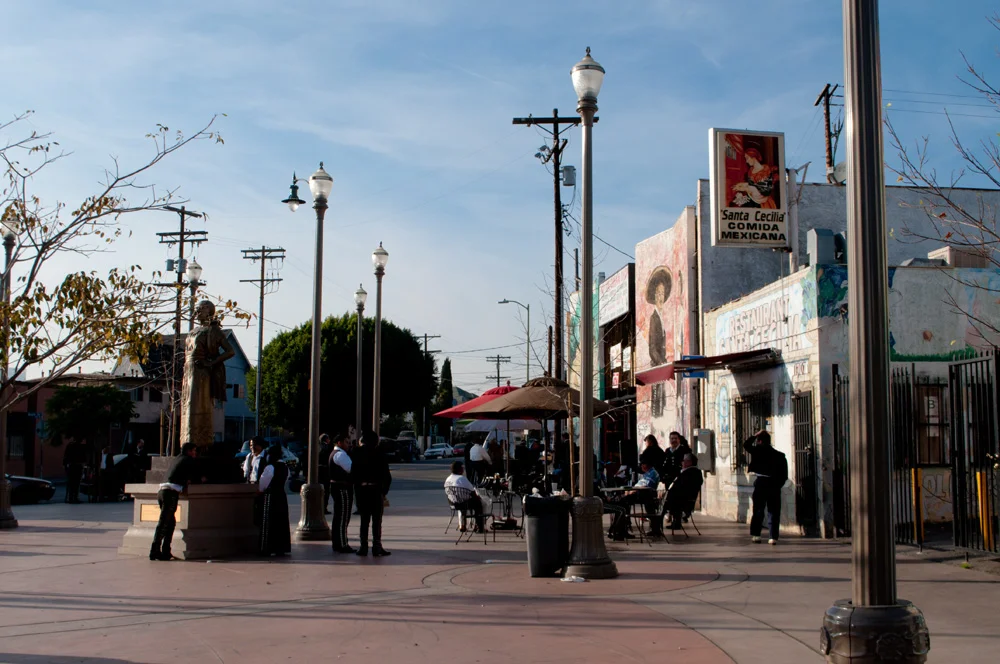
On a corner of Boyle Heights, men in silver-studded trajes de charro arrive before dawn, guitar cases in hand, waiting to be hired for a quinceañera or a serenade. This is Mariachi Plaza — part job market, part cultural monument, part open-air concert hall — where the sound of trumpets and guitarróns has never really stopped.
A Corner That Became a Tradition
The story of Mariachi Plaza begins not with a grand founding but with a man named Juan Gonzalez Muñiz, known as El Cochero, who began gathering musicians on this corner of First Street and Boyle Avenue in the 1930s. No city permit authorized it, no civic plan ordained it. Musicians simply gravitated here because the work was here — and the community that loved their music was here.
Boyle Heights in those years was a dense, working-class neighborhood that had absorbed wave after wave of immigrants: Jewish families, Japanese Americans, Russian Molokans, and, increasingly, Mexican families who had crossed the border seeking work in California's factories and fields. For those families, a mariachi band was not entertainment so much as a living thread connecting them to home — to weddings and funerals and saints' days celebrated with the same songs their grandparents had known in Jalisco or Michoacán.
For decades the plaza remained informal — a sidewalk economy sustained by loyalty and word of mouth. Then, on November 22, 1992, the feast day of Saint Cecilia, patron saint of musicians, the city broke ground on a real plaza. The date was no accident. It was a statement about whose culture was being honored.
Stone from Jalisco
The centerpiece of Mariachi Plaza is a cantera kiosk — a carved stone pavilion in the tradition of the town squares of western Mexico. It arrived in 1998, a gift from the governor of Jalisco, the Mexican state most closely associated with mariachi music. Jalisco is the birthplace of the modern mariachi ensemble, and the kiosk's presence asserts a direct lineage: these musicians in Boyle Heights are heirs to a tradition that stretches back centuries.
Beneath and around the kiosk, bronze and stone speak to the legends of the form. A sculpture called El Niño Perdido, by artist Alejandro de la Loza, stands in the plaza. More commanding is the presence of Lucha Reyes, honored here as the 'Mother of Ranchera Music.' Reyes — who performed in the 1920s and '30s, whose raw, anguished voice transformed the ranchera song from entertainment into emotional testimony — represents everything the plaza is about: music that carries pain and pride simultaneously, that refuses to be genteel.
In September 2022, the street bordering the plaza was renamed in honor of Vicente Fernández, the beloved singer who died in December 2021 and who had long been a patron of traditional Mexican music. The renaming was part of a broader reckoning — a city slowly acknowledging the cultural wealth that Boyle Heights had produced and preserved.
Where the City Meets the Music
In 2009, the Metro E Line opened its Mariachi Plaza station, embedding the space permanently into the infrastructure of Los Angeles. Passengers stepping off the train now arrive in a plaza framed by the kiosk, the sculptures, and — on any given morning — groups of musicians in full regalia waiting for a call.
The hiring process has always been direct. A family drives up, negotiates a price, and a band climbs in or follows. For weddings, birthday parties, baptisms, and funerals, the musicians provide not just sound but occasion — the sense that something important is happening, that it deserves to be marked with trumpets and song.
Critics have sometimes noted that the plaza's formalization turned something organic into something curated. But the musicians who gather here each morning are not performing for tourists; they are working, as their predecessors worked, as the form itself has always required — adapting to the needs of the people who love it, generation after generation, on this corner of Boyle Heights.
From the Air
Nearby Stories
- Warner Grand Theatre 1.5 km away
- Silverado Fire 4.2 km away
- Nethercutt Collection 15 km away
- Fillmore and Western Railway 16 km away
- Amgen 19 km away
- Santa Barbara Island 36 km away
- San Bernardino Train Disaster 42 km away
- Calico: The Ghost Town Walter Knott Saved 111 km away