Marias Massacre
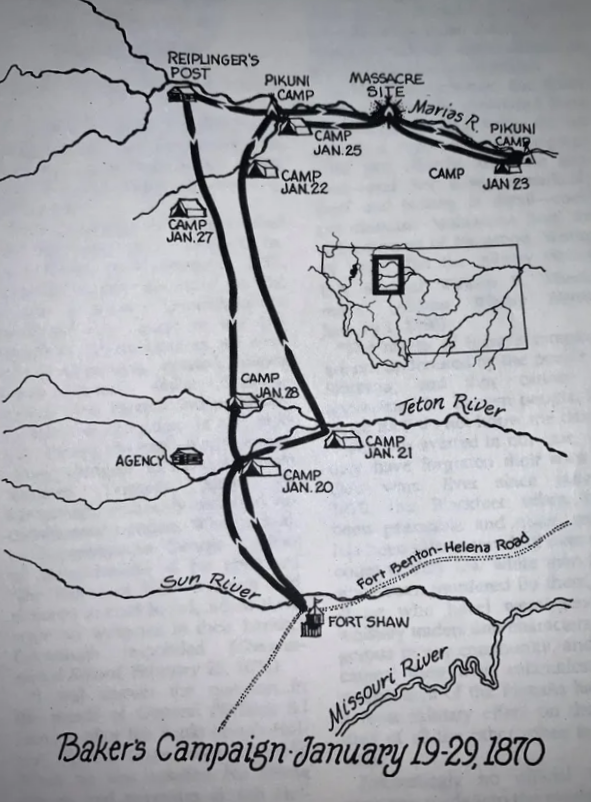
Chief Heavy Runner ran toward the soldiers waving a piece of paper above his head. It was a safe conduct pass from the Indian Bureau, proof that his band was peaceful, that they were the wrong camp. The soldiers shot him down. On January 23, 1870, along the Marias River in Montana Territory, Major Eugene Baker's cavalry had been sent to punish the band of Mountain Chief for raids on white settlements. Instead, in a dawn attack on a camp full of people weakened by smallpox, they killed approximately 200 Piegan Blackfeet, the vast majority of them women, children, and older men. Scout Joe Kipp, who recognized Heavy Runner's camp and tried to stop the attack, counted 217 dead.
The Murder That Started Everything
Malcolm Clarke was a fur trader and rancher who had once attended West Point before being expelled for fighting. In 1867, a young Piegan warrior named Owl Child stole horses from Clarke, retaliation for Clarke's role in losing horses that Owl Child blamed on him. Clarke and his son Horace caught up with Owl Child and beat him publicly, humiliating him before other Blackfeet. According to Blackfeet oral histories, Clarke also assaulted Owl Child's wife. On August 17, 1869, Owl Child and his companions came to the Clarke ranch. They shot Horace, who survived, then found Malcolm Clarke and killed him with an ax. The incident gave the Army the justification it had been seeking.
Orders to Strike Hard
General Philip Sheridan wanted the Blackfeet punished. "If the lives and property of the citizens of Montana can best be protected by striking Mountain Chief's band," he wrote, "I want them struck. Tell Baker to strike them hard." Sheridan intended a dawn attack in deep winter, the same strategy he had used when George Custer attacked Black Kettle's Cheyenne at the Washita River in 1868. Major Baker left Fort Ellis on January 6, 1870, picked up reinforcements and scouts at Fort Shaw, and marched toward the Marias River. His scouts included Joe Kipp and Joseph Cobell, men who knew the different Piegan bands and could distinguish between hostile and friendly camps.
The Wrong Camp
When Baker's column found the Piegan encampment on the frozen Marias, scout Joe Kipp recognized that it belonged to Heavy Runner, a chief considered peaceful and explicitly protected by orders from Colonel de Trobriand at Fort Shaw. Kipp told Baker this was the wrong camp. Baker's response: "That makes no difference, one band or another of them; they are all Piegans and we will attack them." He ordered a sergeant to shoot Kipp if he tried to warn the camp. Kipp shouted anyway. Baker had him arrested and gave the command to fire. Heavy Runner emerged from his lodge and ran toward the soldiers, waving his safe conduct pass. He was shot down immediately.
The Killing and Its Cover-Up
Baker's men counted 173 dead Blackfeet; Kipp later said the true number was 217. Only one cavalryman died, a Private McKay. Another soldier broke his leg falling off his horse. Agent William Pease interviewed survivors and reported a death toll of eighteen older men, ninety women, and fifty children. Only fifteen young men of fighting age were killed. Many in the camp had been suffering from smallpox, too weak to resist. The Army portrayed Baker as a hero. Colonel de Trobriand implied that Heavy Runner had been killed through "his own fault" for leaving the safety of a trading post. General Sheridan succeeded in preventing any official investigation.
A Policy Changed by Outrage
The massacre backfired politically. News of the slaughter of women and children, many sick with smallpox, provoked public outrage that ended Sheridan's campaign to place Indian affairs under military control. President Ulysses S. Grant instead pursued what became known as the Peace Policy, appointing Quakers and other religious figures as Indian agents in hopes of reducing the corruption that had plagued the Bureau of Indian Affairs. Mountain Chief, the actual target of the expedition, escaped to Canada with his band. Each January 23, students and faculty from Blackfeet Community College hold a memorial at the massacre site. In one year they placed 217 stones there, one for each victim as counted by Joe Kipp. In 2010, the Baker Massacre Memorial was erected at the site. In 2022, a Yellowstone peak named for massacre participant Gustavus Doane was renamed First Peoples Mountain.
From the Air
Coordinates: 48.39N, 111.66W. The massacre site lies along the Marias River in north-central Montana, approximately 30 miles south of the Canadian border. Best viewed at 3,000-4,000 feet AGL. The river valley cuts through rolling prairie. Nearest airports: Cut Bank Municipal (KCTB) 25 miles northwest, Great Falls International (KGTF) 75 miles southeast. The Baker Massacre Memorial marks the site. The terrain is typical Montana high plains, open grassland with river-bottom cottonwoods.