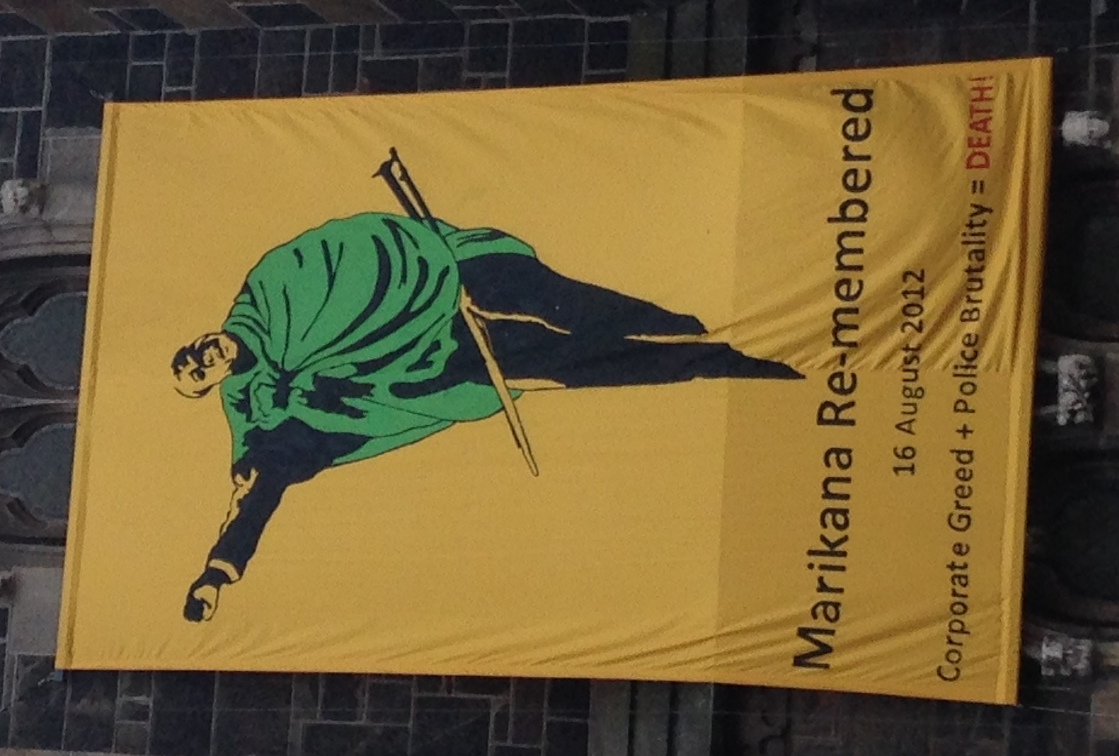
Marikana Massacre
Thirty-four people died in roughly ten minutes. On August 16, 2012, South African Police Service officers opened fire on a group of striking platinum miners near a rocky outcrop called a koppie at Lonmin's Marikana mine in the North West Province. The miners were rock drill operators -- the men who work at the deepest, most dangerous levels of the platinum shafts -- and they had been striking for a wage increase from approximately 4,000 rand to 12,500 rand per month. When the shooting stopped, 34 miners lay dead and at least 78 were wounded. It was the single deadliest use of force by South African security services against civilians since the end of apartheid, and the images that emerged -- bodies sprawled on the dusty ground, armored police vehicles advancing on men carrying sticks and blankets -- shattered assumptions about what had changed in South Africa and what had not.
The Men on the Hill
The strikers were overwhelmingly rock drill operators, among the lowest-paid workers performing the most physically punishing labor in South Africa's platinum belt. They drilled at depths where temperatures and pressures are extreme, earning wages that left many of them living in informal settlements around the mine with limited access to clean water or sanitation. Their demand -- 12,500 rand per month, roughly triple their base pay -- reflected not just a wage grievance but a deeper fury about the gap between the wealth extracted from the ground beneath their feet and the conditions in which they lived above it. The strike was driven largely by the Association of Mineworkers and Construction Union (AMCU), which had been gaining members among workers who felt that the dominant National Union of Mineworkers (NUM) had grown too close to both the mining companies and the governing African National Congress.
A Week of Violence
The shooting on August 16 did not emerge from a vacuum. In the preceding week, ten people had already died in clashes connected to the strike -- including two Lonmin security guards, two police officers, and six miners. Tensions between NUM and AMCU supporters had turned violent. On August 13, police officers were attacked and two were killed; their service pistols were taken. Armed strikers gathered on and around the koppie, many carrying traditional weapons -- pangas, spears, and knobkerries -- and some reportedly possessing firearms. The South African Police Service massed armored Nyala vehicles, water cannon, and razor wire around the koppie, preparing an operation they described as a plan to disarm and disperse. AMCU president Joseph Mathunjwa visited the koppie the morning of August 16 and, in an emotional address, begged the strikers to leave peacefully. Many did not.
Scene One and Scene Two
The police operation began in the afternoon. Officers unrolled barbed wire, and a repositioned Nyala cut off some miners who had been leaving the koppie. What happened next unfolded across two locations that investigators would call Scene One and Scene Two. At Scene One, a group of strikers moved toward a gap in the police line. Within ten seconds, 47 Tactical Response Team members opened fire with R5 assault rifles. At Scene Two, events were even harder to reconstruct: no crime scene photographs were taken, and a warrant officer later admitted he had moved weapons from the vicinity of dead and injured miners on his own initiative, without recording their original positions. Journalist Greg Marinovich of the Daily Maverick, examining the physical evidence, concluded that at Scene Two, "heavily armed police hunted down and killed the miners in cold blood." The Farlam Commission of Inquiry, appointed by President Jacob Zuma, spent years investigating but ultimately satisfied few of the families seeking accountability.
After the Shooting Stopped
In the immediate aftermath, police arrested 259 mineworkers near the massacre site. Over the following two weeks, 11 more were detained, including some reportedly taken from hospitals where they were recovering from gunshot wounds. The National Prosecuting Authority initially charged the surviving miners with the murder of their colleagues under common purpose doctrine -- the same legal framework the apartheid government had used against anti-apartheid activists. Public outcry was swift and fierce. The charges were dropped within weeks, but the fact that they had been brought at all deepened the wound. Lonmin, facing plummeting share prices and unable to meet production targets, eventually negotiated a wage increase of up to 22 percent. The company's share value had already fallen by millions of dollars. The strike had lasted roughly five weeks and cost the industry an estimated 10 billion rand.
What Marikana Left Behind
The massacre at Marikana forced South Africa to confront questions it had been deferring since the transition to democracy. The striking miners were not dissidents challenging an illegitimate government. They were workers in a democratic South Africa, employed by a multinational corporation, shot by a police force ostensibly serving a constitutional state. Their deaths exposed the persistence of deep inequality in the post-apartheid economy, the failures of labor institutions to represent the most vulnerable workers, and the willingness of the state to use lethal force against its own citizens in defense of corporate operations. Rehad Desai's documentary Miners Shot Down, which contained footage of the shooting, won an International Emmy. Books, academic studies, and memorials have followed. But as of the years since, no police officer has been criminally prosecuted for the killings. Each August 16, families of the dead return to the koppie. They remember the men who went to work in the mines and never came home.
From the Air
The Marikana mine area is located at 25.678°S, 27.509°E in the North West Province, approximately 100 km northwest of Johannesburg in the heart of the Bushveld platinum belt. From 3,000-5,000 feet AGL, the open-pit and shaft mining operations of the Lonmin (now Sibanye-Stillwater) complex are visible, surrounded by informal settlements and the rocky koppie where the strikers gathered. Pilanesberg International Airport (FAPS) is approximately 40 nm north. Lanseria International Airport (FALA) is about 45 nm southeast. The Pilanesberg mountain range and Sun City resort complex are visible to the north. Clear conditions prevail on the Highveld plateau, with summer afternoon thunderstorms.