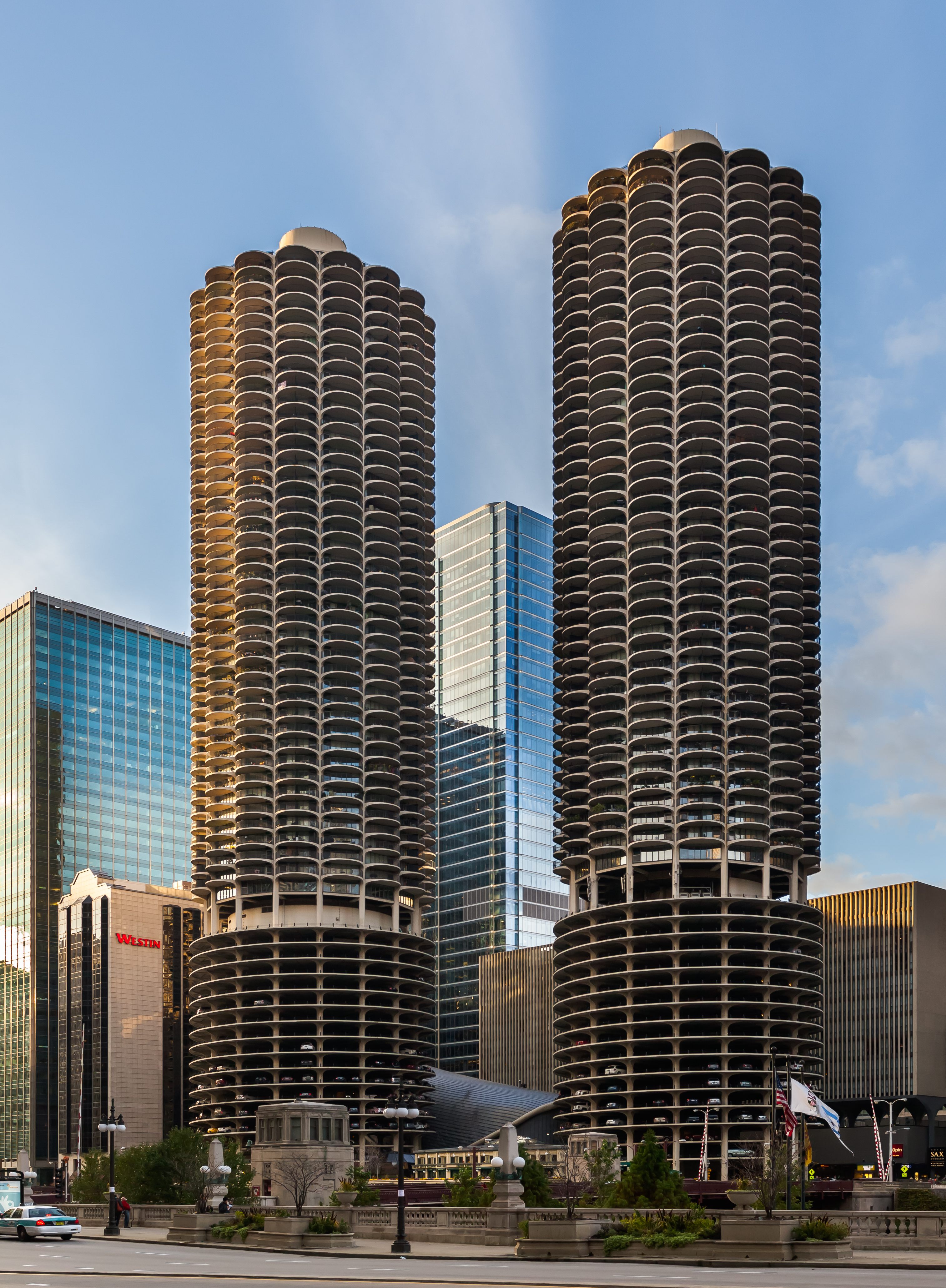
Marina City
Chicagoans call them the corncobs. The twin 65-story cylindrical towers of Marina City rise from the north bank of the Chicago River like nothing else on the skyline -- or any skyline, for that matter. When they opened in 1963, they were simultaneously the tallest residential buildings and the tallest reinforced concrete structures in the world. But the truly strange part of the story is who paid for them. The Building Service Employees International Union -- a union of janitors and elevator operators -- financed the $36 million project because its members were watching their jobs disappear as middle-class families fled to the suburbs. The corncobs were a bet that people could be persuaded to live downtown again, and it worked so well that the mixed-use tower-over-parking model Marina City pioneered has become the default blueprint for urban development around the globe.
A City Within a City
Architect Bertrand Goldberg designed Marina City in 1959 as a self-contained urban village. The complex was not just two apartment towers -- it included a ten-story office building, a saddle-shaped auditorium that served as a cinema, a theater, gym, swimming pool, ice rink, bowling alley, restaurants, shops, and a marina for pleasure boats at river level that gave the whole project its name. The idea was that a resident should never need to leave. Goldberg rejected the suburban notion that living and working had to happen in different places, and he built his argument in concrete. The complex was constructed between 1961 and 1968 by a joint venture of Brighton Construction Company and James McHugh Construction Company, using Linden climbing tower cranes -- the first time that technology had been deployed in the United States.
No Right Angles
Step inside a Marina City apartment and the geometry shifts. Almost no interior right angles exist in the entire building. On each residential floor, a circular hallway wraps around the elevator core, with sixteen pie-shaped units radiating outward. Kitchens and bathrooms tuck toward the center; living spaces occupy the outer edges, each terminating in a semicircular balcony separated from the room by floor-to-ceiling glass. Every single living room and bedroom in the building has a balcony -- nine hundred of them, stacked in rings, creating the ribbed corncob profile visible from miles away. The bottom nineteen floors of each tower form an exposed spiral parking ramp with roughly 896 spaces, and a 360-degree open-air roof deck crowns the 61st floor. The elevators move fast enough to travel from the lobby to that roof deck in approximately 33 seconds.
The Broadcast Tower
Before Willis Tower existed, WLS-TV -- ABC's Channel 7 in Chicago -- transmitted from an antenna mounted on top of one of the Marina City towers. The local radio station WCFL operated from the complex's office building. Fox affiliate WFLD kept its studios and transmitter at Marina City for eighteen years before Metromedia bought the station and moved it out. For a stretch of the 1960s and 1970s, the corncobs were as much a part of Chicago's media infrastructure as they were its residential landscape. A weather beacon once blinked atop one of the towers, visible across the lakefront -- a navigational landmark for the city's TV viewers and its pilots alike.
Album Covers and Car Chases
Marina City has embedded itself in popular culture with a persistence few buildings can match. The towers dominate the cover of Wilco's Yankee Hotel Foxtrot, the 2001 album so identified with the buildings that fans began calling them the 'Wilco Towers.' Steve McQueen chased a suspect through the spiral parking garage in The Hunter in 1980, sending a car flying off a high floor into the Chicago River -- a stunt later recreated for an Allstate insurance commercial. The Bob Newhart Show's opening credits featured the towers prominently enough that viewers assumed Bob lived there. The buildings also appear in Ferris Bueller's Day Off, Candyman, The Bear, and the Japanese manga Gunsmith Cats, which rendered the parking structure with remarkable fidelity. In 2014, tightrope walker Nik Wallenda performed a walk across the towers. The New York Chapter of the American Institute of Architects awarded the design a prize for innovation in 1965, and in 2018, AIA Illinois selected Marina City as one of the Illinois 200 Great Places for the state bicentennial.
Still Standing, Still Evolving
Marina City's complex today houses the House of Blues concert hall, built inside the shell of the long-disused movie theater. The ten-story office building became Hotel Chicago. The old ice rink was demolished to make room for Smith and Wollensky steakhouse. Restaurants, a bowling lounge, and bars fill the commercial spaces. In 2006, decorative lighting was installed around the circular rooftop mechanical sheds -- the first illumination the tower caps had seen since the 1960s. The complex was designated a Chicago Landmark in 2016, more than fifty years after it opened. What started as a union's gamble against suburban flight remains one of the most recognizable silhouettes in American architecture, proof that Goldberg's radical idea -- that people would choose to live, work, and play in a single vertical community along the river -- was not radical at all.
From the Air
Located at 41.888°N, 87.629°W on the north bank of the Chicago River, Marina City's twin cylindrical towers are among the most distinctive structures visible from the air over Chicago. The corncob-shaped profiles and the exposed spiral parking ramps are unmistakable. The complex sits on State Street directly across the river from the Loop. Best viewed at 1,500-3,000 feet AGL. Nearest airports: Chicago O'Hare (KORD, 15 miles northwest) and Chicago Midway (KMDW, 9 miles southwest). The towers' circular rooftop lighting is visible at night.