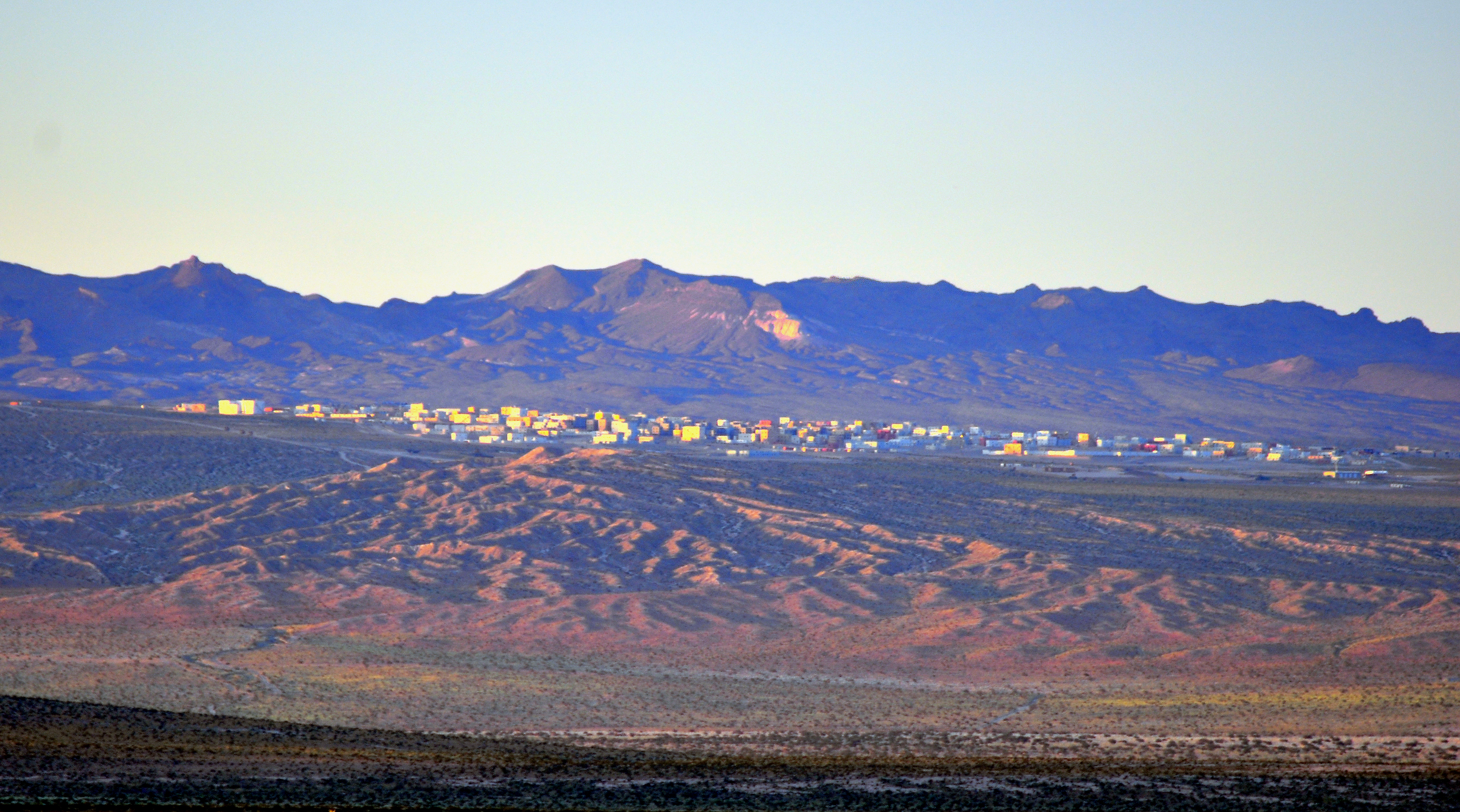
Marine Corps Air Ground Combat Center Twentynine Palms
At its peak, a Marine expeditionary brigade has roughly 16,500 personnel. The Marine Corps Air Ground Combat Center at Twentynine Palms is designed to train exactly that force — on terrain that includes ancient lava flows, dry lake beds, arroyos that can flood fast enough to move armored vehicles, and a sprawling fabricated village nicknamed Combat Town.
From Glider School to Combat College
The base began as an abandoned World War II glider airfield. During the Korean War, Marines needed more live-fire training ranges than Camp Pendleton could provide, and in 1952, a small detachment arrived at Condor Field — the old Army glider school — to begin establishing a training center. The first major exercise, a large-scale live-fire maneuver by the 3rd Marine Division in December 1952, demonstrated what the terrain could handle. By 1957 the installation had grown to base status. In 1979, following the addition of an expeditionary airfield, it was redesignated the Marine Corps Air Ground Combat Center — MCAGCC, or simply "29 Palms" to everyone who has served there.
The Scale of the Place
The base covers 1,102 square miles, encompassing terrain that runs from 1,800 to 4,500 feet in elevation. Mountains and valleys run northwest-southeast in the characteristic Basin and Range geometry of the Mojave. Ancient lava flows darken the surface in places; abandoned mines and unexploded ordnance make unauthorized travel in the training areas genuinely dangerous. Summer temperatures reach 120 degrees; winter mornings dip to 15. Annual rainfall averages four inches. The median age of the resident population, as of the 2000 census, was 21 years. For every 100 females on base, there were 404 males — numbers that tell you, without any additional context, that this is a military installation during operational decades.
Combat Town and Mojave Viper
The base is home to Combat Town, a 274-acre fabricated Middle Eastern village complete with a mosque, role-players, and an alley seeded with simulated improvised explosive devices. The program known as Mojave Viper became the standard pre-deployment training regimen before Operation Iraqi Freedom, and the majority of Marine Corps units deploying to Iraq passed through 29 Palms first. The base historian Colonel Verle E. Ludwig described the vision: "Twentynine Palms was to be a permanent combined-arms exercise college for all of the Marine Corps." The Mojave Desert, it turned out, was a good classroom. The terrain is varied and merciless. The distances are real. And the sun, which reaches 120 degrees in summer, does not grade on a curve.
From the Air
Located at 34.23°N, 116.06°W adjacent to the city of Twentynine Palms. The base is bounded by restricted airspace (R-2501 and related areas) — verify clearances before transiting. The main cantonment is visible from altitude as a grid of roads and structures in the Morongo Basin. The expeditionary airfield IATA code is TNP (Twentynine Palms Airport). The base covers roughly 30 miles east-west and is one of the most visible military installations in the western U.S. from altitude.