Marine Corps Recruit Depot Parris Island
The yellow footprints are painted on the pavement outside the receiving barracks, and every recruit who steps off the bus in the middle of the night plants their feet on those marks. It is the first act of compliance in a thirteen-week transformation that has been unfolding on this South Carolina sea island since 1915. But Marine Corps Recruit Depot Parris Island carries far more history than boot camp. Before the drill instructors, before the rifle ranges and the Crucible, this patch of Lowcountry marsh was contested by French Huguenots and Spanish conquistadors, farmed by enslaved people, liberated by Union gunboats, and championed by a freedman who escaped slavery by hijacking a Confederate ship. The name on the maps came from Colonel Alexander Parris, the colonial-era Public Treasurer of South Carolina, but the stories etched into this ground belong to centuries of arrivals, departures, and reinventions.
Flags Over the Marsh
Long before it became Marine territory, Parris Island was claimed and abandoned by European powers with remarkable regularity. The Spanish named the area Punta de Santa Elena -- one of the oldest continuously used European place names in the United States. In 1562, a French Huguenot expedition led by Jean Ribault built Charlesfort here, then left a small garrison while Ribault sailed home for supplies. Wars in Europe delayed him, and the garrison mutinied, built a ship, and sailed back to France. Four years later, Pedro Menendez de Aviles founded the Spanish settlement of Santa Elena, which became the capital of La Florida. When Francis Drake raided St. Augustine in 1586, the Spanish feared Parris Island would be next and abandoned it by 1587. The island passed to English control, was granted to Robert Daniell in 1706, and eventually took its name from Colonel Parris after his death in 1736.
From Plantation to Freedom
From the 1720s through the Civil War, plantations defined the island -- first growing indigo, then cotton. The war changed everything. Union forces captured Port Royal Sound in November 1861, and Parris Island became a Navy coaling station. Enslaved people gained their freedom, and the island became a site of freedmen schools where abolitionists like Frances Gage and Clara Barton taught formerly enslaved men, women, and children to read. One of those freedmen, Robert Smalls, had already achieved the extraordinary: he commandeered the Confederate transport CSS Planter in Charleston Harbor and delivered it to the Union Navy. Smalls went on to serve in the U.S. Congress and fought for the creation of a federal military installation on the very island where his people had been held in bondage.
The Making of Marines
Marines first arrived on June 26, 1891 -- a small security detachment of one first sergeant, two corporals, and ten privates, attached to Naval Station Port Royal. That modest unit was commended for saving lives during devastating hurricanes in 1891 and 1893. On November 1, 1915, the island was officially designated a Recruit Depot, and it has produced Marines without interruption ever since. The scale of that production is staggering. In the month after Pearl Harbor, 5,272 recruits arrived; 9,206 followed in January 1942. By war's end, the depot had trained 204,509 recruits and housed more than 20,000 at the time of the Japanese surrender. The Korean War pushed the peak training load to 24,424 in March 1952. During Vietnam, 10,979 recruits were in training in a single month. In 1949, the Marines activated a separate command for training female recruits -- the only such facility until San Diego began integrated training decades later.
Ribbon Creek and Reform
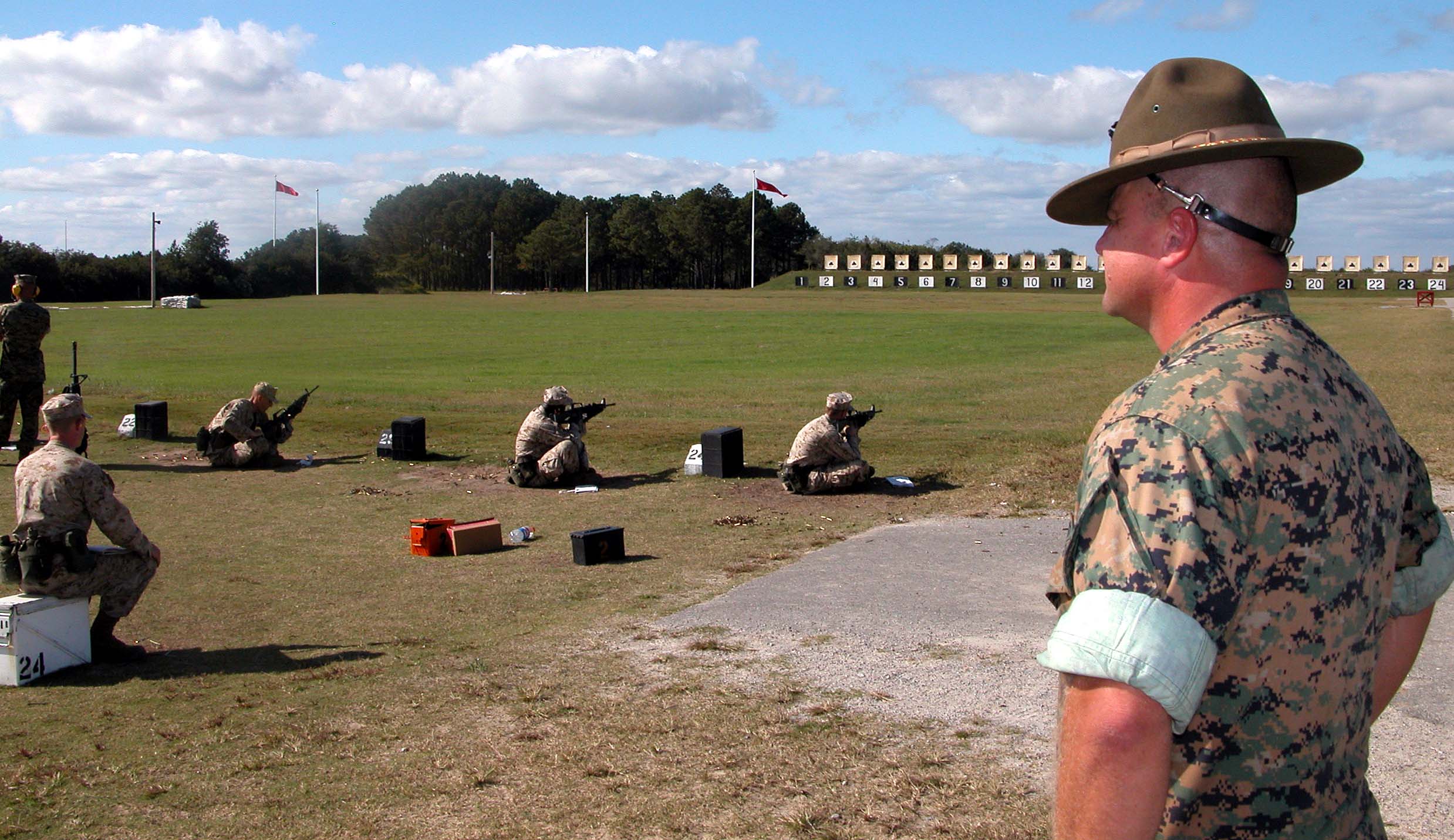
On the night of April 8, 1956, a drill instructor marched his platoon into the tidal waters of Ribbon Creek. Six recruits drowned. The tragedy reverberated through the Marine Corps and across the nation, forcing a wholesale rethinking of how drill instructors were supervised. The series commander role was introduced, oversight expanded, and training methods formalized. The Ribbon Creek incident remains a defining moment in the depot's history -- a reminder that the intensity meant to forge warriors must be governed by discipline and responsibility. Today, about 17,000 recruits train at Parris Island each year. The thirteen-week cycle includes weapons qualification with the M16A4, martial arts, swimming, close-order drill, and the 54-hour simulated combat exercise known as the Crucible. It is, by design, the most demanding entry-level military training in the American armed forces.
An Island in American Culture
Parris Island has embedded itself in the national imagination. Stanley Kubrick immortalized it in Full Metal Jacket, with former Marine drill instructor R. Lee Ermey delivering a performance so authentic it redefined the public image of boot camp. Billy Joel wrote of Marines meeting as soulmates here in 'Goodnight Saigon.' Before 1929, the only way to reach the island was by ferry from Port Royal; that year, a causeway and bridge over Archer's Creek finally connected the depot to the mainland. The causeway was dedicated in 1984 as the General E.A. Pollock Memorial Causeway. Military buildings and family quarters built between 1891 and World War I form the Parris Island Historic District, centered around the commanding general's home, a 19th-century wooden dry dock, and an early 20th-century gazebo -- all listed on the National Register of Historic Places.
From the Air
Located at 32.339N, 80.690W in Port Royal Sound, South Carolina. MCRD Parris Island is a distinct island connected to the mainland by a single causeway, clearly visible from altitude. Best viewed at 2,000-4,000 feet AGL. The geometric grid of barracks, parade decks, and rifle ranges contrasts with the surrounding salt marshes and tidal creeks. Nearest airports: KNBC (Beaufort County Airport, 7nm NE), KSAV (Savannah/Hilton Head Intl, 30nm SW). Look for the causeway bridge over Archer's Creek as a visual reference. The island's landing field (NF08) is also visible.