The Courthouse That Wrote Mining Law
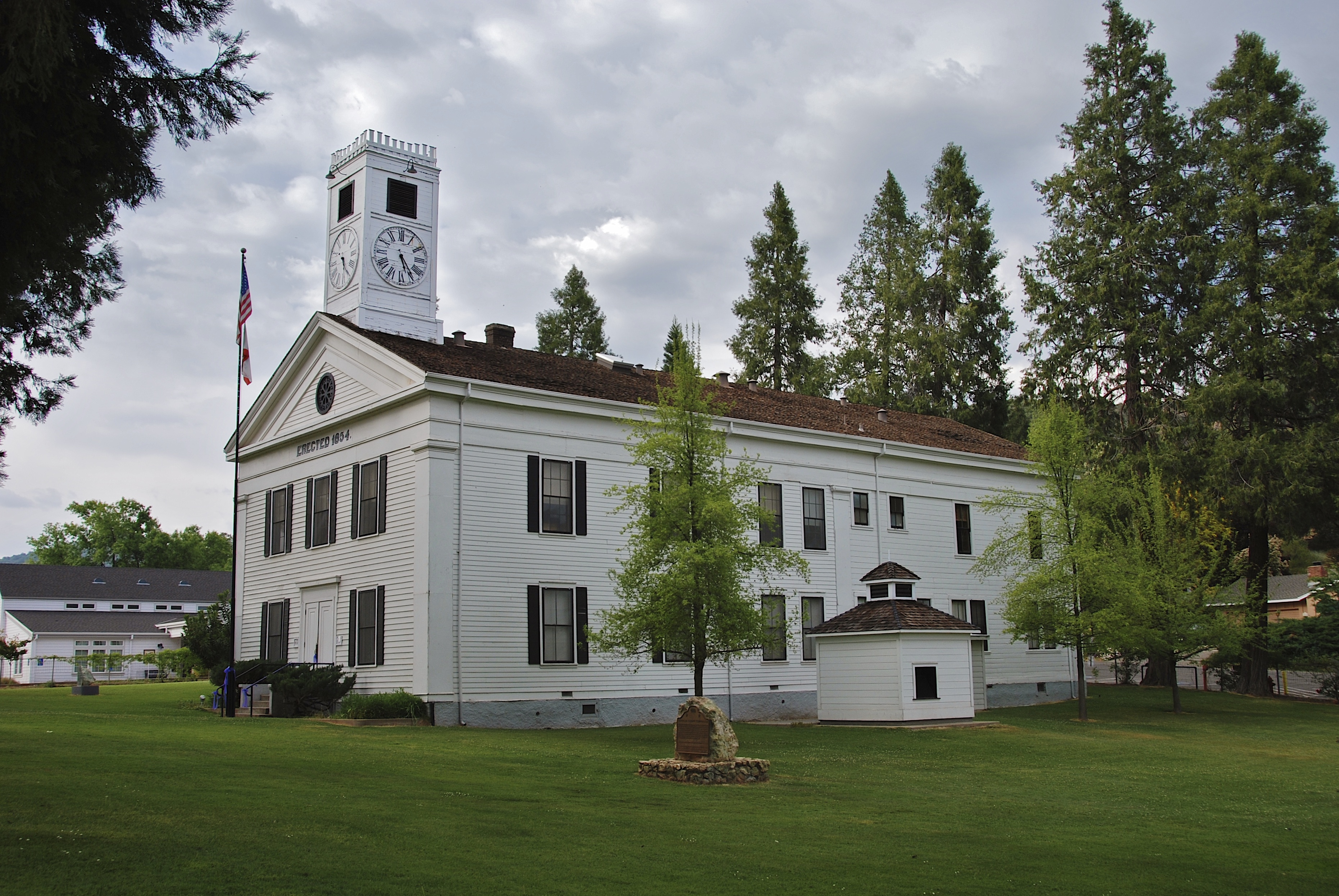
The building cost $9,200. That figure is worth sitting with for a moment -- less than the price of a single good claim in the Sierra Nevada foothills, less than what some miners pulled from the ground in a week. Yet the modest two-story frame courthouse that Fox and Shriver raised on Bullion Street in Mariposa in 1854 would shape the legal landscape of American mining more profoundly than any vein of gold beneath it. The Mariposa County Courthouse is the oldest courthouse in continuous use in California. Not the oldest courthouse building -- the oldest one still hearing cases, still filing documents, still functioning as the civic heart of a county. For over 170 years, this wooden structure has stood while the mines that paid for it went silent, while the Gold Rush towns around it burned and rebuilt and burned again, while California grew from a territory of prospectors into the most populous state in the nation.
Nine Thousand Two Hundred Dollars
By 1851, Mariposa was chaos. Miners had flooded into the Sierra foothills following the discovery of gold at Sutter's Mill, and every imaginable dispute -- over claims, boundaries, water rights, and ownership of the ground itself -- demanded resolution. There was, however, nowhere to resolve them. The need for a courthouse was not ceremonial but urgent, a matter of preventing the foothills from descending into outright anarchy. Fox and Shriver, the builders, used local lumber and straightforward construction techniques. The result was solid rather than elegant: a rectangular frame building that made no concessions to architectural fashion. The first meeting was held on February 12, 1855, and from that day the courthouse became the place where miners who had been settling disputes with fists and firearms began settling them with arguments and evidence. The building's simplicity was its strength. While grander structures in Sacramento and San Francisco succumbed to fire, the Mariposa courthouse endured.
Precedents Carved in Quartz
What made this courthouse extraordinary was not its architecture but its docket. When gold was discovered in California, the United States had no comprehensive body of mining law. The questions were elemental: Who owns the minerals beneath the surface? Can a prospector claim ground that belongs to a rancher? What happens when two miners stake overlapping claims? The answers emerged case by case, argument by argument, in courtrooms like this one. Mariposa County sat in the heart of the Mother Lode, the belt of gold-bearing quartz veins that runs through the western Sierra Nevada, and the disputes that arrived at the courthouse were as rich and tangled as the geology that produced them. John C. Fremont's battle over his Rancho Las Mariposas grant -- a floating land claim he repositioned to capture the richest deposits -- reached the U.S. Supreme Court in 1856, but cases of smaller scale and equal consequence were decided right here. The legal precedents established in Mariposa's courtroom shaped federal mining law that governed extraction across the American West.
The Clock Tower and the Monument
For its first twelve years, the courthouse had no tower. It was a working building, and ornamentation was a luxury that a mining town could not justify. In 1866, someone decided the time had come. A clock and cupola were added to the roof, giving the courthouse the silhouette it carries today -- a small white tower visible from the approaches along Bullion Street, marking the civic center of a town that had survived its wildest years and was settling into something more permanent. On the grounds, a quartz monument and bronze plaque were later dedicated by the Yosemite Parlor No. 24 of the Native Sons of the Golden West, honoring the pioneers of Mariposa County. The monument is made of the same material that built the town's fortune: quartz, the host rock for Mother Lode gold. It is a fitting memorial in a place where the stone beneath one's feet was never just stone but the promise, or the ruin, of an entire life.
Still Standing, Still Working
The courthouse was listed as a California Historical Landmark in 1977, designated Landmark No. 670. It also holds a place on the National Register of Historic Places, recognized for its significance to both the architectural and legal heritage of the state. But what distinguishes the Mariposa County Courthouse from the many preserved Gold Rush structures scattered across the Sierra foothills is that it never stopped working. This is not a museum or a restored relic. The Superior Court of Mariposa County still convenes here. Documents are still filed. Disputes -- now over land use, water rights, and the ordinary friction of rural governance rather than mining claims -- are still heard in rooms where the walls absorbed the arguments of forty-niners. The courthouse sits at the center of a town that serves as the gateway to Yosemite National Park, surrounded by the sixty-three historic buildings of the Mariposa Town Historic District. Visitors often photograph it without realizing that behind the white clapboard walls, the law is still being practiced. It was built to last one Gold Rush. It has lasted through everything since.
From the Air
The Mariposa County Courthouse sits at 37.485N, 119.966W on Bullion Street in Mariposa, California, at approximately 2,000 feet elevation. From the air, the courthouse's white clapboard structure and clock tower cupola are visible at the center of Mariposa's small town grid, near the junction of State Route 140 and State Route 49. Mariposa-Yosemite Airport (MPI) lies approximately 3 nm to the north. The surrounding terrain is rolling Sierra Nevada foothills with oak woodland transitioning to mixed conifer forest at higher elevations. Yosemite Valley is roughly 30 nm to the east.