Marischal College
Only the Escorial Palace near Madrid is a larger granite building. Marischal College in Aberdeen is the second, and unlike the Escorial, it has reinvented itself repeatedly over four centuries -- from Protestant seminary to Enlightenment university to medical school to council offices. An urban legend claims it was Adolf Hitler's favourite building in the United Kingdom. There is no evidence for this, but looking at the carved granite pinnacles of Alexander Marshall Mackenzie's 1906 facade, you can understand why someone might invent the story. The building demands superlatives.
The Town College
George Keith, 5th Earl Marischal of Scotland, founded the college in 1593 with the express aim of training clergy for the post-Reformation Kirk. For 267 years, Aberdeen had two universities -- Marischal College in the commercial New Aberdeen and King's College in the ecclesiastical Old Aberdeen -- making this small northeastern city an improbable centre of higher learning. The original charter described the institution variously as a gymnasium, collegium, academia, and universitas, covering all bases. Both Marischal and Edinburgh came to be known as the Town Colleges of their respective cities, institutions embedded in urban life rather than cloistered from it.
The Merger and the Rebuilding
In 1860, the Universities Scotland Act forced the merger of Marischal College and King's College into the University of Aberdeen. Commissioners had favoured unification for decades, despite opposition from King's College, arguing it was essential for the educational system of Northern Scotland. By then, the Marischal College buildings were already being transformed. Aberdeen architect Archibald Simpson had constructed a new U-shaped quadrangle between 1837 and 1844. But the real transformation came between 1893 and 1905, when Alexander Marshall Mackenzie enclosed the quadrangle with a spectacular granite cage front that gave the building its current appearance and secured its claim as the world's second-largest granite structure.
A Building in Search of a Purpose
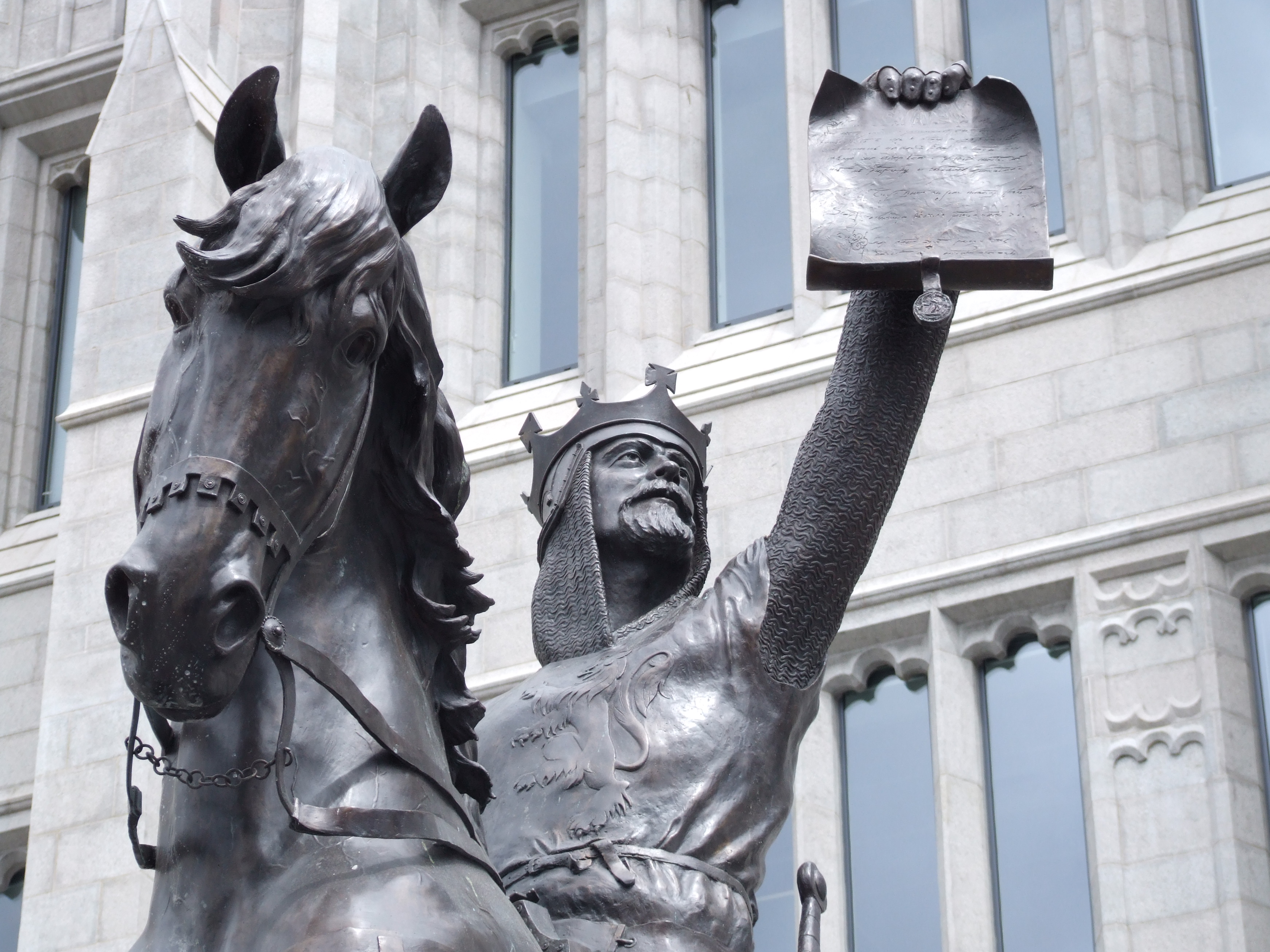
Throughout the 20th century, Marischal College housed the university's sciences and medicine. But as departments migrated to King's College and the Foresterhill medical campus, the building gradually emptied. By the early 2000s, much of it stood derelict. Proposals for reuse came and went. Then, in 2006, Aberdeen City Council announced it would lease the building for 175 years in exchange for 4.7 million pounds, renovating it as new administrative headquarters. The restoration was completed on schedule and under budget, and the building opened to the public in June 2011. A statue of Robert the Bruce now stands before the entrance, and a modern dancing fountain plays in the courtyard.
What the Granite Remembers
The Mitchell Hall, with its large stained-glass window by Thomas Ralph Spence depicting the university's history, remains in university hands for graduations and concerts. Greyfriars Church, built in 1532 and once incorporated into the college, was demolished to make way for Mackenzie's facade, though a replacement church was built into the frontage -- its southern tower crowned with a distinctive spire. The list of Marischal College alumni reads like a catalogue of Scottish intellectual achievement: Robert Brown, discoverer of Brownian motion; Alexander Ogston, who identified Staphylococcus aureus; James Gregory, the mathematician and astronomer; Robert Davidson, inventor of the first electric locomotive in 1837. The poet John Betjeman praised the building after visiting in 1947. Granite, it turns out, is an excellent material for preserving ambition.
From the Air
Located at 57.15N, 2.10W in central Aberdeen on Broad Street. The imposing granite facade with its twin towers and pinnacles is one of the largest single structures visible from the air in the city centre. Nearest airport: Aberdeen (EGPD), approximately 5 miles northwest.