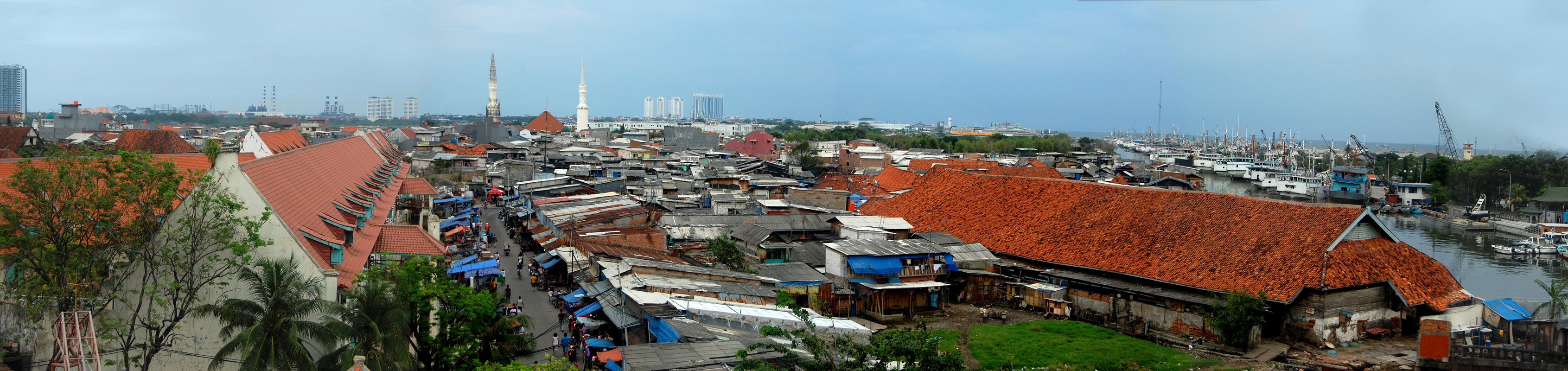
Where Spice Met Sea: Jakarta's Maritime Museum
The smell of old timber and salt air still clings to the thick stone walls of Jakarta's Maritime Museum, and for good reason. These warehouses were built to hold the most valuable cargo on Earth. Beginning in 1652, the Dutch East India Company -- the VOC, the world's first multinational corporation -- stacked nutmeg, pepper, coffee, tea, and cloth in these cavernous rooms before shipping them across the globe. The warehouses stand where the Ciliwung River empties into the Java Sea at Sunda Kelapa, a harbor whose name predates European contact by centuries. Today the spices are gone, replaced by ship models and maritime artifacts. But the building itself remains the most powerful exhibit: a monument to the era when control of these waters meant control of the world's economy.
Warehouses of Empire
The museum occupies three of four building units that make up the Westzijdsche Pakhuizen -- the "warehouses of the west bank" -- constructed between 1652 and 1771 beside the mouth of the Ciliwung River. Across the water once stood the Oostzijdsche Pakhuizen, the east bank warehouses. Together they formed a vast storage complex at the heart of the VOC's commercial network in Batavia. Different dates carved into stones above doorways mark the years of repairs, extensions, and additions, each layer of masonry recording a chapter in the Company's evolution. Some warehouses were rebuilt at the end of the 17th century to widen the gap between the structures and the city wall, creating room for the expanding colonial enterprise. During the Japanese occupation of the Dutch East Indies, the warehouses took on a new function as logistics storage for the Japanese army -- a use that would have been unimaginable to the VOC merchants who first raised these walls.
The Last Sailing Fleets
Among the museum's most remarkable exhibits are the Pinisi schooners of the Bugis people from South Sulawesi. These two-masted wooden sailing vessels represent one of the last sea-going sailing fleets in the world, a living tradition that stretches back centuries before the Dutch arrived. The Bugis were already legendary seafarers when the VOC was establishing its warehouses -- feared as pirates by some, respected as traders by others, and unmatched in their ability to navigate the vast Indonesian archipelago by wind alone. The museum also houses models of Lancang and Gelati traditional vessels, each reflecting the maritime ingenuity of different island cultures. In a nation of more than 17,000 islands, the sea was never merely a boundary. It was a highway, a livelihood, and a defining element of identity.
Carved in Temple Stone
Perhaps the most evocative artifact in the collection is a model of a Majapahit ship from ancient Java, reconstructed from bas-reliefs carved into Borobudur temple in the 8th and 9th centuries. Long before European navigators rounded the Cape of Good Hope, Javanese and Sumatran sailors were crossing the Indian Ocean in outrigger vessels, reaching Madagascar and the East African coast. The Borobudur ship carvings prove that these were not dugout canoes -- they were substantial vessels with outriggers, multiple masts, and room for cargo and crew. Alongside these ancient echoes, the museum displays Dutch East India Company ship models and cannons, as well as a scale model of Onrust Island, the offshore shipyard where VOC vessels came for repair. The juxtaposition is striking: Indonesian maritime traditions predate Dutch colonialism by at least a millennium.
Fire and Resilience
On January 16, 2018, fire swept through the museum. An electrical short circuit ignited the centuries-old structure, and flames consumed much of the building and its contents before firefighters could respond. The goods inside were evacuated after the fire, not before it -- a painful reminder of how quickly irreplaceable artifacts can be lost. The blaze drew international attention, with Reuters and Sky News covering the destruction of the 17th-century heritage building. The irony was not lost on Indonesians: their government had declared the country a "maritime axis" -- a poros maritim -- yet the museum dedicated to that maritime heritage was burning. Restoration efforts have since worked to repair the damage, but some collections were lost forever, leaving gaps in a story that spans centuries of Indonesian seafaring.
The Old Town Quarter
The Maritime Museum sits within Jakarta Old Town, the historic heart of what was once Batavia, the capital of the Dutch East Indies. Walking distance connects it to a constellation of heritage sites: the Jakarta History Museum in the former city hall, the Wayang Museum with its puppet collections, Fatahillah Square where colonial justice was administered, and Sunda Kelapa harbor itself, where wooden Pinisi schooners still dock alongside modern freighters. The neighborhood is a palimpsest of colonial and Indonesian history, its Dutch-era facades sheltering Indonesian businesses and street vendors. Sunda Kelapa has been a trading port since at least the 12th century, when it served the Hindu kingdom of Sunda. The Portuguese came in the 16th century, then the Dutch, then the Japanese, then independence. Through every transition, the harbor kept working. The museum, housed in buildings that have stored spices, military supplies, and now memories, captures that continuity.
From the Air
Located at 6.13S, 106.81E in Jakarta's northern waterfront. Sunda Kelapa harbor is identifiable from the air by the cluster of wooden sailing vessels at its docks. Nearest airport is Soekarno-Hatta International (WIII/CGK), approximately 20 km to the northwest. Halim Perdanakusuma (WIHH/HLP) lies about 15 km to the southeast. Best viewed at lower altitudes where the contrast between Old Town's colonial rooflines and the modern city skyline is visible.