Maritime Museum of San Diego
Star of India has been sailing for over 160 years. Built in 1863 at a shipyard on the Isle of Man, this iron-hulled barque has circled the globe, carried emigrants to New Zealand, hauled cargo to India, and crossed the Pacific countless times. Today she floats at the heart of the Maritime Museum of San Diego, the oldest ship still sailing regularly and the cornerstone of one of America's most remarkable collections of historic vessels.
A Fleet Anchored in Time
Since 1948, the Maritime Museum has gathered ships along San Diego's Embarcadero, creating a floating timeline of maritime history. The collection spans over a century and a half of naval architecture. Beside Star of India floats Berkeley, an 1898 ferryboat from San Francisco Bay that now houses the museum's MacMullen Library and Research Archives. The steam yacht Medea, built in 1904, served in both World Wars before finding her final berth here. Pilot, a 1914 harbor pilot boat, represents the smaller vessels essential to port operations. USS Dolphin, a diesel-electric submarine launched in 1968 and decommissioned in 2007, allows visitors to experience the cramped reality of undersea service. Together, these vessels create an experience no building-based museum could match: the creak of timbers, the smell of salt and tar, the deck rolling gently underfoot.
Replicas That Bring History to Life
Alongside its historic originals, the museum maintains several working replicas that make the past tangible. HMS Surprise, originally built in 1970 as HMS Rose, gained fame as Captain Jack Aubrey's command in Master and Commander: The Far Side of the World. The schooner Californian, built in 1984 as a replica of an 1847 revenue cutter, serves as California's official tall ship. America recreates the legendary yacht that won the trophy that became the America's Cup in 1851. The museum's most ambitious project, San Salvador, was constructed in full public view at Spanish Landing Park starting in 2011. This replica of Juan Rodriguez Cabrillo's flagship recreates the vessel that became the first European ship to enter San Diego Bay in 1542. Launched in 2015 and opened for tours in 2016, San Salvador represents both a connection to San Diego's origins and a demonstration of traditional shipbuilding techniques.
Where Research Meets the Tide
The Maritime Museum is more than a collection of floating artifacts. Its quarterly peer-reviewed journal, Mains'l Haul: A Journal of Pacific Maritime History, contributes to scholarship on the region's seafaring heritage. The MacMullen Library and Research Archives aboard Berkeley preserve documents, photographs, and records that chronicle the Pacific coast's maritime development. Behind the ferryboat, a railroad barge that visitors often mistake for a floating dock conceals workshops and storerooms where the museum maintains its collection. The ongoing work of preservation is itself part of the experience: visitors might see craftsmen replanking a deck, repairing rigging, or applying traditional finishes to century-old woodwork.
A Rising Tide Lifts All Ships
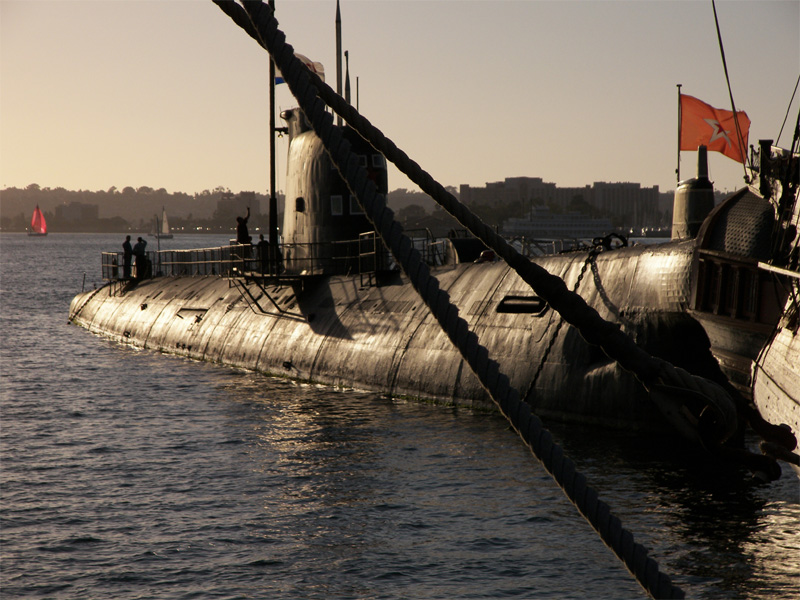
When the USS Midway Aircraft Carrier Museum opened nearby, some worried it would compete with the Maritime Museum for visitors. Instead, the opposite occurred: visitation to the Maritime Museum increased. The two institutions, though independently operated, create a critical mass of maritime heritage that draws visitors from around the world. San Diego Bay has become a destination for those who want to understand how ships shaped the American West, from Spanish exploration to Cold War submarine patrols. The museum's collection continues to evolve. The Soviet Foxtrot-class submarine B-39 spent fifteen years as a visitor attraction before being towed to a scrapyard in Ensenada in February 2022. Ships come and go, as they always have in a working harbor. What remains constant is the mission: to preserve these vessels and the stories they carry, keeping alive the memory of those who built, sailed, and fought aboard them.
From the Air
Located at 32.72N, 117.17W along San Diego's Embarcadero. The museum's tall ships with their masts and rigging are visible from the air, particularly Star of India's distinctive iron hull. San Diego International Airport (KSAN) lies approximately 1 nm to the northwest. The USS Midway is visible nearby as a massive aircraft carrier. Best viewed at lower altitudes when approaching from over the bay.