Maritime Research Institute Netherlands
Tucked into the green flatlands of Wageningen, 65 kilometres from the nearest sea, sits one of the largest indoor oceans in the world. Wave generators line its sides. Wind machines hang above. A 252-metre tank stretches off in another direction, long enough that the curvature of measurement begins to matter. This is MARIN - the Maritime Research Institute Netherlands - and almost every commercial ship built today has a relative here: a precisely scaled model, towed and tortured and measured, so that the full-size hull will behave in real water the way it did in this artificial one.
A Country That Floats for a Living
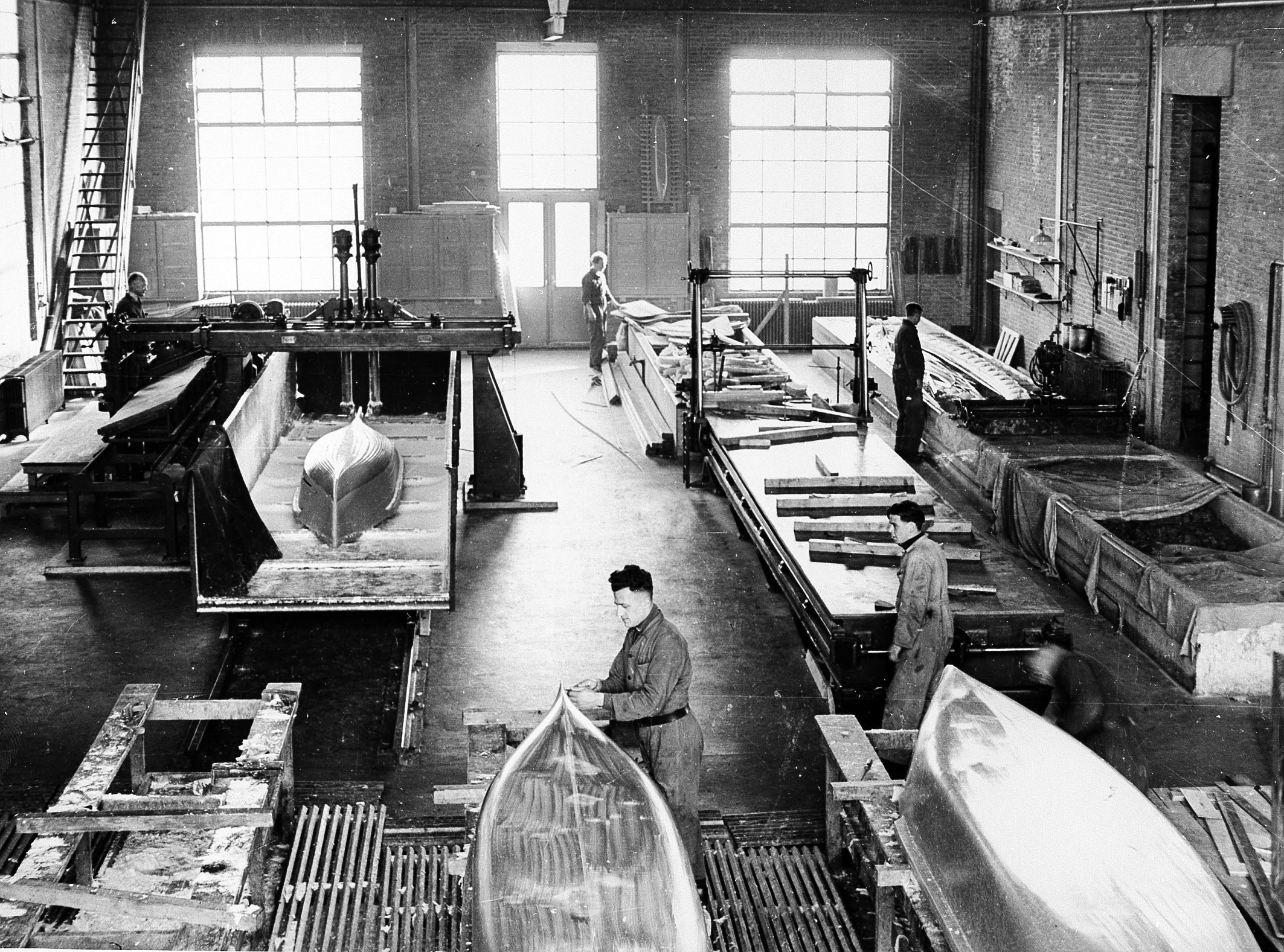
The story begins in 1873, when Bruno Tideman - a senior engineer in the Royal Netherlands Navy - ran the first ship-model resistance tests in the country, using a scaled-down version of the cruiser Atjeh to predict how much engine power the real thing would need. Tideman was solving a practical Dutch problem: a nation whose entire identity rested on ships could not keep guessing how those ships would perform. It took another half-century for the idea to become a building. After the 1922 economic depression and the recovery that followed, four major Dutch shipping lines pooled half the foundation costs and the Dutch government covered the rest. On 9 May 1932 the NSP - Dutch Shipbuilding Testing Facility Foundation - opened its single towing tank in Wageningen with no permanent staff. Within a year it was making money.
The Tanks Get Stranger
Once the demand existed, the facilities multiplied. By 1938 the place needed new offices for its 36 employees. In 1941, with the country under German occupation, a large cavitation tunnel was built specifically to study what happens to a ship's propeller when the water around it boils into vapour bubbles - the noisy, destructive phenomenon called cavitation. By 1952 the original tank had been extended to 252 metres. Then came the Seakeeping Basin (1956) for studying behaviour in waves. The Shallow Water Basin (1958) for tugs and inland barges. The High Speed Basin (1965) for hulls and appendages moving very fast. The Wave and Current Basin (1965) where wind, current and waves could all be simulated together, for oil platforms and dredgers facing complex sea states. By the 1970s a Maneuvering Simulator had joined them, then a Vacuum Tank at Ede in 1972 for propeller cavitation experiments at reduced pressure - mimicking deep submergence.
How You Make a Real Ocean Indoors
The trick of model testing is scaling. A model at 1:50 is 50 times smaller than the real ship, but the water is the same water and gravity is the same gravity. The waves, the resistance, the way water flows around a bow - all of these scale differently. A century of careful work has built the mathematics that lets engineers measure a small model and predict the behaviour of a 400-metre container ship. MARIN's Depressurized Wave Basin - the old Vacuum Tank, given flap-type wave makers on two sides in 2012 - can lower its air pressure so that scaled cavitation actually occurs on a scaled propeller. Few facilities in the world can do this. It is the difference between guessing and knowing whether a new propeller design will quietly hum or chew itself to pieces.
A Quiet Dutch Monopoly
Today MARIN has roughly 450 employees from forty countries, nine major test facilities, and a portfolio of simulators. Over 85% of its turnover comes from commercial projects: naval architects, shipbuilders, classification societies, oil and LNG companies, navies. The remaining 15% is fundamental research, the long-horizon work that keeps the rest possible. The head office is still in Wageningen. There are smaller offices in Ede, Houston, and Annapolis on the Chesapeake. Partnerships extend into Brazil, Singapore, and a joint venture with the Shanghai Ship and Shipping Research Institute. When something new is about to take to the sea - a wind-farm installation vessel, an Arctic LNG carrier, an autonomous container ship - there is a reasonable chance a small painted model of it has already had a very interesting day in Wageningen.
Why Wageningen, of All Places
It is worth standing back and noticing the oddity of the geography. The Maritime Research Institute Netherlands is in a town of 40,000 people, in the middle of orchard country, deep inland. The nearest open sea is a long drive away. But Wageningen is a university town, and in the early twentieth century the Dutch shipping industry chose a quiet inland site precisely because it offered the calm, controlled, vibration-free conditions that precision hydrodynamic measurement needs. The same logic that put VTS simulators here in 1986 - training Vessel Traffic Service operators to manage real harbours from a synthetic one - applies to the basins themselves. The North Sea is twenty minutes away by helicopter. But the model of the North Sea, the one engineers can actually adjust and watch, is here in the polder.
From the Air
MARIN's main campus sits at 51.97 N, 5.66 E in Wageningen, on the western edge of the city near the Wageningse Berg. The complex of low industrial buildings hides the enormous tanks - they read as roof lines from above. The Rhine runs about 2 km south. Nearest airport is Schiphol (EHAM) 75 km west; Eindhoven (EHEH) 60 km south.