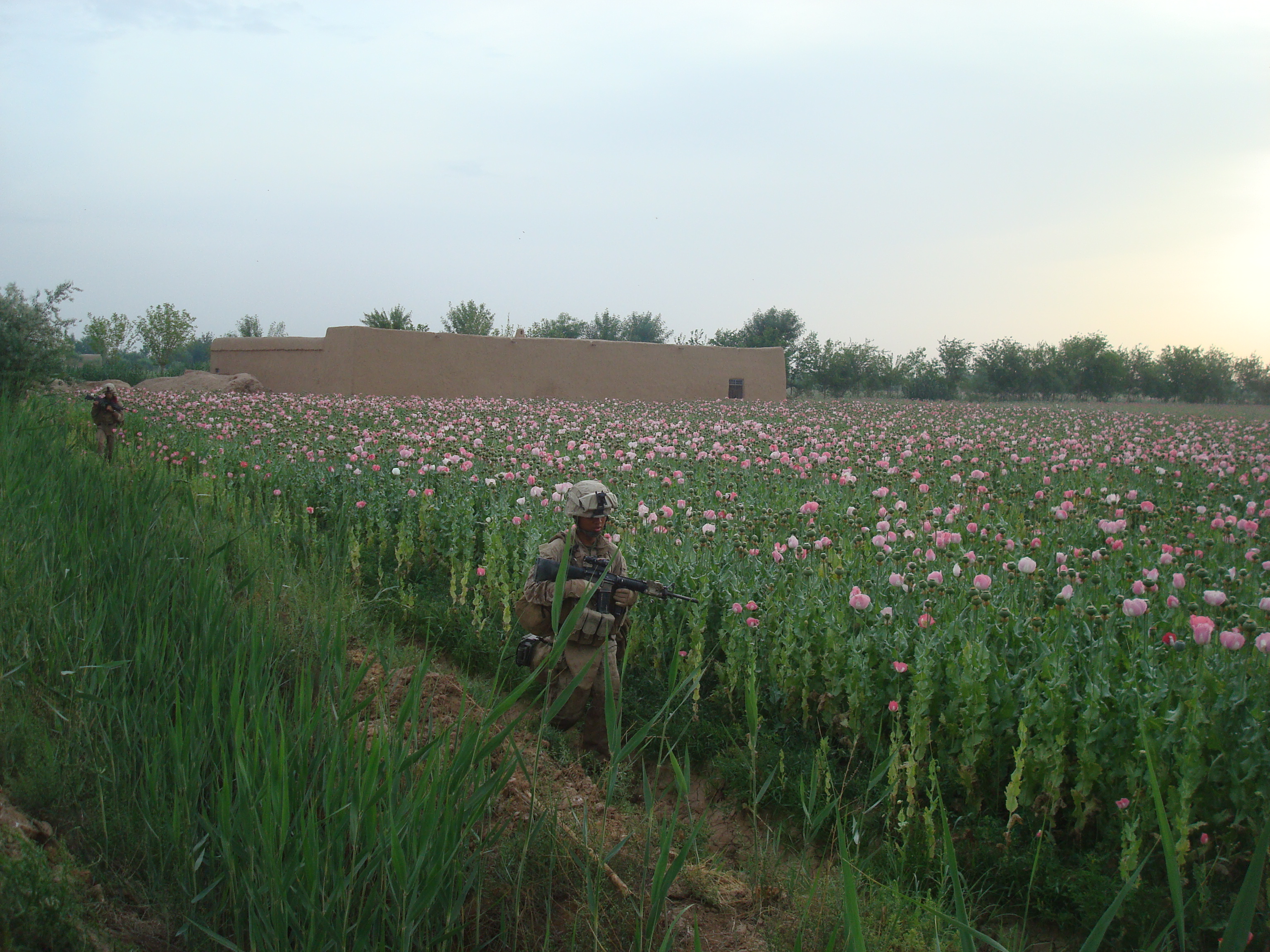
Marjah
Helmand Province once had an American nickname. In the 1950s and 1960s, engineers from the United States funded a vast irrigation scheme through the Helmand and Arghandab Valley Authority, digging canals across the desert to turn barren ground into farmland. The locals called the provincial capital Lashkar Gah "Little America." Marjah, a cluster of villages southwest of that capital, was one of the project's beneficiaries -- its fields crisscrossed with canals that remain to this day. What those canals irrigated, however, changed with the times. By 2000, an estimated ten percent of the world's illicit opium originated from the Marjah and Nad-i-Ali area. American engineering had, through decades of war and neglect, helped create the funding engine of the very insurgency American soldiers would later be sent to destroy.
Little America's Long Shadow
The Helmand and Arghandab Valley Authority was a Cold War prestige project, meant to demonstrate that American development could outperform Soviet influence in Central Asia. Engineers built dams, dug irrigation channels, and transformed desert into arable land across Helmand Province. Marjah's network of canals dates from this era, engineered to carry water from the Helmand River to fields that had never grown anything. For a time it worked. Afghan farmers cultivated wheat, cotton, and vegetables in an area larger than Cleveland or Washington, D.C. But the Soviet invasion of 1979, the civil wars that followed, and the Taliban's rise destroyed the institutional framework that kept the irrigation system functional. Without governance, the canals kept flowing -- and farmers discovered that poppy, which requires less maintenance and generates far more revenue, thrived in the irrigated soil. The infrastructure America built became the plumbing for Afghanistan's opium economy.
A Town That Might Not Be a Town
Marjah's very nature is disputed. Western military planners described it as a city of 80,000 to 125,000 people, large enough to justify the biggest offensive of the Afghan War. Journalists who visited found something different: a sprawl of farming compounds and small villages spread across 80 to 125 square kilometers, connected by dirt roads and irrigation ditches rather than city blocks. One reporter called it "a cluster of villages" and "a community of 60,000 persons." The distinction mattered enormously. The narrative of liberating a major city from Taliban control played differently in Washington than the reality of clearing an agricultural district where the insurgency and the population were deeply intertwined. There was no town square to hoist a flag over, no city hall to recapture. Marjah was farmland, and the people working that farmland had their own calculations about who to support and when.
The Battle That Defined the Surge
In February 2010, Operation Moshtarak brought 15,000 coalition and Afghan troops to Marjah in what ISAF commanders called the largest joint operation of the war. The Taliban had controlled the area for years, taxing the opium trade and running a shadow government. The assault was announced in advance -- a deliberate choice under General McChrystal's doctrine of minimizing civilian casualties -- and the Taliban, forewarned, mined the fields and prepared ambush positions along the canal networks. Marines from the 6th Marine Regiment, British soldiers from the Royal Welsh, and Afghan commandos fought through some of the most heavily booby-trapped terrain NATO had ever encountered. Assault Breacher Vehicles -- 72-ton machines designed to plow through minefields -- led the way. The military phase succeeded within days. Holding Marjah politically proved far harder. The promised "government in a box" never materialized, and the Taliban, many of whom had simply hidden their weapons and blended into the population, reasserted control through targeted killings.
Heat, Dust, and Seasons
Marjah's climate shapes everything. Summer temperatures routinely exceed 100 degrees Fahrenheit from June through August, while winter brings the area's only meaningful rainfall -- about an inch per month from December through March, peaking at 2.46 inches in January. The rest of the year sees almost no precipitation, and evaporation outpaces any moisture the ground retains. For soldiers, this meant fighting in body armor through heat that caused casualties on its own. For farmers, it meant total dependence on the canal system. Poppy grows during the cooler, wetter months, with harvesting in late spring -- a cycle that put the opium economy on a seasonal clock. Military planners learned to factor in the poppy calendar: operations during harvest season risked destroying the crop that farmers depended on for income, turning potential allies into enemies overnight.
What the Canals Remember
Marjah today bears the marks of every force that has tried to reshape it. The American-built canals still carry water through the district, engineering that has outlasted every government since the 1960s. The fields still produce poppy alongside legitimate crops, a dual economy that no military operation or development program has managed to untangle. The compounds and villages still sprawl across the flat terrain, defying the Western desire for a neat boundary between town and countryside, combatant and civilian. After coalition forces left and the Taliban reclaimed control of Helmand, Marjah returned to the kind of quiet that outsiders mistake for peace. The canals flow. The poppies bloom in spring. The dust settles after each convoy, each airstrike, each promise of transformation. Marjah endures, indifferent to the ambitions of its would-be liberators.
From the Air
Coordinates: 31.52N, 64.12E in Nad Ali District, Helmand Province, southern Afghanistan. Marjah sits on flat irrigated farmland southwest of Lashkar Gah, the provincial capital. From 8,000-12,000 ft AGL, the grid pattern of American-built irrigation canals is clearly visible, distinguishing the cultivated zone from surrounding desert. Camp Bastion/Shorabak (OABT) lies approximately 50 nm northwest. Kandahar Airfield (OAKN) is roughly 100 nm east. Terrain is flat with minimal elevation changes. Clear visibility most of the year, with dust storms possible in summer months when temperatures exceed 100F.