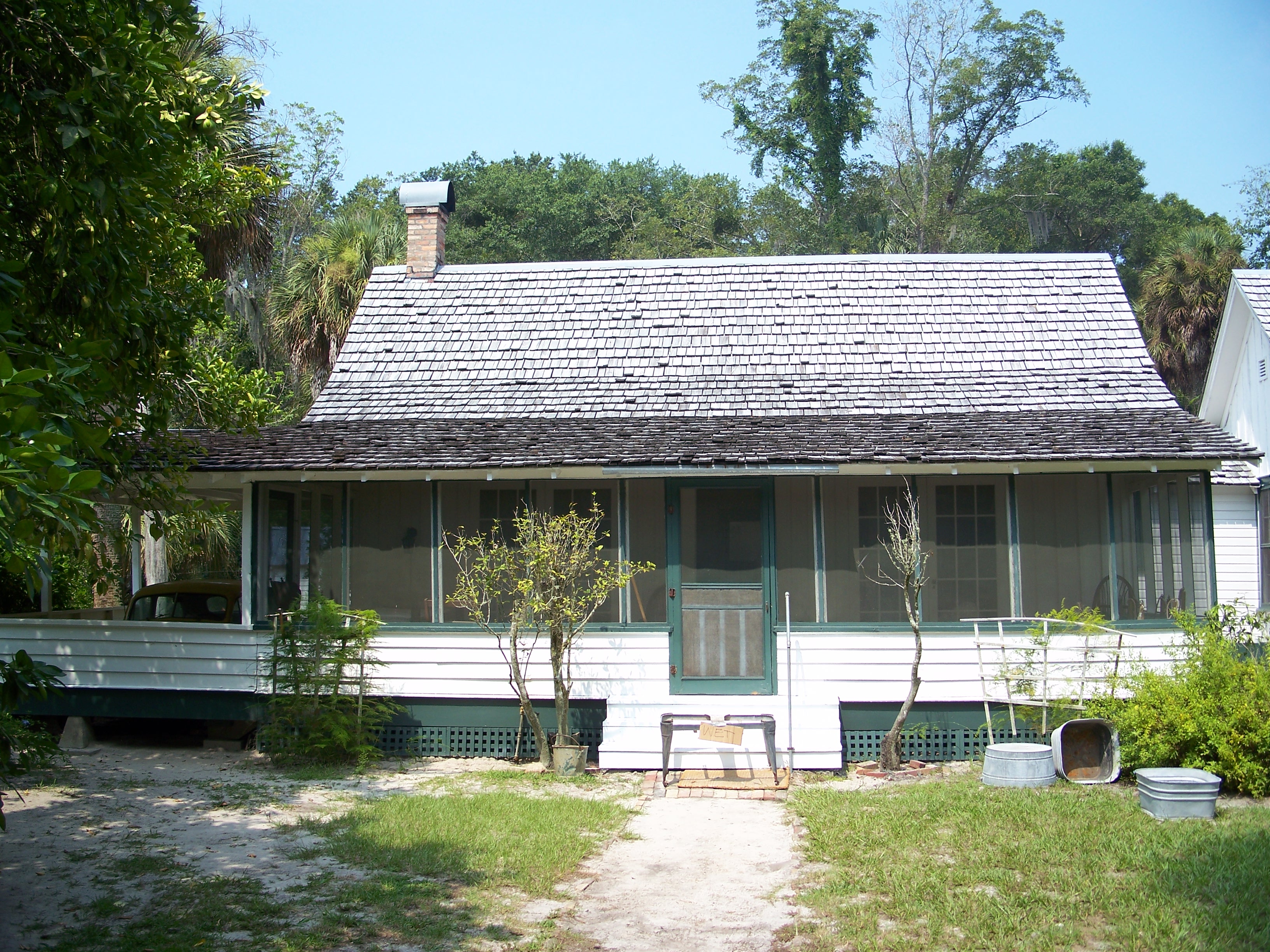
Marjorie Kinnan Rawlings Historic State Park
In 1928, a restless writer from Washington, D.C. drove south into the Florida interior, past the tourist beaches and resort towns, until the paved roads gave out and the live oaks closed overhead. Marjorie Kinnan Rawlings found what she was looking for in Cross Creek, a hamlet so small it barely existed on maps, wedged between two lakes in Alachua County. She and her husband Charles bought a 72-acre orange grove with a rambling dogtrot house at its center, and Marjorie set about transforming both the property and herself. Within a decade, she would win the Pulitzer Prize. The farmstead where she did it still stands, preserved almost exactly as she left it.
The Cracker House on Orange Lake
The heart of the homestead is a single-story wood-frame house built around a 19th-century dogtrot core, that classic Florida vernacular design where a covered breezeway splits the structure in two, funneling whatever wind exists through the living quarters. Rawlings and her husband enlarged it over the years, adding rooms and a screened porch where she wrote by kerosene lamp. A pump house, barn, and small tenant house cluster nearby under the citrus canopy. The property sits on the eastern shore of Orange Lake, surrounded by the hammock and scrubland that would fill her fiction with such vivid particularity. Today, park employees in period clothing guide visitors through the rooms and invite them to pick oranges straight from the trees that once sustained the grove.
Writing the Scrub Into Literature
Rawlings published her first stories about rural Florida life in Scribner's Magazine, drawing immediate attention for the way she captured the dialect, rhythms, and hardship of the Cracker communities around her. She divorced Charles Rawlings in 1933 but stayed on at Cross Creek through the Depression, deepening her connection to the landscape. In 1938, she published The Yearling, the story of a boy and his pet fawn in Florida's scrub country, and it won the Pulitzer Prize for Fiction in 1939. In 1942, she published Cross Creek, an autobiographical account of life among her neighbors and the Florida hammocks. The Book of the Month Club selected it, and an armed services edition was printed and sent to soldiers during World War II. Her writing drew its power from the specific textures of this place: the heat, the mosquitoes, the orange blossoms, the way light fell through Spanish moss.
A Legacy Rooted in Place
Rawlings married Norton Baskin in 1941 and began splitting her time between Cross Creek and St. Augustine, but she kept returning to the farmstead to write until her death in 1953 at age 57. She bequeathed the property to a foundation of the University of Florida, and the state has managed it ever since. The house opened to the public in 1970 and was designated a National Historic Landmark in 2007, the nation's highest recognition for a historic property. Visitors today walk the same grounds, peer into the same kitchen, and stand on the same porch where Rawlings sat with her typewriter, translating the world just beyond the screen door into prose that endures.
Cross Creek Today
The park occupies a small but evocative footprint on the shore of Orange Lake, with adjacent public lands that were historically part of the Rawlings property. Two short hiking trails wind through the hammock, and a boat ramp provides access to the lake. Guided tours of the house run Thursday through Sunday, with the exception of August and September, when the Florida heat mirrors the conditions Rawlings herself endured. The Cross Creek community around the park remains barely a village, much as it was when Rawlings arrived nearly a century ago. The isolation that drew her here, the sense of being surrounded by landscape rather than civilization, is still palpable.
From the Air
Marjorie Kinnan Rawlings Historic State Park is located in Cross Creek, Florida, at 29.481N, 82.160W, on the eastern shore of Orange Lake between Ocala and Gainesville. From the air, look for the distinctive oval shape of Orange Lake with the small homestead visible on its eastern bank. The park is along South County Road 325. Nearest airports: Gainesville Regional (KGNV), approximately 15nm to the northeast, and Ocala International (KOCF), approximately 20nm to the northwest. Best viewed at 1,500-2,500 feet AGL.
Sources
- Marjorie Kinnan Rawlings Historic State Park
- Marjorie Kinnan Rawlings Historic State Park | Florida State Parks
- Marjorie Kinnan Rawlings - Wikipedia
- Rawlings, Marjorie Kinnan (1896-1953) - Encyclopedia.com
- Florida State Parks - Marjorie Kinnan Rawlings Historic State Park
- Friends of the Marjorie Kinnan Rawlings Farm - History