Mark Hopkins Hotel
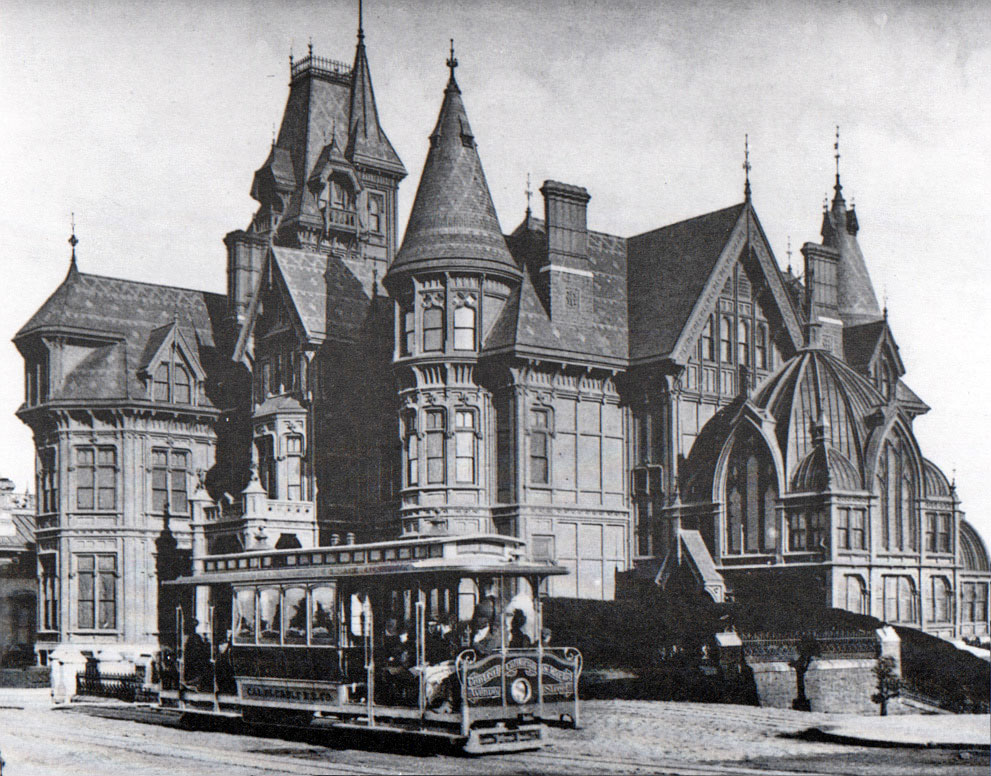
The site has been the highest point on Nob Hill since before there was a hotel, since before there was a mansion, since Eadweard Muybridge climbed to its summit in 1877 to shoot his famous panoramic photograph of San Francisco. Mark Hopkins, one of the four founders of the Central Pacific Railroad, chose this spot for a dream home for his wife Mary. He died before it was completed in 1878. The mansion survived the 1906 earthquake but burned in the three-day fire that followed. On its ashes rose a 19-story hotel that has been dispensing cocktails and heartbreak ever since.
From Mansion to Museum to Rubble
Mark Hopkins never lived in his mansion. Mary Sherwood Hopkins did, until her death in 1891, when she left the property and a $70 million estate to her second husband, Edward Francis Searles. In 1893, Searles donated the building and grounds to the San Francisco Art Association, which renamed it the Mark Hopkins Institute of Art and used it as a school and museum, valued at $600,000. For thirteen years, art students worked where railroad money had built a palace. Then April 18, 1906, arrived. The mansion withstood the earthquake itself but could not survive the inferno that swept across the city for three days afterward. The Art Association's collections were destroyed along with the building.
A Hotel Takes the Summit
Mining engineer and hotel investor George D. Smith purchased the Nob Hill site, cleared the ruins, and commissioned the San Francisco firm Weeks and Day to design a luxury hotel. The result combined French chateau detailing with Spanish ornamentation across 19 stories. The Hotel Mark Hopkins opened on December 4, 1926. One of its banquet areas, the Room of the Dons, contains nine seven-foot panels painted by Maynard Dixon and Frank Van Sloun for the hotel's opening. One panel depicts Queen Calafia and her Amazons against a gold-leaf sky, referencing the mythological origin of California's name. The hotel has changed hands repeatedly: sold to Kratter Corp in 1961 for over $10 million, resold to Louis Lurie for $12 million, leased by Gene Autry, then Loew's Hotels, and finally purchased by Woodridge Capital Partners and Oaktree Capital Management for $120 million in 2014.
The Top of the Mark
In 1939, the 19th-floor penthouse was converted into a glass-walled cocktail lounge called the Top of the Mark. The timing was accidental genius. When World War II began, the Top of the Mark became the place where Pacific-bound servicemen and their sweethearts met for what might be a last drink together before deployment. The views from the lounge encompassed the bay, the bridges, and the ocean that would carry them to war. The emotional weight of those wartime farewells became part of the hotel's identity, the kind of history that no amount of renovation can erase. The lounge remains one of San Francisco's most famous rooftop bars, a place where the city's geography and its emotional geography overlap.
Still the Summit
The Mark Hopkins is the oldest InterContinental hotel in the United States and a member of Historic Hotels of America. It is also a San Francisco Designated Landmark. From its perch on Nob Hill, it has watched the city transform beneath it through depression, war, social upheaval, and technology booms. The view from the top floor has not changed much since Muybridge climbed the same hill with his camera in 1877. The cable cars still climb past the entrance. The fog still rolls through the Golden Gate. The difference is that now, instead of a railroad baron's parlor, there is a cocktail lounge with a bartender who knows how to make a martini that honors both the occasion and the altitude.
From the Air
Located at 37.79°N, 122.41°W atop Nob Hill, one of San Francisco's most prominent hilltops. The 19-story hotel is visible as part of the Nob Hill hotel cluster including the Fairmont. Nearest airports: SFO (KSFO, 11 nm south), Oakland (KOAK, 10 nm east). Nob Hill is identifiable from altitude by its concentration of large hotel buildings at the city's geographic center.