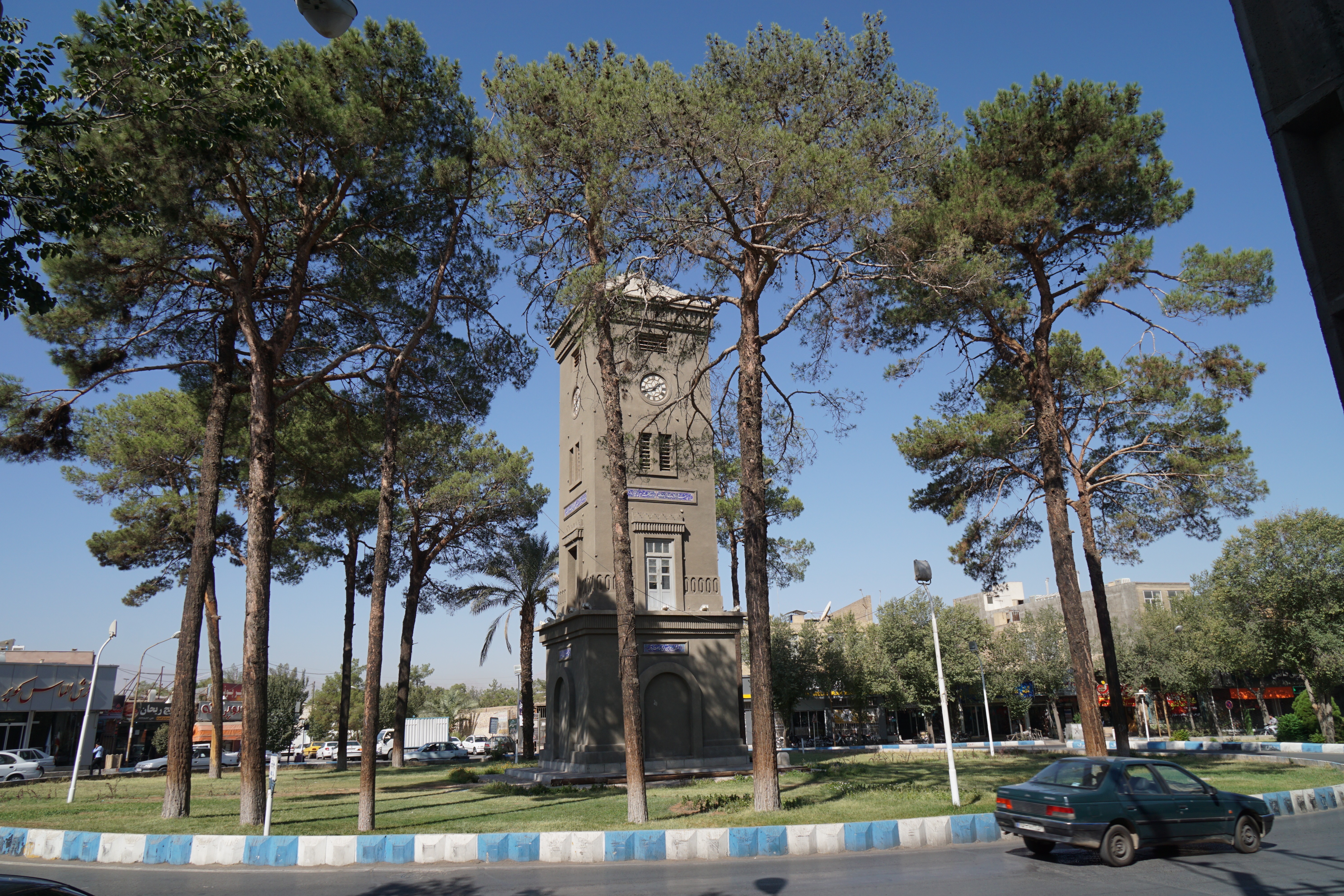
Markar Clock Tower
The last line of poetry carved into the Markar Clock Tower reads: "I am happy from the good deeds of Markar." It sounds like a simple dedication. But the line is also a mathematical puzzle. Each Persian letter carries a numerical value in the Abjad system, and when you add them up -- shin (300) plus alef (1) plus dal (4), and so on through every character -- the total comes to exactly 1320, the year of the tower's construction in the Solar Hijri calendar. The phrase "good deeds" is itself a Zoroastrian maxim. In twenty syllables, the poet Naser encoded a date, a faith, and a thank-you note. The tower is only four meters tall. It says more than buildings ten times its size.
The Dead Center of a Country
The Markar Clock Tower stands at what is considered the geographic center of Iran. Yazd occupies this position by virtue of geometry and history both -- the city sits almost equidistant from Iran's borders, on a plateau between the Dasht-e Kavir and Dasht-e Lut deserts. The tower itself is modest: roughly four meters high, square in plan, topped with a small pyramid that gives it the look of an obelisk. Four clock faces mark the cardinal directions. The clockwork mechanism inside was manufactured in London by J. Smith and Sons, its spring wound by hand each week. It is the kind of civic monument that larger cities would overlook entirely, but in Yazd's compact old city, the Markar Clock Plaza anchors the neighborhood like a town square.
A Gift Across Oceans
Pashutanji Marker was a Zoroastrian of Persian descent living in India, a merchant and philanthropist devoted to the welfare of Iranian Zoroastrians. He funded not just the clock tower but an entire complex: the Markarabad school, gardens, and the plaza that bears his name. Construction of the tower was completed on October 26, 1942. The broader Markar Complex, which opened in 1934, became an anchor for Yazd's Zoroastrian community -- educational facilities, cultural institutions, and public spaces funded by diaspora money flowing back to the ancestral homeland. Mirza Soroush obtained permission for and supervised the construction of the plaza and its surrounding gardens, situated on the road to Kerman just north of the Markarabad school entrance. The pattern was familiar: Parsi Zoroastrians in India repeatedly sent resources back to Iran to support a community that had endured centuries of marginalization.
Poetry on Every Face
Poems by a local poet named Naser wrap around all four sides of the tower, arranged in two lines meant to be read clockwise. The upper line honors Ferdowsi, the epic poet whose Shahnameh preserved pre-Islamic Persian identity in verse. The lower line celebrates the tower's benefactor. This pairing is deliberate. Ferdowsi, who spent decades writing the Persian national epic in defiance of Arabic literary dominance, and Marker, who spent his wealth sustaining Zoroastrian heritage in an Islamic republic -- both men devoted themselves to keeping something alive that others might have let fade. The poetry turns a clock tower into a monument to cultural persistence.
Yazd's Quiet Intersection
Today the Markar Complex includes a museum of Zoroastrian history and culture, sitting alongside the school and the tower in a city where Zoroastrian and Islamic architecture share the skyline. Yazd is one of the few places in Iran where this coexistence remains visible. Fire temples and mosques occupy the same neighborhoods. The Markar Clock Tower, with its London-made mechanism and its Persian poetry and its Zoroastrian funding, embodies a particular kind of cosmopolitanism -- not the flashy internationalism of capital cities but the quiet interconnection of communities linked by faith and memory across continents. The clock still keeps time. The spring still needs winding every week. Someone in Yazd still does it, the way someone has always done the small, persistent work of keeping things going.
From the Air
Located at 31.88N, 54.37E in central Yazd, Iran, at the geographic center of the country. The tower itself is only 4 meters tall and not individually visible from altitude, but it sits within the distinctive mud-brick urban fabric of Yazd's historic center. Yazd Shahid Sadooghi Airport (OIYY) is approximately 7 km to the south. The city sits at roughly 1,230 meters elevation on the Iranian plateau, surrounded by desert terrain stretching to the horizon in every direction.