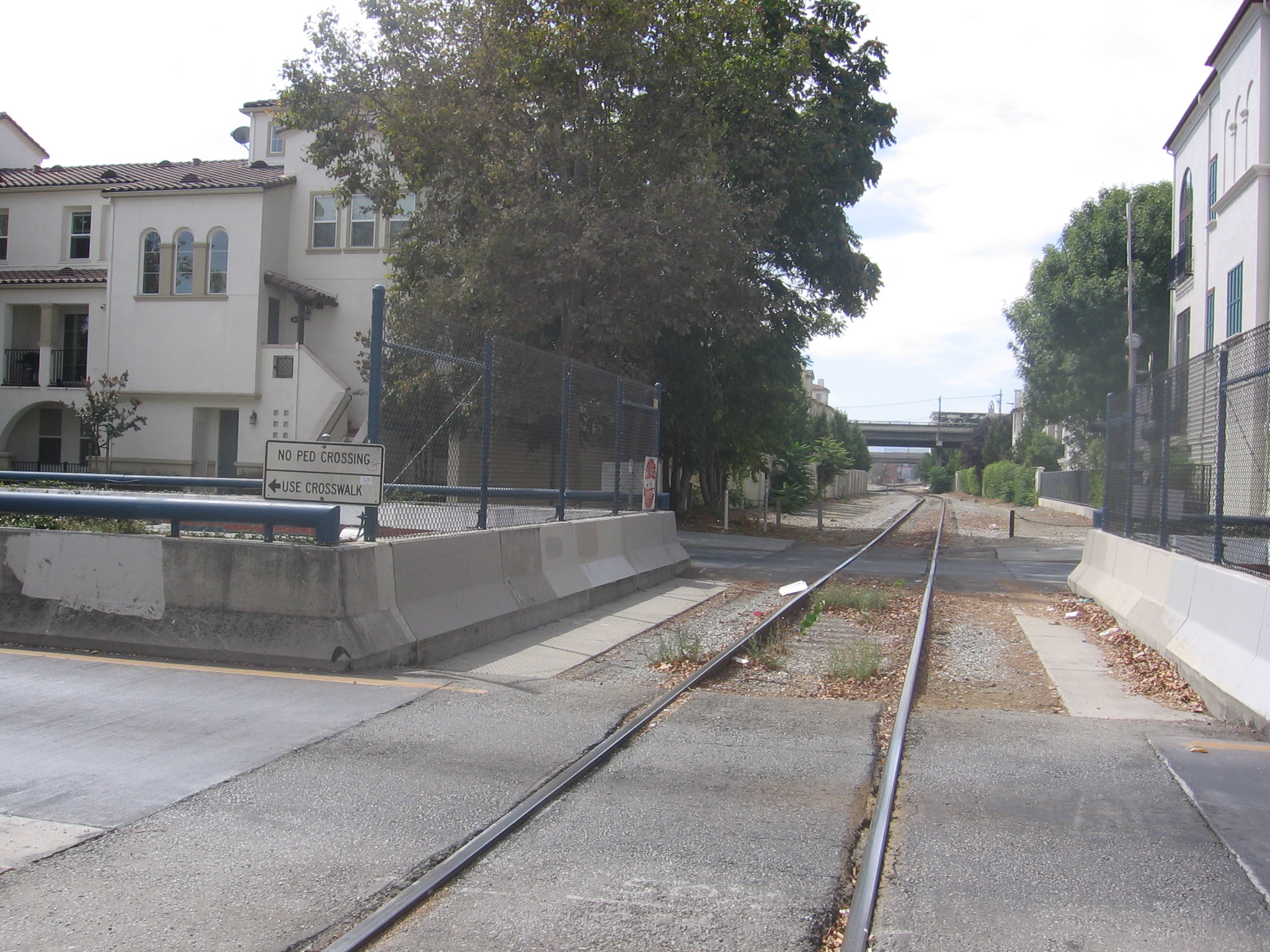
Market Street Depot
On January 16, 1864, the first train from San Francisco rolled into San Jose and changed the Santa Clara Valley forever. The Market Street Depot, standing at the corner of Market and Bassett Streets, became the gateway through which passengers, freight, and ambition flowed between the valley's orchards and the booming port city fifty miles to the north. For more than seventy years, this modest station anchored downtown San Jose's identity as a railroad town -- until the very progress it helped create conspired to make it obsolete.
End of the Line
The San Francisco and San Jose Railroad chose this spot as its southern terminus, and the depot that rose here served a dual purpose: welcoming passengers stepping off from San Francisco and handling the freight -- much of it agricultural -- that moved in both directions. The original facilities were functional rather than grand, built for a railroad still proving its worth. By 1883, a new station building replaced the first, accompanied by an extension of Market Street itself. The earlier end-of-line facilities were repurposed exclusively for freight, a role they would fill for another half-century. The railroad's integration into the Southern Pacific system brought the depot into a much larger network, connecting San Jose not just to San Francisco but eventually all the way down the Coast Line to Los Angeles.
When the Tracks Became the Problem
Success, it turned out, was the depot's undoing. The completion of the Coast Line to Los Angeles and the Bayshore Cutoff near San Francisco funneled dramatically more rail traffic straight through downtown San Jose in the early 1900s. Trains that had once terminated at Market Street now rumbled through on Fourth Street at all hours. Meanwhile, the automobile was remaking American cities, and San Jose was no exception. Rail crossings that had been minor inconveniences became serious bottlenecks as car traffic surged. The combination of more trains and more cars on the same streets created delays that the city could no longer tolerate. Something had to give, and it would not be the automobile.
The Move to Cahill Street
San Jose's solution was to reroute the railroad entirely. New trackage, extensive grade crossings, and a brand-new depot on Cahill Street replaced the aging Market Street facility. In December 1935, passenger operations shifted to the new station, and the tracks along Fourth Street were torn up. The Cahill Street depot would later be renamed Diridon Station, a name that persists today as one of the Bay Area's major transit hubs. The Market Street passenger buildings were demolished, though the freight depot lingered on into the mid-twentieth century before it too disappeared. Where trains once idled, apartments eventually rose.
Ghosts of the Rails
Today, almost nothing remains of the Market Street Depot above ground. The site sits near the VTA light rail underpass, an infrastructure feature built specifically to avoid the kind of street-level rail conflicts that doomed the original station. Mainline tracks still run beside the former depot site, a quiet echo of the route that first connected San Jose to the wider world. The transformation tells a broader story about the Santa Clara Valley itself: a landscape that shifted from agriculture to railroads to automobiles and, eventually, to the technology industry that now defines it. The depot's coordinates mark a spot where that long arc of change began, even if the building itself has vanished into memory.
From the Air
Located at 37.341N, 121.896W in downtown San Jose. The former depot site sits near the VTA light rail underpass and mainline railroad tracks, visible as the rail corridor running through the urban grid. Nearby airports include San Jose International (KSJC) approximately 2 nm to the northwest and Reid-Hillview Airport (KRHV) about 4 nm to the east. Best viewed at 2,000-3,000 feet AGL where the railroad right-of-way through downtown is clearly visible.