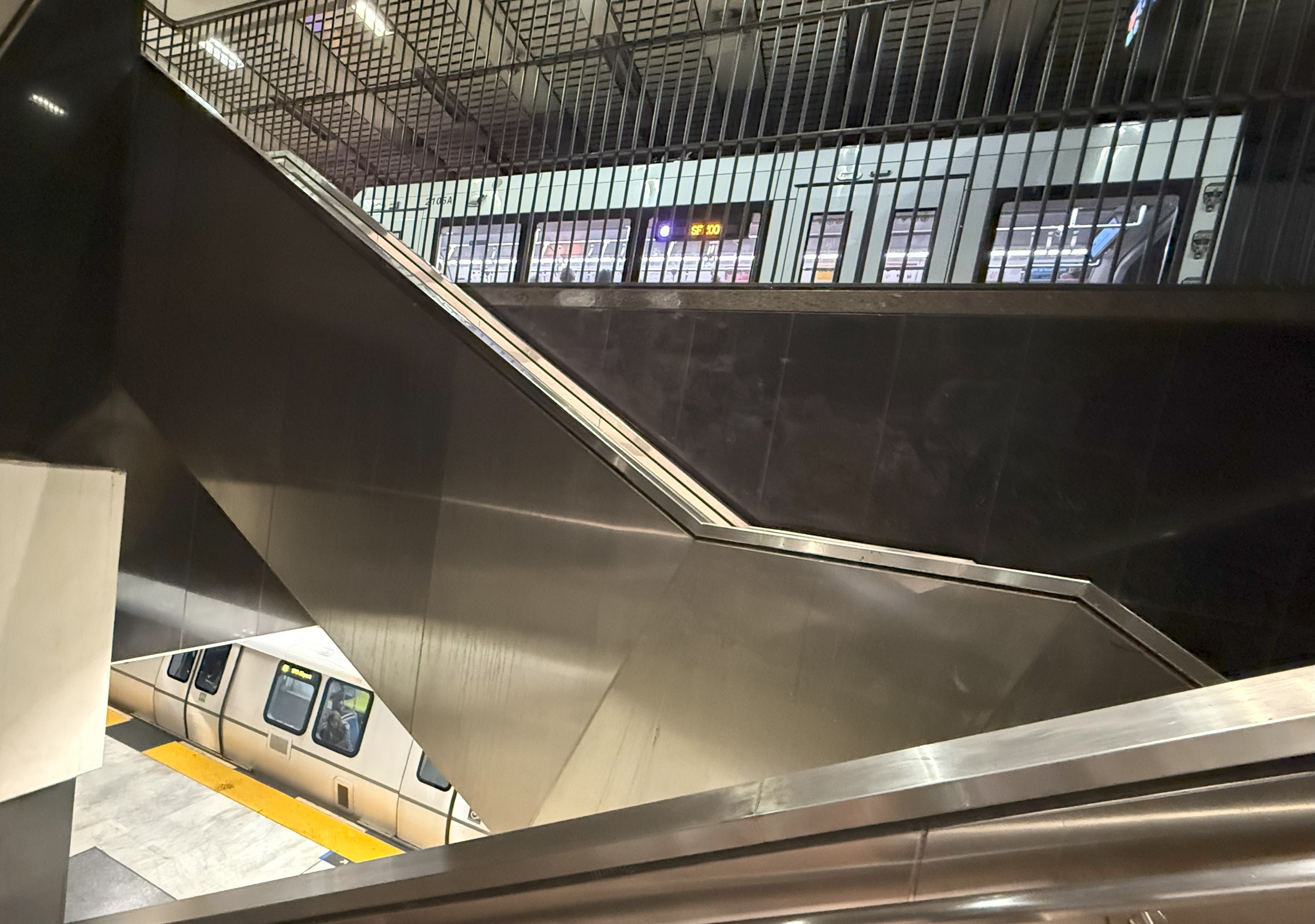
Market Street subway
Beneath the busiest street in San Francisco runs a two-level subway that was never supposed to work the way it does. The Market Street subway carries BART rapid transit trains on its lower level and Muni Metro light rail on its upper level, a split-personality arrangement that emerged from a political bargain: BART needed San Francisco's votes to pass a bond measure, so it agreed to build a subway that would also serve the city's streetcar system. The result is an engineering oddity, a light-rail tunnel built to rapid transit dimensions, running under a street that has carried rail traffic in one form or another since 1860.
A Subway to Win an Election
Plans for a subway under Market Street date to at least 1912, when four parallel rail tracks on the surface, two for Muni and two for the United Railroads, created the congestion known as the roar of the four. Serious construction planning came only when the Bay Area Rapid Transit District needed San Francisco voters to approve its bond. To win their support, BART proposed a two-level subway that would accommodate both BART and Muni. BART designed Muni's upper level with very long platforms, theoretically allowing future conversion to BART trains. This conversion never happened, but the infrastructure was already built to those specifications, producing a light-rail subway with rapid-transit-scale stations, a concept known elsewhere as premetro. BART, notably, did no planning for how to integrate Muni's existing lines into the subway before making their pitch to voters.
Cut-and-Cover
Construction began in July 1967 using the cut-and-cover method, which meant literally tearing up Market Street, digging a trench, building the subway, and putting the street back. The disruption lasted years and devastated the mid-Market shopping district, contributing to a decline from which the area has never fully recovered. BART trains first ran through the subway on November 5, 1973, with service to Daly City. The Transbay Tube connection opened on September 16, 1974, linking San Francisco to Oakland underground. Muni's surface operations were partially routed underground in 1980, with full service changes in 1982. The southwestern end of the Muni level connects to the much older Twin Peaks Tunnel, and the northeastern end emerges to surface tracks along the Embarcadero.
Seven Stations, Two Systems
The subway contains seven stations running from Embarcadero to Castro. Four stations serve both BART and Muni on separate levels with no direct connection between them. The remaining three serve only Muni. BART carries four of its five system lines through just two tracks in this segment, creating some of the shortest headways in the system. In 1997, the automated SelTrac signaling system was installed, and by 2001 station-to-station operation was fully automated under normal conditions. In April 2015, Muni began double-berthing, placing two trains in a station simultaneously so the rear one discharges passengers while the front one boards. The Central Subway, completed in November 2022, connected to the Market Street subway via a pedestrian underpass at Powell Street, rerouting the T Third Street line through Chinatown.
Pandemic and Recovery
On March 30, 2020, the COVID-19 pandemic shut down Muni Metro service through the subway, replacing trains with buses. Rail returned in stages over nearly two years. The T Third Street came back first in January 2021. The N Judah and M Ocean View followed. The J Church, which had been running only on the surface, returned to the subway in February 2022. The L Taraval, its line under construction, did not resume rail service until September 2024. The pandemic exposed something the Market Street subway had always obscured: how fragile the system's operations are beneath the surface. A subway built as a political compromise, carrying two incompatible transit systems on two levels, designed for a conversion that never occurred, remains the backbone of San Francisco's public transportation. It works, mostly. It is elegant, never.
From the Air
The Market Street subway runs beneath Market Street from approximately 37.79°N, 122.40°W (Embarcadero) to 37.76°N, 122.44°W (Castro). The subway is entirely underground and not visible from the air, but Market Street's diagonal path across the city marks its route. Nearest airports: SFO (KSFO, 10 nm south), Oakland (KOAK, 10 nm east).