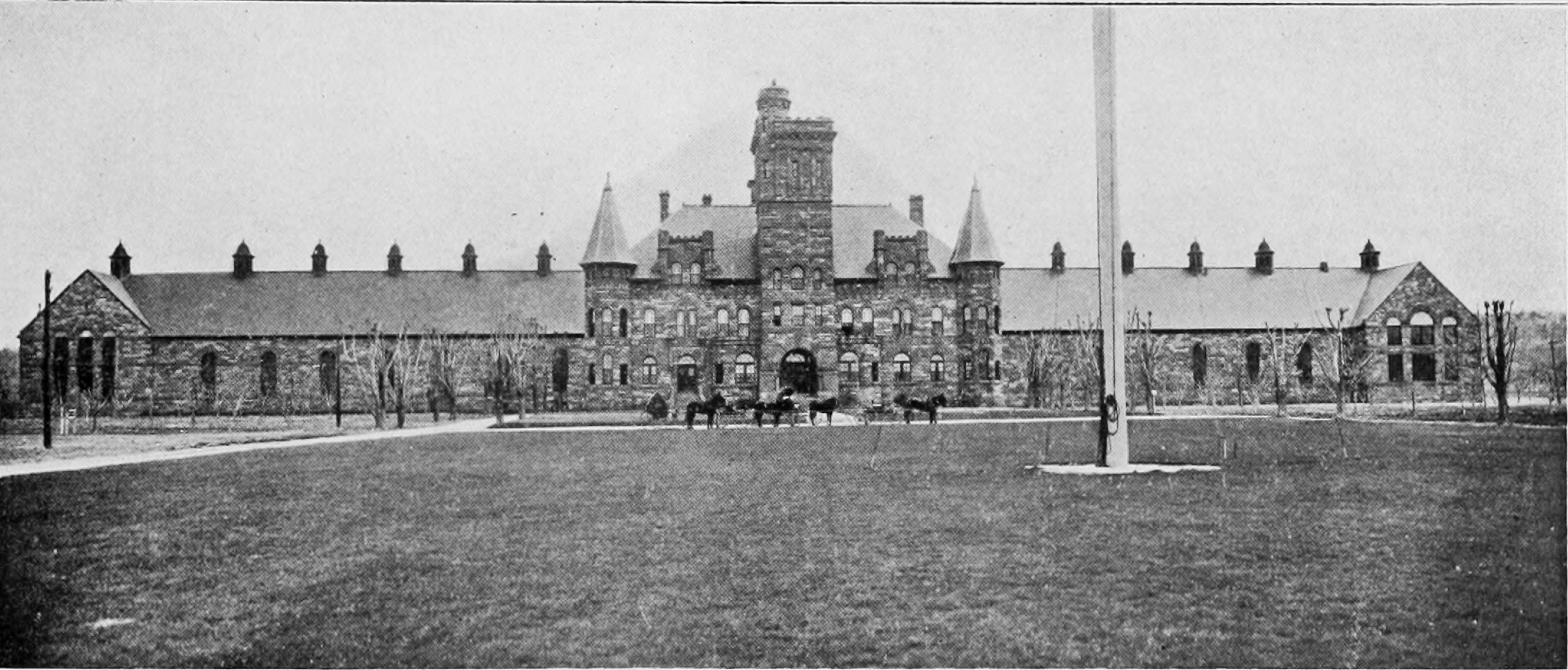
Marquette Branch Prison
On February 2, 1954, the Detroit Red Wings -- Gordie Howe, Ted Lindsay, Terry Sawchuk, and the rest of a team that would win the Stanley Cup two months later -- drove to a prison in Michigan's Upper Peninsula and played hockey outdoors against inmates. The temperature was around 21 degrees. After the first period, the Red Wings led 18-0, and the officials stopped keeping score. For the remaining two periods, players from both sides shuffled teams. It was the first outdoor game involving an NHL team, decades before the league turned the concept into the Winter Classic spectacle. And it happened inside the walls of the Marquette Branch Prison, a Romanesque sandstone fortress that has sat on the south shore of Lake Superior since 1889.
Built for the Upper Peninsula
By the late 19th century, Michigan's Upper Peninsula was booming. Copper and iron mining had drawn thousands of workers, and with population growth came a rising number of criminal convictions. Transporting prisoners from the Upper Peninsula to the state prisons at Ionia and Jackson in lower Michigan was expensive and logistically difficult. The Business Men's Association of Marquette lobbied hard, arguing that the city offered a centrally located community with excellent transportation, water facilities, and the natural resources needed to build a prison. They won. The prison opened in 1889, designed by William Scott and Company of Detroit in the Richardsonian Romanesque style, constructed from local sandstone. The Administration Building is a three-story structure measuring 112 by 56 feet, crowned by a central square tower that rises 88 feet and features a massive 10-foot-wide Syrian entryway arch. Octagonal bays at the corners are topped by pointed spires, and round-arch windows line every story. It is a building that looks more like a medieval cathedral than a house of corrections.
The Night the Warden Fell
On the evening of December 11, 1921, three convicts -- Arthur "Gypsy Bob" Harper, Jasper Perry, and Charles Roberts -- attacked Warden Theodore Catlin, Deputy Warden Fred Menhennett, Menhennett's son Arthur, and prison guard Charles Anderson in the prison's movie theater. The weapons were knives. Deputy Warden Menhennett died at the scene. Warden Catlin survived for six more weeks before succumbing to his injuries. The aftermath was as extreme as the attack. Beginning the very next day, December 12, Harper and Perry received 30 lashes each and Roberts received 25. Perry and Roberts were flogged again on Tuesday and Wednesday, 25 lashes each day. Harper avoided further flogging only because he was smashing his head on the floor and had to be restrained in a straitjacket. The flogging had been approved by the governor. But it created a legal paradox: when prosecutors sought to try the three men for murder, the court ruled that the flogging constituted punishment, and trying them again would be double jeopardy. The murder charges were dismissed. Harper, Perry, and Roberts served out their existing life sentences with no further penalty for the killing of the warden.
Hockey Behind the Walls
The idea for the 1954 hockey game originated during a summer visit to the prison sponsored by Stroh Brewing Company. Red Wings general manager Jack Adams and captain Ted Lindsay toured the facility, and Adams casually agreed to bring the team for a game -- not realizing the prison had no rink. Months later, Warden Emery Jacques called to say everything was on track. Leonard "Oakie" Brumm, the prison's recreation director and a former University of Michigan hockey star, built an outdoor rink inside the prison walls. The inmate team, called the Marquette Prison Pirates, entered the game with a respectable 4-1-1 record against outside teams. The exhibition drew national attention. After the lopsided first period, the spirit of the event shifted from competition to camaraderie, with Red Wings players joining the Pirates' roster and vice versa. The day ended with the visiting professionals receiving a trophy crafted from a galvanized steel honey bucket and personalized leather wallets made in the prison workshop.
Still Standing on the Shore
Marquette Branch Prison was listed on the National Register of Historic Places as the State House of Correction and Branch Prison on November 23, 1977. Today it holds approximately 1,100 inmates in maximum and minimum-security housing, staffed by 282 custody personnel and 145 support staff. Programming includes work assignments, psychological services, a main law library and four satellite law libraries, religious services, and educational programs. The prison's sandstone walls still stand on the south shore of Lake Superior, where they have weathered more than 130 Upper Peninsula winters. From the water or from the air, the fortress-like silhouette is unmistakable -- a reminder that Marquette's history is not only about mining and wilderness, but also about the institutions a growing frontier built to keep order.
From the Air
Marquette Branch Prison is located at 46.512N, 87.383W on the south shore of Lake Superior in Marquette, Michigan. The prison complex is visible from the air as a large institutional compound with distinctive sandstone buildings near the waterfront, south of the city center. Look for the fortress-like Administration Building with its 88-foot central tower. The nearest airport is Marquette Sawyer Regional (KSAW), approximately 15nm to the south. Recommended viewing altitude: 2,000-3,000 feet AGL for architectural detail. Lake Superior to the north and the city of Marquette provide strong visual references.