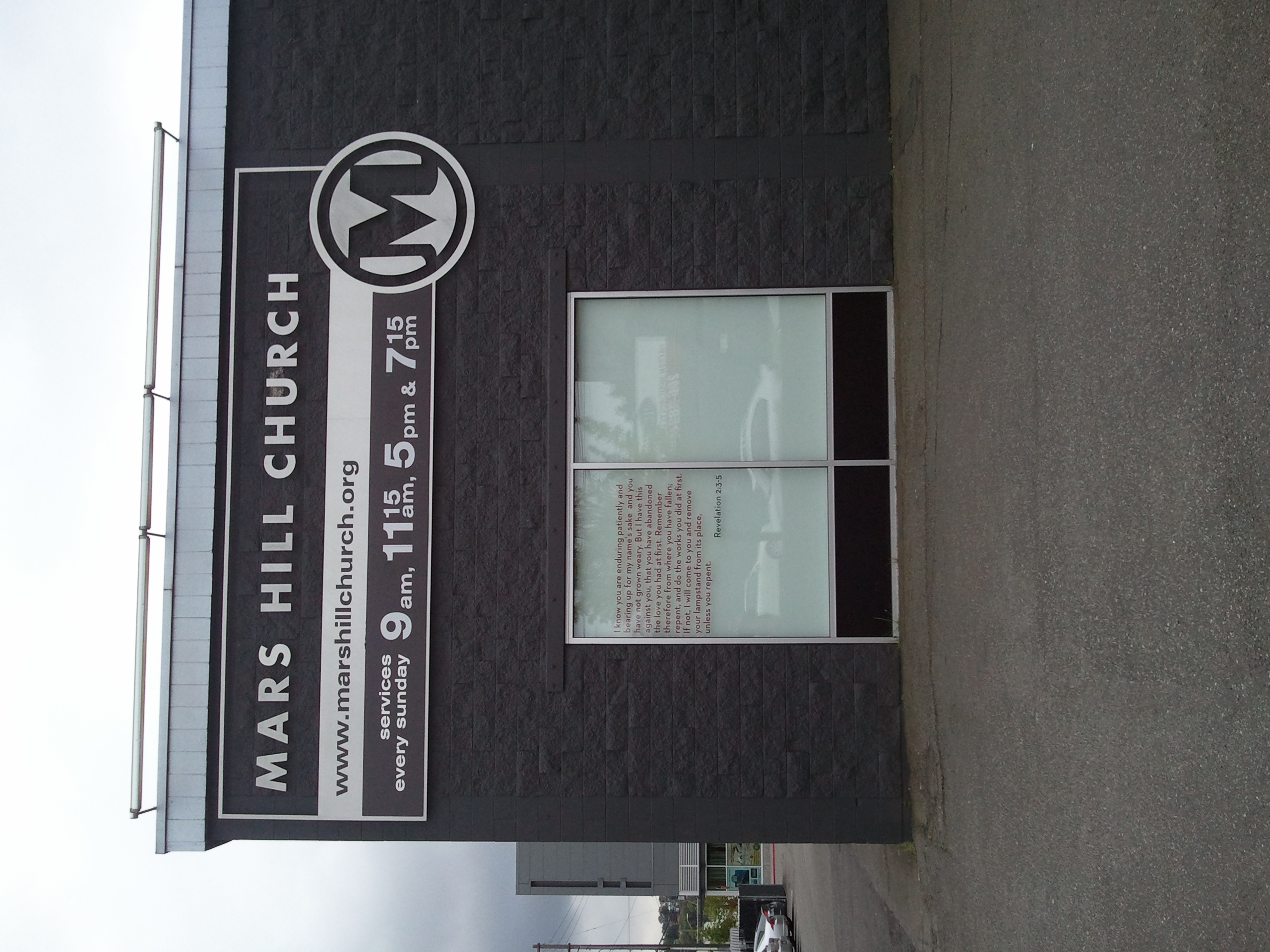
Mars Hill Church
It started in a rental house. In the spring of 1996, Mark Driscoll, Lief Moi, and Mike Gunn gathered about thirty people from Antioch Bible Church in a living room in Seattle and called it Mars Hill Church. Eighteen years later, Mars Hill had grown to 15 locations across four states, with 12,329 people attending weekly services and 260,000 sermon views online every week. On January 1, 2015, the entire network dissolved. The rise and fall of Mars Hill Church is a story about charisma, ambition, and the question of what happens when a religious institution is built around a single personality.
A Living Room Becomes a Movement
The early years were scrappy. Attendance dropped to 60 at one point as the young church debated its vision and mission. By the spring of 1997, enough people were showing up to require two evening services. Driscoll's invitation to speak at a California pastors' conference that year proved pivotal, connecting him with Bob Buford's Leadership Network and drawing media attention. Driscoll settled on a theological approach that was theologically Reformed, culturally hip, and complementarian on gender roles. The church installed its first team of elders and launched a Gospel Class for new members. By the fall of 1999, Mars Hill had 350 weekly attendees and could finally pay Driscoll a full-time salary. He had served unpaid for three years.
The Video Church
In 2003, Mars Hill moved into a renovated hardware store in Ballard. Three years later, to relieve overcrowding, it opened a satellite campus in Shoreline, becoming a multi-site church. Driscoll's sermons were broadcast via high-definition video to remote campuses, a model that allowed each location to maintain local leadership while the main campus controlled the message. New campuses multiplied: a sixth in downtown Seattle in 2008, a seventh in Olympia, an eighth in Albuquerque, New Mexico, the first outside Washington state. By 2012, Mars Hill was launching four new churches simultaneously in Portland, Rainier Valley, Sammamish, and Orange County. The church claimed over $31 million in assets by 2006. Ranked in the top five American churches for growth, innovation, and church planting, Mars Hill seemed unstoppable.
The Fractures
The controversies accumulated in layers. Repeated bylaw rewrites concentrated power among a small group of executive pastors. Two pastors were fired in 2007, and church members were instructed to shun them. A young man's disciplinary documents leaked to a blogger in 2012, revealing a shunning contract. In March 2014, World magazine reported that Mars Hill had paid ResultSource $210,000 to buy 11,000 copies of Driscoll's book Real Marriage, briefly pushing it to number one on the New York Times bestseller list. Plagiarism allegations against Driscoll surfaced in late 2013, with claims that passages in A Call to Resurgence borrowed extensively from Peter Jones without citation. The Evangelical Council for Financial Accountability called the bestseller-list scheme a violation of its ethical standards. Former members and leaders began speaking publicly about what they described as bullying, financial opacity, and autocratic management.
The Collapse
In August 2014, the Acts 29 church planting network, which Driscoll had helped found, removed both him and Mars Hill from membership, calling his behavior "ungodly and disqualifying." Driscoll took a six-week break from ministry while charges were investigated. A letter signed by nine current Mars Hill pastors urged him to step down; within weeks, eight of the nine had resigned or been fired. Weekly attendance dropped from over 12,000 to between 8,000 and 9,000. Donations declined steeply. The church laid off 30 to 40 percent of its paid staff and closed its downtown Seattle and University District branches. On October 14, 2014, after an investigation by church elders found "bullying" and "patterns of persistent sinful behavior," Driscoll declined a proposed restoration plan and resigned. Two weeks later, lead pastor Dave Bruskas announced the dissolution of all 13 remaining campuses, effective January 1, 2015. Eleven became independent churches. The rest simply ended.
From the Air
Mars Hill Church's main campus was in the Ballard neighborhood of Seattle, at approximately 47.66N, 122.37W. The renovated hardware store that served as the Ballard campus is in the commercial corridor along NW Market Street. Nearest airport is Boeing Field/King County International (KBFI), approximately 7 nm south. The church's multi-site model spread across the Seattle metro area. Best viewed from 2,000-3,000 ft AGL over Ballard.