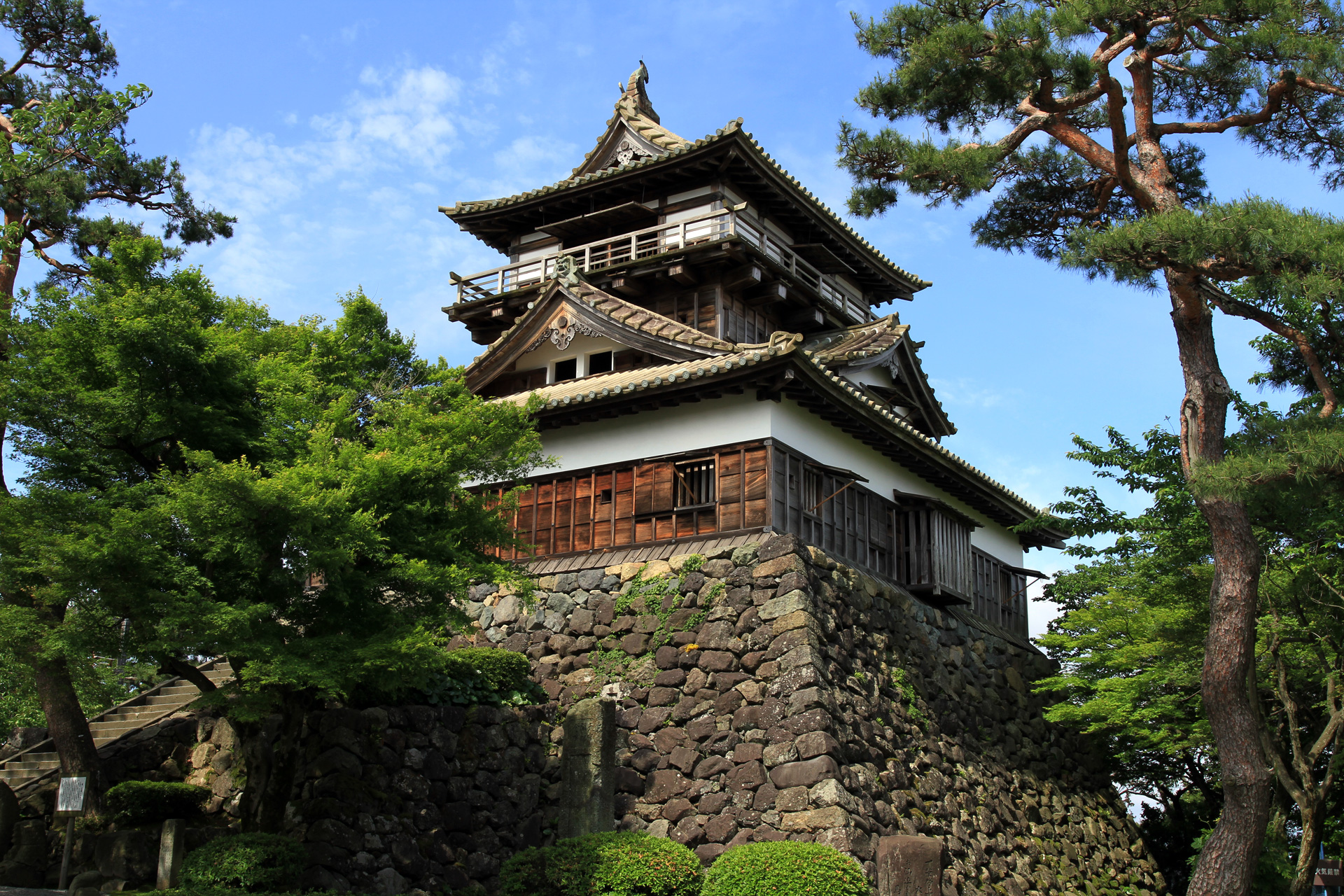
Maruoka Castle
A woman named O-shizu stands in a pit of unfinished stone. Above her, workers argue over walls that will not hold. She has agreed to die here, crushed beneath the foundation stones, on one condition: that her son be made a samurai. Whether the legend of the human pillar is historical fact or feudal myth, it has clung to Maruoka Castle for over four centuries, inseparable from the rough-hewn stones that still support its keep. Perched on a low hill in the plains north of Fukui city, this compact fortress is one of just twelve castles in all of Japan to have kept its original tenshu. Its nickname tells you what it was designed to do: Kasumigajo, the Castle in the Mist, said to summon a veil of fog whenever enemies draw near.
Stones That Would Not Stand
Maruoka Castle was built in 1576 by Shibata Katsutoyo, nephew and adopted son of Shibata Katsuie, one of the feared generals serving Oda Nobunaga during the closing years of the Sengoku period. The site was chosen for its position along the Hokurikudo highway connecting Kaga Province with Echizen Province, at the junction where the Mino Kaido highway linked the inland provinces to the Sea of Japan. It was a strategic crossroads, and the castle was meant to control it. But the builders faced a problem. The tenshu needed height, and the only way to achieve it on such a low hill was to mount the keep on a tall stone base. The technique for constructing steep-faced stone walls was still in its infancy, particularly when using rough, uncut stones in the method known as nozurazumi. The base kept collapsing. It was in this context that the legend of O-shizu took root: a desperate solution to an engineering problem that the era's masons had not yet mastered.
A Parade of Lords
Katsutoyo died of illness during the Battle of Shizugatake in 1583, and the castle passed to the Aoyama clan. They backed the wrong side at the Battle of Sekigahara in 1600, siding with Ishida Mitsunari's Western Army against Tokugawa Ieyasu, and were swiftly dispossessed. Ieyasu gave Echizen Province to his son Yuki Hideyasu, who parceled out a 26,000 koku holding centered at Maruoka to his retainer Imamura Moritsugu. By 1613, an internal political crisis within Fukui Domain prompted the shogunate to elevate Maruoka to 40,000 koku and hand it to Honda Narishige, son of one of Ieyasu's most trusted generals. Narishige's service at the Siege of Osaka pushed the domain's value to 46,300 koku. His descendants completed the castle town, the surrounding jokamachi, but the good fortune did not last forever. His great-grandson Honda Shigemasu proved to be an alcoholic and an incompetent administrator, and in 1695, the shogunate stripped the Honda family of their domain.
The Riddle of the Oldest Keep
Maruoka's tenshu has long claimed the title of Japan's oldest surviving castle keep, a distinction contested by Inuyama Castle and Matsumoto Castle. The debate took a dramatic turn in 2019 when researchers from Fukui University of Technology, using tree-ring dating, radiocarbon analysis, and oxygen isotope ratios, determined that most of the structurally critical through-pillars were cut from trees felled after 1626. This was puzzling: the architectural style of the tenshu was already considered outdated by the 1620s. The castle may have been substantially rebuilt decades after its original construction while deliberately preserving an older design vocabulary. It is an architectural paradox, a building that looks older than it may actually be, raising questions about what 'original' truly means when centuries of repair and reconstruction blur the line between preservation and replacement.
Stone Tiles and Secret Floors
Step inside the tenshu and the details of feudal engineering reveal themselves. The roof is covered not with the ceramic tiles typical of Japanese castles but with slabs of a local stone called shakudani, believed to provide better thermal insulation against Fukui's harsh winters. Stone shachihoko ornaments, the mythical fish-tiger guardians, perch on the roofline. Along the right side of the keep, protruding ishiotoshimado, stone-dropping windows, allowed defenders to fire down through timber slats or pour boiling water and oil on attackers below. The tenshu also conceals a hidden floor, invisible from the exterior, adding an extra layer of deception to a castle already famous for vanishing into mist. Today, the grounds are incorporated into Kasumigajo Park, home to roughly 400 cherry trees. Each April, during the first three weeks of the blossom season, over 300 paper lanterns illuminate the trees after dark, turning the old fortress into one of Japan's most atmospheric hanami destinations.
An Important Cultural Property
Maruoka Castle was designated an Important Cultural Property in 1950. Several of its original gates survive in unexpected places: one was relocated to the temple of Kozen-ji in Komatsu, Ishikawa, and another to Rensho-ji in nearby Awara. A small museum at the base of the hill displays arms, armor, and household items connected to the castle's succession of lords. In October 2019, a typhoon damaged the northeast exterior wall of the tenshu, a reminder that this structure, whatever its precise age, remains exposed to the same Sea of Japan storms that have battered it for centuries. The city of Sakai has launched a national treasure promotion campaign, hoping to elevate the castle's designation and ensure its preservation for future generations.
From the Air
Maruoka Castle sits at 36.15°N, 136.27°E on a low hill in the Fukui plain. From the air, look for the small wooded hilltop surrounded by the pentagonal moat outline and Kasumigajo Park's cherry trees, northwest of central Fukui city. The nearest airport is Komatsu Airport (RJNK), approximately 30 km to the northeast. Best viewed at 3,000-5,000 feet AGL in clear weather. The Sea of Japan coastline is visible to the west.