Marvel Cave
On July 7, 1963, Don Piccard flew a hot air balloon inside a cave. The Cathedral Room of Marvel Cave, near Branson, Missouri, is so enormous -- one of the largest cave entrance rooms in North America -- that Piccard could achieve and set an underground altitude record within it. Three decades later, in 1994, five hot air balloons flew simultaneously in the same chamber to celebrate 100 years of guided cave tours. Marvel Cave is the kind of place where the improbable becomes routine. A National Natural Landmark hidden beneath the rides and attractions of Silver Dollar City theme park, this Ozark underworld holds legends of Spanish gold, stories of vigilante executions, and passages that divers and explorers have yet to fully map.
Marble That Never Was
The cave's story begins with a mistake. In 1882, explorers saw what they believed was marble on the cave's ceiling and founded the Marble Cave Mining Company to extract it. The marble turned out to be something else entirely. After four and a half years of fruitless operations, the mining company gave up. William Lynch purchased the cave in 1889 and opened it to the public. The first guided tours, run by the Lynch family starting in 1894, lasted a grueling eight hours. Visitors climbed down through the sinkhole on a ladder, then slid down the enormous debris pile -- the "Underground Mountain" -- to the bottom, each carrying a single candle. The cave was originally called Marble Cave; the name changed to Marvel Cave after Lynch's death in 1927, when ownership passed to his daughters, Genevieve and Miriam.
Spanish Ladders and Bald Knobber Legends
Evidence suggests the Spanish explored the cave as early as 1541, hunting for riches and possibly the Fountain of Youth. In 1869, when lead mining magnate Henry T. Blow of St. Louis led the first recorded expedition with six other miners, they found Spanish-style ladders -- small trees with notches carved in them -- in the Mammoth Room. A legend persists that the Spanish buried gold somewhere in the cave's depths. Silver Dollar City park lore also claims the Bald Knobbers, a group of Ozark vigilantes who turned outlaw, threw victims through the 94-foot sinkhole into a chamber called Devil's Den. The Bald Knobbers did not actually form until 1883 in neighboring Taney County, and written evidence for their use of the cave is absent, but the stories thrive in the same darkness that swallowed the candlelight of early visitors.
A Cathedral Underground
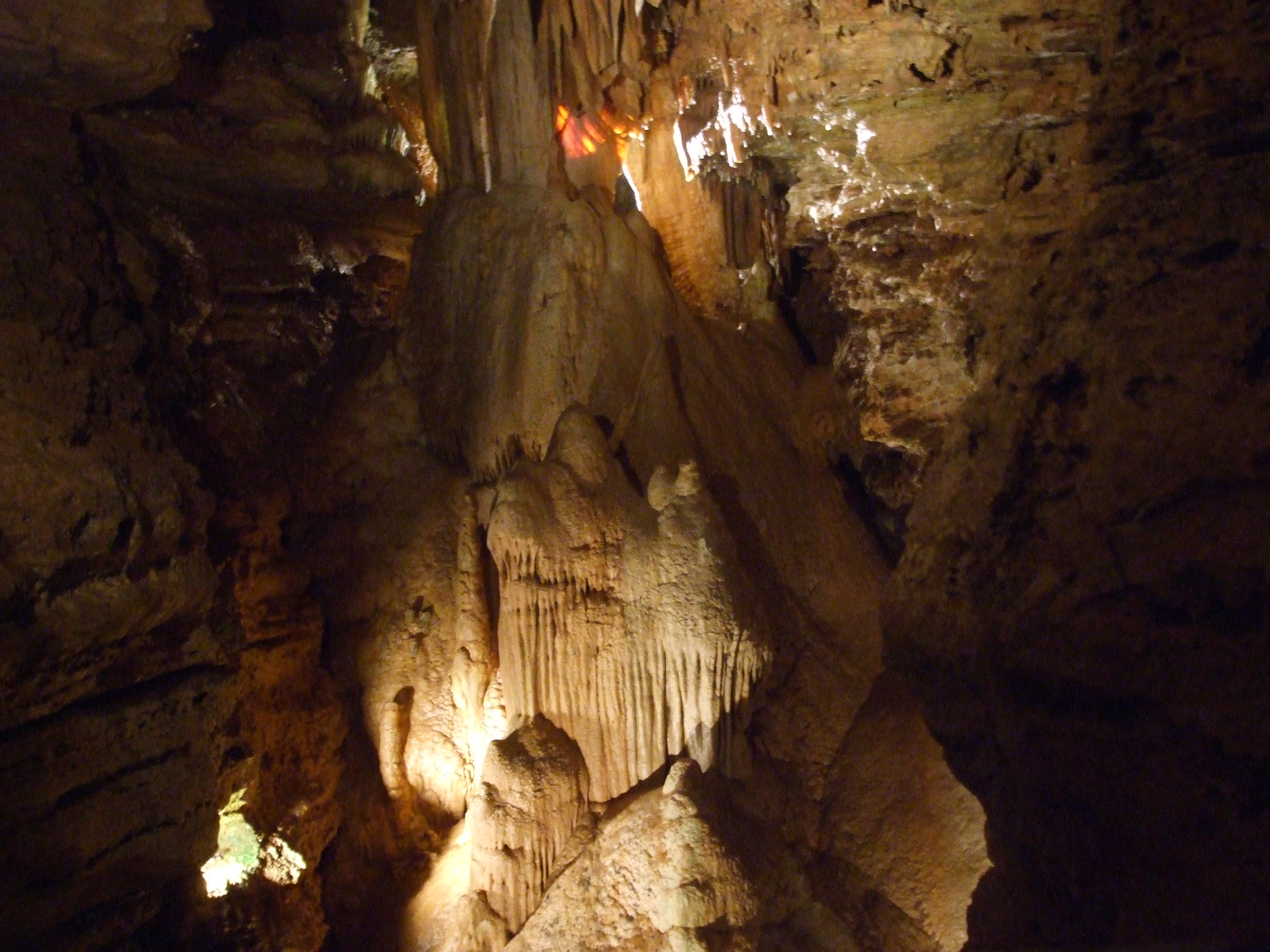
The Cathedral Room's scale defies expectations for a cave entrance. Visitors enter through a sinkhole 94 feet deep, with two large openings at the bottom. Centuries of falling rocks, trees, dirt, and animals have built a debris pile inside so large it is called the Underground Mountain. Beyond the Cathedral Room, the cave unfolds into a labyrinth of named passages and chambers. The Egyptian Room -- renamed the Shoe Room for its ceiling shaped like a sandal -- was named by Genevieve and Miriam Lynch, who saw in its formations echoes of King Tutankhamen's sarcophagus and the Sphinx. The Gulf of Doom was once thought to be bottomless; rocks hurled into the darkness made no sound, because thick layers of clay and bat guano padded the floor over 100 feet below. The Dungeon features blood-red walls stained by iron oxide, which early guides claimed as evidence of Spanish torture.
The Unmapped Depths
Marvel Cave has never been fully explored. The Lakes Passage contains two underground lakes named Genevieve and Miriam, after the Lynch daughters. Divers have found multiple underwater passages branching off the lakes but have not reached the end. The Mystic River Passage opens into the T Room, the cave's second-largest chamber. Beyond it, the passage narrows to what cavers call the "Sewer Pipe" -- a tight, mud-and-water-filled crawl that must be navigated on one's back with face above water. No one has reached its terminus. The cave is also a living ecosystem. Marvel Cave hosts colonies of endangered gray bats alongside eastern pipistrelles, little brown bats, big brown bats, cave salamanders, and grotto salamanders. The cave has been recognized for its outstanding work in preserving its gray bat colony. In 1950, Hugo Herschend leased the cave for 99 years. The Herschend family added concrete stairs and modern lighting, and later built Silver Dollar City on the surface above -- an Ozark theme park that sits, literally, on top of a mystery that extends deeper than anyone has yet been able to follow.
From the Air
Located at 36.668N, 93.340W in Stone County, Missouri, approximately 1,200 feet MSL. The cave entrance is beneath Silver Dollar City theme park, just west of Branson. Branson Airport (KBBG) is approximately 6 nm to the southeast. Springfield-Branson National Airport (KSGF) lies 35 nm to the north. The Silver Dollar City complex is visible from altitude as a cleared area amid the wooded Ozark ridges. Table Rock Lake is a prominent visual landmark to the south. The cave itself is invisible from the air -- its entrance is a sinkhole beneath the theme park grounds. Best viewed at 3,000-5,000 feet AGL for the surrounding Ozark terrain context.