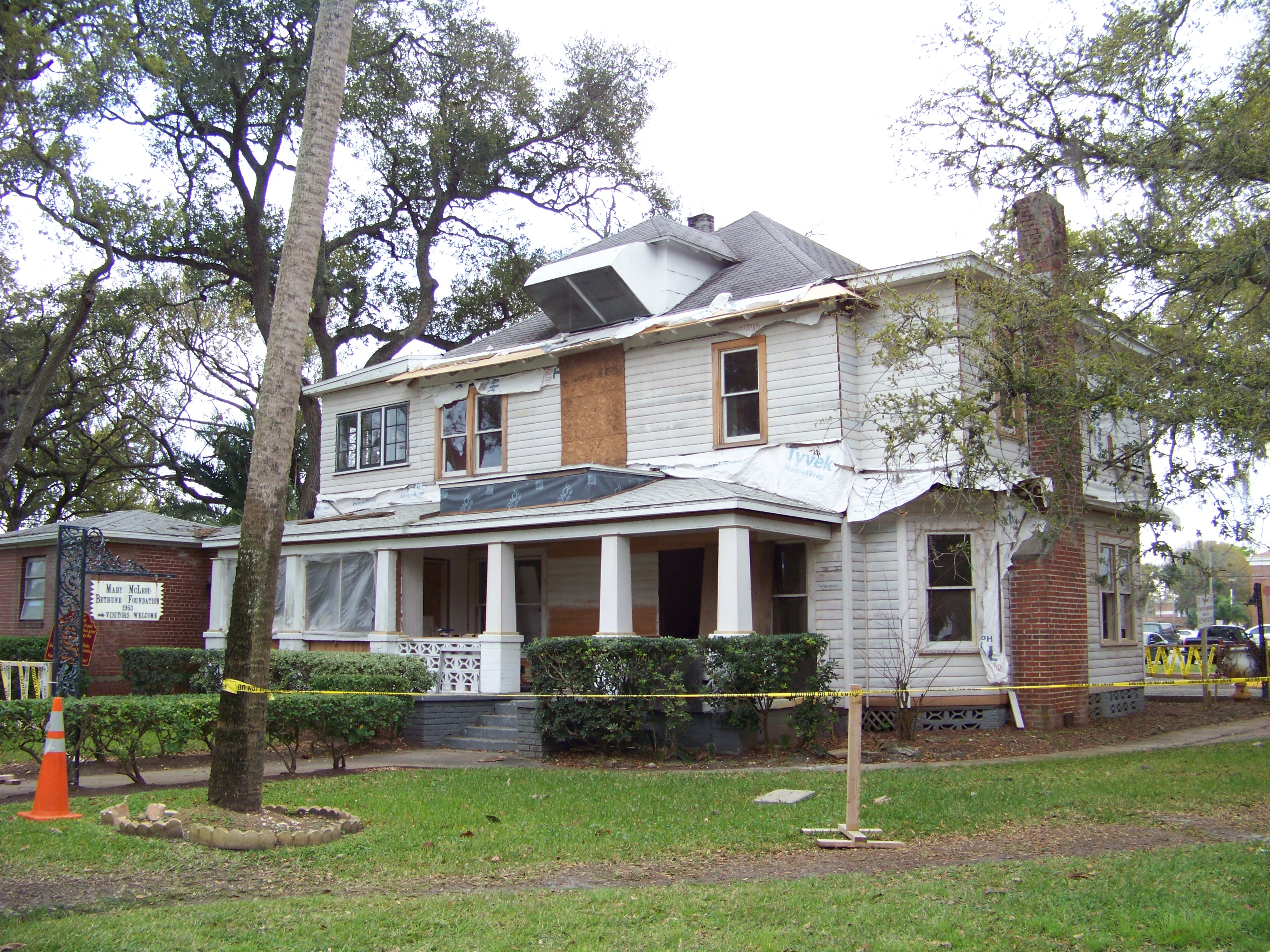
Mary McLeod Bethune Home
She started with a dollar and fifty cents. In 1904, Mary McLeod Bethune opened the Daytona Literary and Industrial Training School for Negro Girls with five students, her young son, and almost nothing else. She fashioned pencils from charred wood, made ink from elderberries, and stuffed mattresses with Spanish moss. She raised money selling sweet potato pies to railroad workers. Within two years, enrollment had grown to 250 students. The modest two-story house on what became the Bethune-Cookman campus would be her home from 1913 until her death in 1955, and the base from which she would become one of the most influential African-American women of the twentieth century.
The Seventeenth Child, Born Free
Mary Jane McLeod was born on July 10, 1875, in Mayesville, South Carolina, the seventeenth child of Sam and Patsy McLeod, and the first born free. Her parents had been enslaved, and most of her older siblings had been born into bondage. She walked five miles each way to attend a mission school, and that education transformed her ambitions. She attended Scotia Seminary in North Carolina and the Moody Bible Institute in Chicago, intending to become a missionary in Africa. When that assignment never came, she redirected her calling to education in the American South, where illiteracy among Black communities remained a deliberate legacy of slavery.
A School Built on Sweet Potato Pies
Bethune chose Daytona Beach because the Florida East Coast Railway was bringing laborers to the area, and their families needed schools. She purchased a plot of land near the city dump for five dollars down. With no desks, no books, and no supplies, she improvised everything. The school grew through sheer force of will and community support. By 1923, the institution merged with the Cookman Institute for Men, a Jacksonville school founded in 1872. The combined Bethune-Cookman College received full accreditation and survived the Great Depression, becoming a four-year institution in 1941. Bethune served as its president until 1942, building it into one of the most respected historically Black colleges in the South.
Advisor to the President
Bethune's influence reached far beyond Daytona Beach. She became a close friend of Eleanor and Franklin Delano Roosevelt, and in the 1930s, Roosevelt appointed her to lead the Division of Negro Affairs within the National Youth Administration, making her the first Black woman to head a federal agency. She founded the National Council of Negro Women in 1935, creating a coalition of Black women's organizations with real political power. During World War II, she helped integrate the Women's Army Corps and advised on racial policy at the highest levels of government. Her counsel shaped federal programs that opened doors for an entire generation of African Americans.
What the House Holds
The Mary McLeod Bethune Home sits on the northeast corner of the Bethune-Cookman campus, west of Dr. Martin Luther King Jr. Boulevard. It is an American Foursquare, a practical two-story frame structure with wings extending to each side and a hip-roof porch spanning the front. The house is architecturally unassuming, typical of early-1900s Florida construction. A brick addition from 1953 holds papers and documents of the Bethune Foundation. Designated a National Historic Landmark in 1974, the home is now managed as a historic house museum. Inside, the rooms preserve the daily environment of a woman who reshaped American education and civil rights from a small house in a small city.
A Legacy Carved in Stone and Bronze
In 2022, a statue of Mary McLeod Bethune became the first representation of an African American in the National Statuary Hall at the United States Capitol, representing the state of Florida. It replaced the statue of a Confederate general. The symbolism is inescapable: a woman born to enslaved parents now stands in the halls of national power. But the truest monument may still be the campus that surrounds her modest home in Daytona Beach, where Bethune-Cookman University continues to educate thousands of students. The house itself remains quietly extraordinary, proof that changing the world does not require a grand stage, just a dollar fifty, elderberry ink, and iron conviction.
From the Air
Located at 29.21N, 81.03W on the campus of Bethune-Cookman University in Daytona Beach, Florida. The campus sits west of the Halifax River and east of downtown Daytona Beach. The Bethune Home is a small residential structure, not easily distinguished from altitude, but the Bethune-Cookman campus is identifiable as a cluster of institutional buildings in central Daytona Beach. Nearest airport: Daytona Beach International (KDAB) approximately 2nm south. Recommended viewing altitude: 1,500-3,000 ft AGL. Best approached from over the Halifax River looking west.