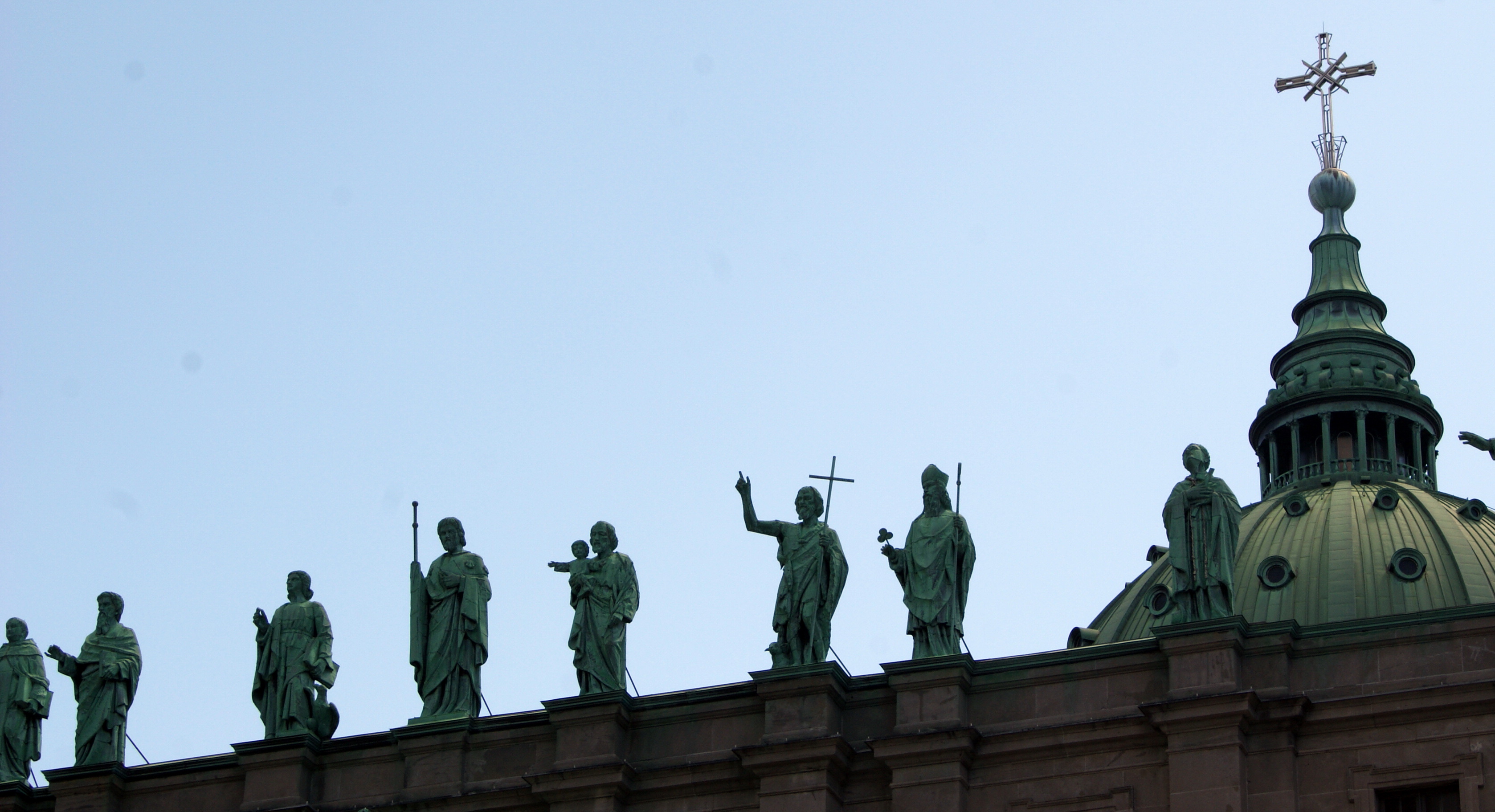
Mary, Queen of the World Cathedral
The architect said it could not be done. Victor Bourgeau studied Saint Peter's Basilica in Rome, turned the commission over in his mind, and concluded that the world's most famous church simply could not be reproduced at a smaller scale. Bishop Ignace Bourget disagreed. The second bishop of Montreal had already lost his cathedral -- the original Saint-Jacques had burned in 1852 -- and he was not about to lose an argument about its replacement. Bourget wanted a miniature Saint Peter's planted squarely in the western, predominantly English-speaking part of downtown Montreal, a deliberate provocation aimed at both the Sulpician order and the Anglican establishment, who favored the Neo-Gothic style. He sent a chaplain to Rome to secretly build a scale model, and in 1875, construction began on what would become one of the most audacious acts of architectural defiance in Canadian history.
A Bishop's Holy Vendetta
The rivalry behind the cathedral was intensely personal. The Sulpicians had served as the feudal seigneurs of Montreal since the city's founding, and their influence over parish life rankled Bourget for decades. When the Anglican Christ Church Cathedral rose in Neo-Gothic splendor on Sainte-Catherine Street, Bourget had his answer: he would build in the Renaissance style of Rome itself, signaling that Montreal's Catholic faithful answered not to local Protestant taste but to the Pope. The location he chose -- at the corner of what is now Rene Levesque Boulevard and Metcalfe Street -- was itself a statement, placing a French-Canadian Catholic monument in an English-speaking neighborhood. Meanwhile, as Italian nationalists under Victor Emmanuel II threatened the Papal States, Bourget dispatched 507 Canadian Zouaves to defend Rome. Their names are inscribed in gold on marble slabs inside the cathedral, beneath their motto: "Love God and go your way."
Rome on the Saint Lawrence
The cathedral that rose between 1875 and 1894 is unmistakably Roman in its DNA. At 101 meters long, 46 meters wide, and 77 meters tall at the cupola, it is roughly one-quarter the scale of Saint Peter's. The copper-and-gold-leaf baldaquin covering the main altar is a direct reproduction of Bernini's famous canopy, created in Rome in 1900 by Joseph-Arthur Vincent and adorned with hand-sculpted angels by Olindo Gratton between 1910 and 1911. Thirteen patron saints of Montreal parishes stand atop the facade, echoing the apostle statues on Saint Peter's. Inside, the cupola carries the same Latin inscription found in its Roman model: "Tu es Petrus, et super hanc petram aedificabo Ecclesiam meam" -- You are Peter, and upon this rock I will build my Church. The Casavant Freres organ, inaugurated in 1893, has grown from 56 stops to 93 over a century of rebuilds.
Painted Histories
The aisles and transept arches hold nine large paintings that transform the cathedral into a visual chronicle of Montreal's founding. Georges Delfosse painted seven of them, depicting scenes from the city's earliest days as Ville-Marie: Marguerite Bourgeoys teaching Indigenous students in 1694, the martyrdom of Jesuit missionaries Jean de Brebeuf and Gabriel Lalemant, Jeanne Mance tending the sick at the city's first hospital. Perhaps the most evocative canvas shows the consecration of the Associates of Montreal's project on February 3, 1641, when nobles and priests gathered in Notre-Dame de Paris to pray for what many considered a "foolish undertaking" -- the founding of a new city in New France. Three frames remain empty, waiting for stories yet to be told. Meanwhile, the bishops' mortuary chapel, completed in 1933 with Italian marble walls and mosaic floors, holds the tomb of Bourget himself at its center.
Layers of Consecration
The cathedral has been named and renamed as ecclesiastical politics shifted around it. Consecrated in 1894 as Saint James Cathedral after the parish's patron saint, it became a minor basilica in 1919 under Pope Benedict XV. In 1955, Pope Pius XII rededicated it to Mary, Queen of the World, at the request of Cardinal Paul-Emile Leger, following the pope's 1954 encyclical Ad caeli reginam proclaiming that Marian title. The chapel on the nave's west side holds a wood-carved altarpiece dating to about 1635, made by a Spanish monk at the Benedictine Abbey in Bellelay, Switzerland. After the monks were expelled, French troops sold the abbey's furnishings, and the altarpiece wandered through obscurity until an Austrian conservator discovered it in a church in Suarce, France. It reached Montreal in 1994 as a donation to the Archdiocese. Designated a National Historic Site of Canada on March 28, 2000, the cathedral continues to anchor Dorchester Square as the seat of the Roman Catholic Archdiocese of Montreal.
From the Air
Mary, Queen of the World Cathedral sits at 45.50N, 73.57W in downtown Montreal, at the corner of Rene Levesque Boulevard and Metcalfe Street, forming the eastern edge of Place du Canada and Dorchester Square. Its green copper dome is visible from moderate altitude against the surrounding office towers. Best viewed from 2,000-4,000 feet AGL. Montreal/Pierre Elliott Trudeau International Airport (CYUL) is 11 nm to the west. Montreal/Saint-Hubert Airport (CYHU) lies 9 nm to the southeast. The nearby Bonaventure metro station and Central Station provide ground-level reference points.