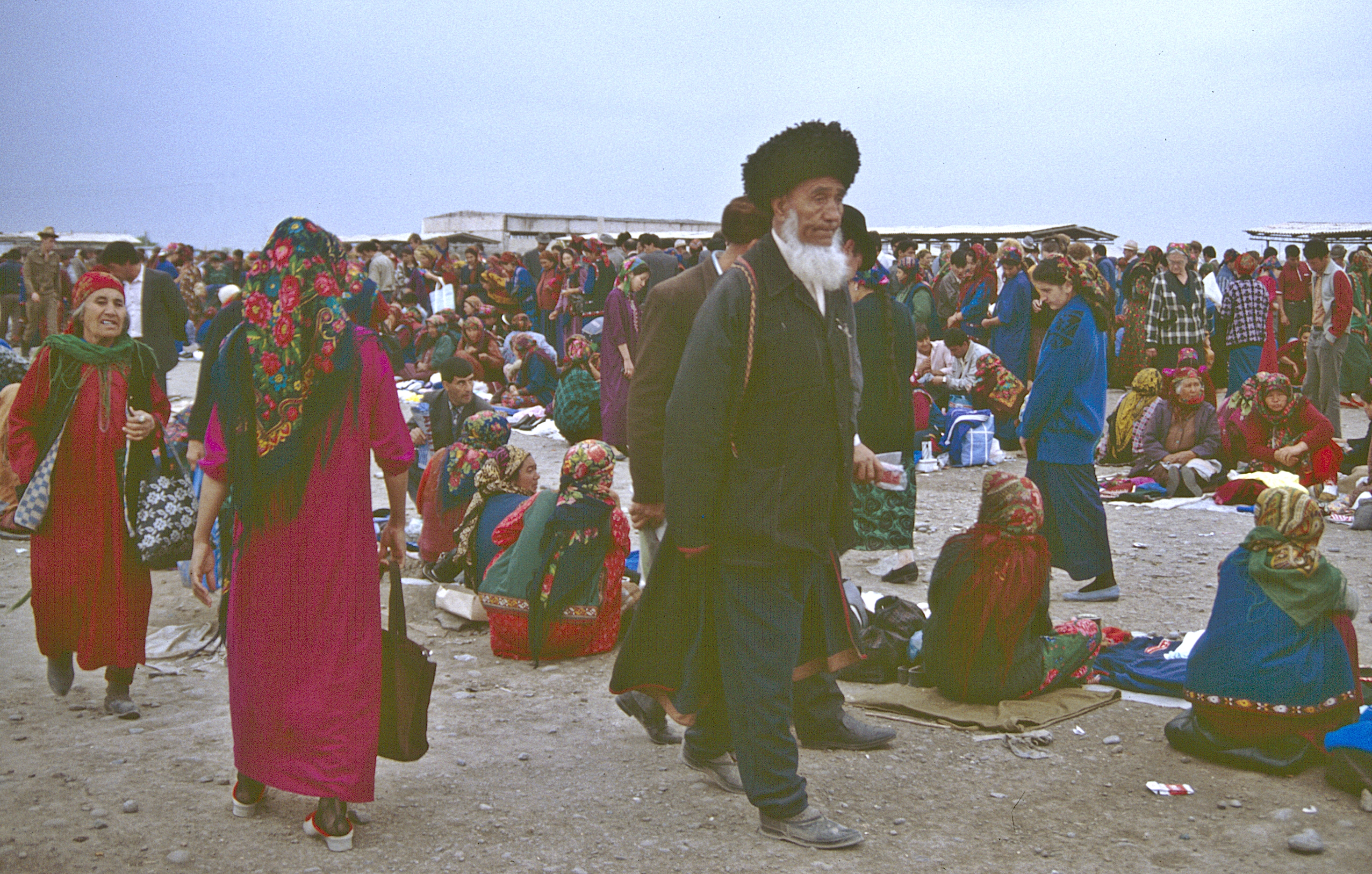
Mary, Turkmenistan
The name has been written a dozen different ways across two and a half millennia. Muru in Zoroastrian texts. Margiana carved into rock at Behistun, Iran, twenty-five hundred years ago. Merv, Maru, Mary. Some scholars trace the root to a word meaning "green field" or "grassland," which sounds improbable until you see the irrigated strip along the Murgab River, a corridor of cultivation cut through the Karakum Desert that has sustained human settlement since the Bronze Age.
The Shadow of Merv
Thirty kilometers from modern Mary lie the ruins of one of antiquity's great cities. Merv was an oasis metropolis on the Silk Road, a place where caravans carrying silk, spices, and ideas paused between East and West. In the thirteenth century, the Mongols annihilated its population. The city revived slowly, only to suffer again at the hands of nomadic Teke raiders in the nineteenth century. By 1882, the British journalist Edmund O'Donovan described what remained as a shadow of its former self. Two years later, Imperial Russia established a military and administrative post nearby, naming it after the ancient city. The Russian occupation triggered the Panjdeh incident of 1885, a confrontation between Russian and Afghan forces over border territory that brought the British and Russian empires to the brink of war.
A Crossroads of Empires
Mary's modern history reads like a compressed survey of Central Asian geopolitics. In August 1918, forty Punjabi soldiers of the British Indian Army and a British officer engaged the Bolsheviks near the city, marking the first direct clash between British and Russian troops since the Crimean War. The Soviet Union later developed the surrounding region into a major cotton-producing zone, channeling water through an expanding network of irrigation canals. In 1968, enormous natural gas reserves were discovered twenty kilometers west of the city in the Shatlyk Gas Field, transforming Mary's economic identity. After Turkmen independence in 1991, Mary became the capital of its province on May 18, 1992, and the city entered yet another chapter of reinvention.
Marble and Ambition
The 2000s brought a building campaign that reshaped Mary's skyline. A new airport terminal, a theater, and a forty-two-meter-tall spherical library supported by sixty-two columns appeared across the city. The library, which opened in October 2011, holds space for three million books and features a telescope beneath a dome shaped like tulip petals. The Gurbanguly Hajji Mosque, a new historical museum costing eighteen million dollars, the Margush Hotel, a stadium, an equestrian complex, and a new railway station followed. In 2012, Mary was declared a cultural capital of the Commonwealth of Independent States. The city also erected a three-story artificial yurt in 2015 for large events. These structures reflect the monumental architectural style that defines Turkmenistan under President Gurbanguly Berdimuhamedow.
Cotton, Gas, and Carpets
With a population of roughly 167,000 as of 2022, Mary is Turkmenistan's fourth-largest city and a significant industrial center. Natural gas and cotton drive the economy, ranking among the nation's top export earners. The city also serves as a trade hub for cereals, hides, and wool. A six-hundred-kilometer motorway links Mary to the capital, Ashgabat, and to the city of Tejen. The climate is unforgiving: hot arid conditions bring sweltering summers, cool winters, and almost no humidity. What little precipitation falls arrives in late winter and early spring.
Lives and Legends
Mary has produced a surprisingly varied roster of notable figures. Yelena Bonner, the Soviet and Russian human rights activist, was born here. So was Eduard Asadov, the poet who lost his sight in World War II and became one of the most widely read authors in the Soviet Union. The city's football team, Merw FK, carries the name of the ancient city. Perhaps the most striking local tradition belongs to Turkmen Keraites who maintain a Nestorian Christian belief that the Tomb of the Virgin Mary is located in their city, connecting this Central Asian oasis to a spiritual geography that spans continents. Sister city relationships with Jeddah, Samarkand, Xi'an, and Oryol reinforce the sense that Mary, despite its isolation, has always looked outward.
From the Air
Located at 37.60N, 61.83E on the Murgab River in the Karakum Desert, central Turkmenistan. Mary Airport (UTAM) is the nearest facility. From altitude, the city appears as a green irrigated patch against the tan desert, with the Murgab River running through it. The ruins of ancient Merv are visible approximately 30 km to the east. Recommended viewing altitude: 5,000-10,000 feet for city context, 15,000+ feet to see the contrast between irrigated oasis and surrounding desert. Summers bring extreme heat and haze; winter and spring offer clearer visibility.