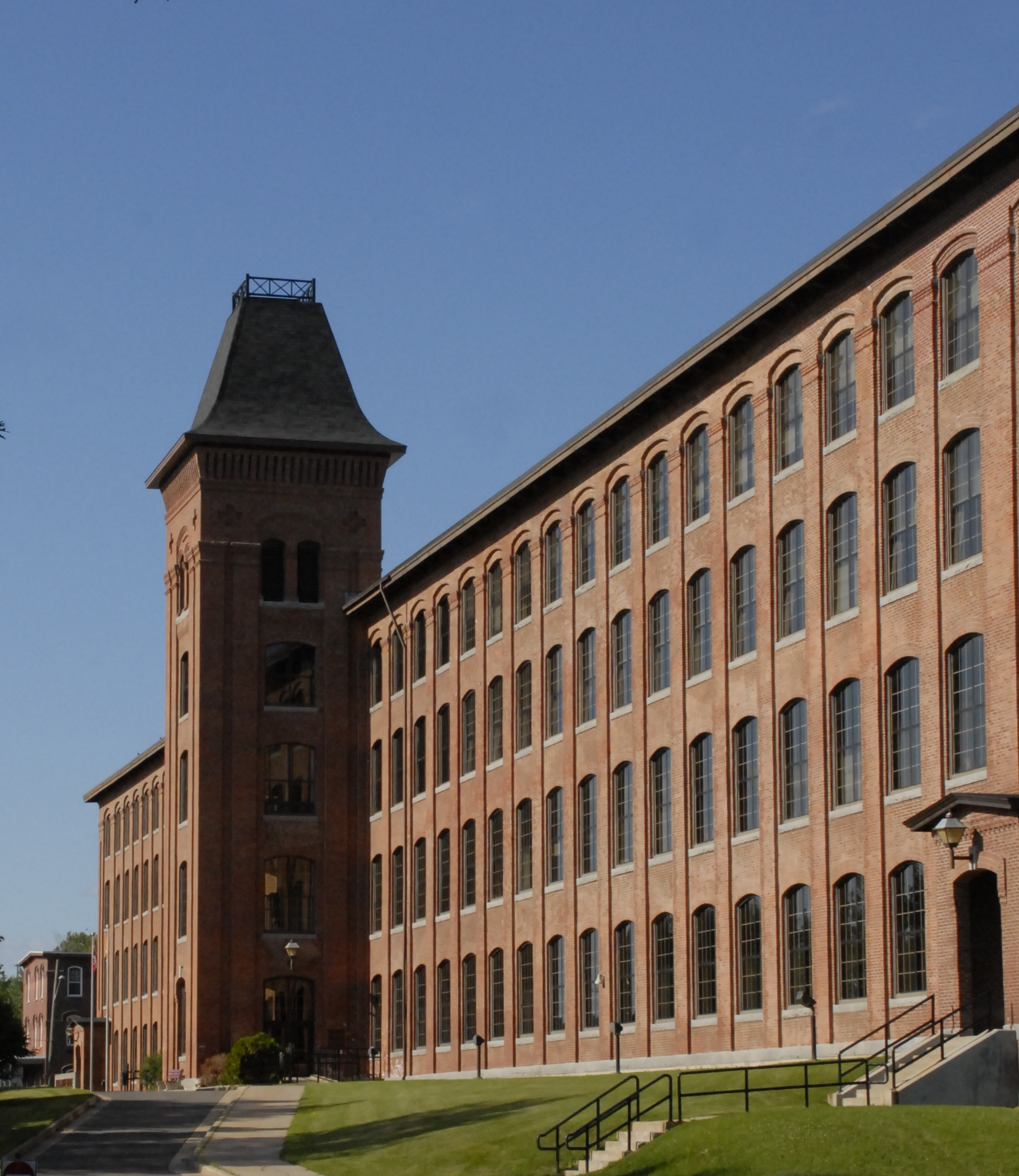
Marysville Cotton Mill
Every morning, a steam whistle sounded from the factory on the east bank of the Nashwaak River, and the town of Marysville woke up. Every evening, it sounded again, dismissing workers after a ten-hour day. Between those two blasts, the four-storey brick cotton mill that Alexander Gibson completed in 1885 defined the rhythm of life for an entire community he had created from scratch. Gibson did not just build a factory in New Brunswick's interior. He built the town around it, the railway to connect it, and the brickyard to supply the materials. The Marysville Cotton Mill, now known as Marysville Place, is a National Historic Site of Canada -- a monument to one man's industrial ambition and to the company town model that shaped so many Canadian communities.
The Lumber Baron Pivots
Gibson arrived in what would become Marysville in late 1862, moving from Lepreau in Charlotte County. For 7,300 pounds, he purchased a property that included sawmills, a gristmill, a blacksmith shop, a general store, a farm, houses, and 7,000 acres of woodland. The sawmills operated on the Nashwaak River, and Gibson acquired the rights to float logs and rafts down to its mouth at the Saint John River. He built dams to control the water flow, ensuring year-round log transport. When the provincial government offered land grants of 10,000 acres per mile of railway track constructed, Gibson seized the opportunity, funding a narrow-gauge railway line to Chatham that earned him a total grant of 1,647,000 acres. He sold the railway for $800,000 and turned his attention from lumber to textiles.
A Model Village from Filthy Ground
The property Gibson had purchased was not pretty. Buildings were filthy, sanitation was poor, and typhoid fever was endemic. He had the site cleared and, using the proceeds from his railway sale, built a model village named Marysville to house the workers and their families. Twenty-four duplex houses, known as "White Row," went up on the east side of the river near the mill, connected to the factory by a footbridge across the Nashwaak. On the west side, Gibson and his managers built mansions on the hills above -- a physical arrangement that made the social hierarchy visible in the landscape itself. Gibson established a brickyard to manufacture the building materials locally rather than importing them, and those bricks went into the mill, the tenements, and the infrastructure of the town.
Lockwood, Greene, and a 418-Foot Factory
Construction of the cotton mill began in 1883 and finished in 1885. Lockwood, Greene and Company, an engineering firm based in Providence, Rhode Island, designed the building in the style of New England mills, using a brick pier foundation. Contractor Albert H. Kelsey oversaw the work. The finished structure stretched 418 feet long and 100 feet wide across four storeys, with rows of identical multi-pane mullion windows on each level. It was the first building in Fredericton to have electric lighting and included a sprinkler system. Most materials came from the surrounding area, with the exception of southern hard pine imported for the posts and beams. Along with an operation in Milltown -- now part of St. Stephen -- the Marysville Cotton Mill was the largest and most isolated textile mill in the Maritime provinces.
The Whistle and the Ledger
Gibson ran a tight operation. The company built a church and a school, and operated a company store that deducted bills and housing rent directly from employees' monthly pay. The arrangement, combined with company housing and the expectation that entire families would work in the mill, was designed to "maximize dependence and discourage sudden resignations," as one account put it. Yet Gibson was not simply an exploiter. He provided employees with land for kitchen gardens and pasture, supplied free firewood, and earned genuine respect from his workforce, which constituted the bulk of the town's population. The steam whistle that governed their days was the sound of a paternalistic contract: labor and loyalty in exchange for a home, a community, and steady work in a province where all three could be hard to find.
From Cotton to Data
The mill manufactured textiles until the 1970s, when it finally closed after nearly a century of operation. In 1985, the Government of New Brunswick undertook a restoration, and the building reopened as Marysville Place, housing the Department of Tourism, Recreation and Heritage as its first tenant. The cotton mill was designated a National Historic Site in 1986. Marysville itself became a national historic district in 1993, and in 2007, Alexander Gibson was named a Person of National Historic Significance. The narrow-gauge railway he built to Chatham was converted into a hiking trail. For a time, the building housed the Marysville Data Centre, serving government departments including Finance, Health, and Public Safety. The town Gibson built was absorbed into Fredericton in 1973, but his mill still stands on the Nashwaak's east bank, its rows of windows looking out over the river that powered everything he built.
From the Air
Located at 45.98°N, 66.59°W on the east bank of the Nashwaak River in the Marysville neighborhood of Fredericton, New Brunswick. The four-storey red brick building with its distinctive central tower is visible from low altitude along the river. The surrounding historic district of workers' houses is also recognizable. Fredericton International Airport (CYFC) is approximately 12 km south-southeast.