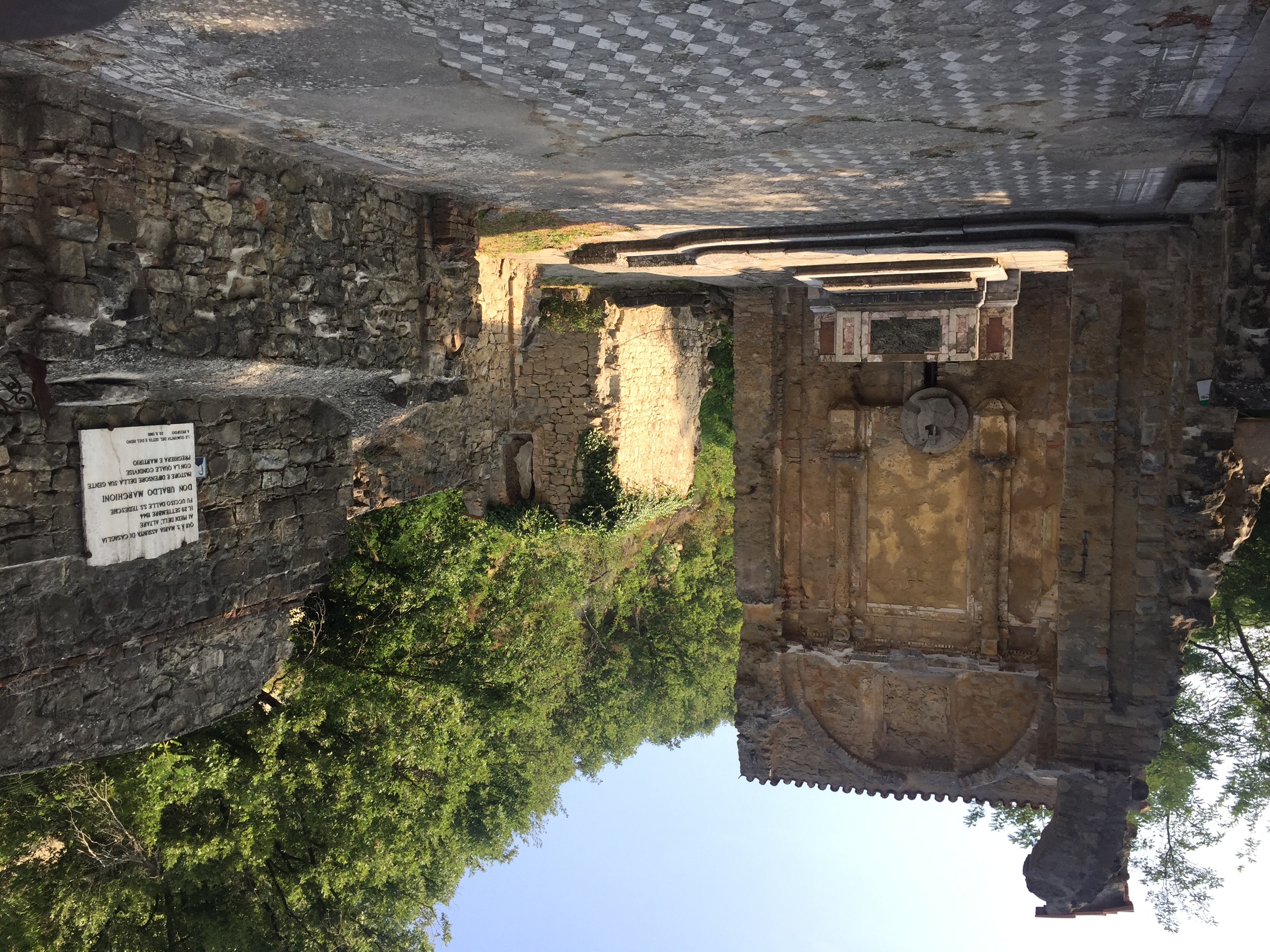
Marzabotto Massacre
The priest was burying the dead when they found him. Giovanni Fornasini, a parish priest and member of the Italian Resistance, had spent the days of the massacre protecting his parishioners, guiding families away from the killing, saving lives at the risk of his own. When an SS officer discovered him laying the victims to rest -- an act the Nazis had forbidden -- Fornasini admitted to helping villagers escape execution. The officer shot him. He was 29 years old. His story, both its courage and its ending, captures the human reality of what happened in the mountains south of Bologna between September 29 and October 5, 1944: the largest massacre of civilians committed by the Waffen-SS in Western Europe during the war, and the deadliest mass killing in Italian history.
Seven Days on Monte Sole
The operation was framed as a reprisal. Italian partisans and the Resistance had been attacking German soldiers in the mountainous terrain around Marzabotto, in the massif of Monte Sole along the Apennine range south of Bologna. SS-Sturmbannfuhrer Walter Reder, commanding soldiers of the 16th SS Panzergrenadier Division Reichsfuhrer-SS, led a systematic sweep through the area. They did not target the partisans. They targeted the population. Over seven days, soldiers moved through Marzabotto and the adjacent communes of Grizzana Morandi and Monzuno, killing civilians in their homes, in churches, in fields. The killing was methodical and comprehensive. Historians have struggled to establish a definitive count: estimates range from 770 to 1,830 victims. The Peace School Foundation of Monte Sole reports 770 dead, a figure close to Reder's own official report, which euphemistically recorded the 'execution of 728 bandits.'
The Faces of the Victims
The numbers carry a demographic weight that makes the nature of the massacre unmistakable. Among the victims, 155 were children under ten years old. Ninety-five were between ten and sixteen. One hundred and forty-two were over sixty. Four hundred and fifty-four were male and 316 were female. Five were priests. These were not combatants. They were families -- grandparents, parents, and children caught in a decision made by men who viewed civilian populations as legitimate targets for collective punishment. The killing extended to the religious: churches were not sanctuaries but targets. Don Ubaldo Marchioni was among the priests killed. The church of Santa Maria Assunta di Casaglia, where some villagers had gathered seeking shelter, became one of the massacre sites. Today a memorial at the church preserves his name alongside the others, a quiet reminder that the murdered included the people a community turns to in its darkest moments.
Justice Delayed
Accountability came slowly, incompletely, and decades late. The British tried SS General Max Simon for his part in the massacre. He was sentenced to death, but the sentence was commuted to life imprisonment, and he was released in 1954. He died in 1961, a free man. Walter Reder, an Austrian national, was arrested by Americans in Salzburg and extradited to Italy in May 1948. His trial in an Italian military court in Bologna in 1951 resulted in a life sentence, served in the military prison at Gaeta. He was released in 1985 and died in 1991. In January 2007 -- more than sixty years after the massacre -- ten of seventeen suspected former SS members were found guilty in absentia by an Italian military tribunal in La Spezia. They were sentenced to life imprisonment and ordered to pay roughly 100 million euros to survivors and relatives of the victims. Seven suspects were acquitted. By the time of the verdict, most of the convicted men were elderly and living in Germany, beyond the practical reach of Italian justice.
Memory on Monte Sole
In 1998, on the 54th anniversary of the massacre, German President Johannes Rau traveled to Marzabotto and made a formal apology to Italy, expressing 'profound sorrow and shame' to the families of the victims. The gesture was significant -- a head of state acknowledging the crimes committed by his nation's soldiers against civilians whose only transgression was living in the wrong place at the wrong time. Monte Sole is now a regional park, its slopes covered in the kind of quiet forest that grows back over scars. The Peace School Foundation of Monte Sole operates on the site, dedicated to education about the massacre and the broader questions of war, responsibility, and reconciliation. Giovanni Fornasini was posthumously awarded the Gold Medal of Military Valour and beatified by the Catholic Church in September 2021. His story -- of a man who chose to bury the dead when burying the dead was forbidden, and who paid for that act of dignity with his life -- remains the most human thread in a history that defies comprehension.
From the Air
Located at 44.310N, 11.220E in the Apennine foothills approximately 25 km south of Bologna. Monte Sole rises in a ridge visible from the Po Valley below. The area is now the Monte Sole Regional Park, heavily wooded with scattered memorial sites and the ruins of destroyed villages. Best viewed at 3,000-5,000 feet AGL. Nearest airport: Bologna Guglielmo Marconi (LIPE/BLQ), approximately 30 km north. The terrain is hilly with elevations reaching 800 meters; maintain adequate clearance. The memorial sites are not individually visible from the air, but the forested ridge of Monte Sole is a clear geographic reference.