Masada
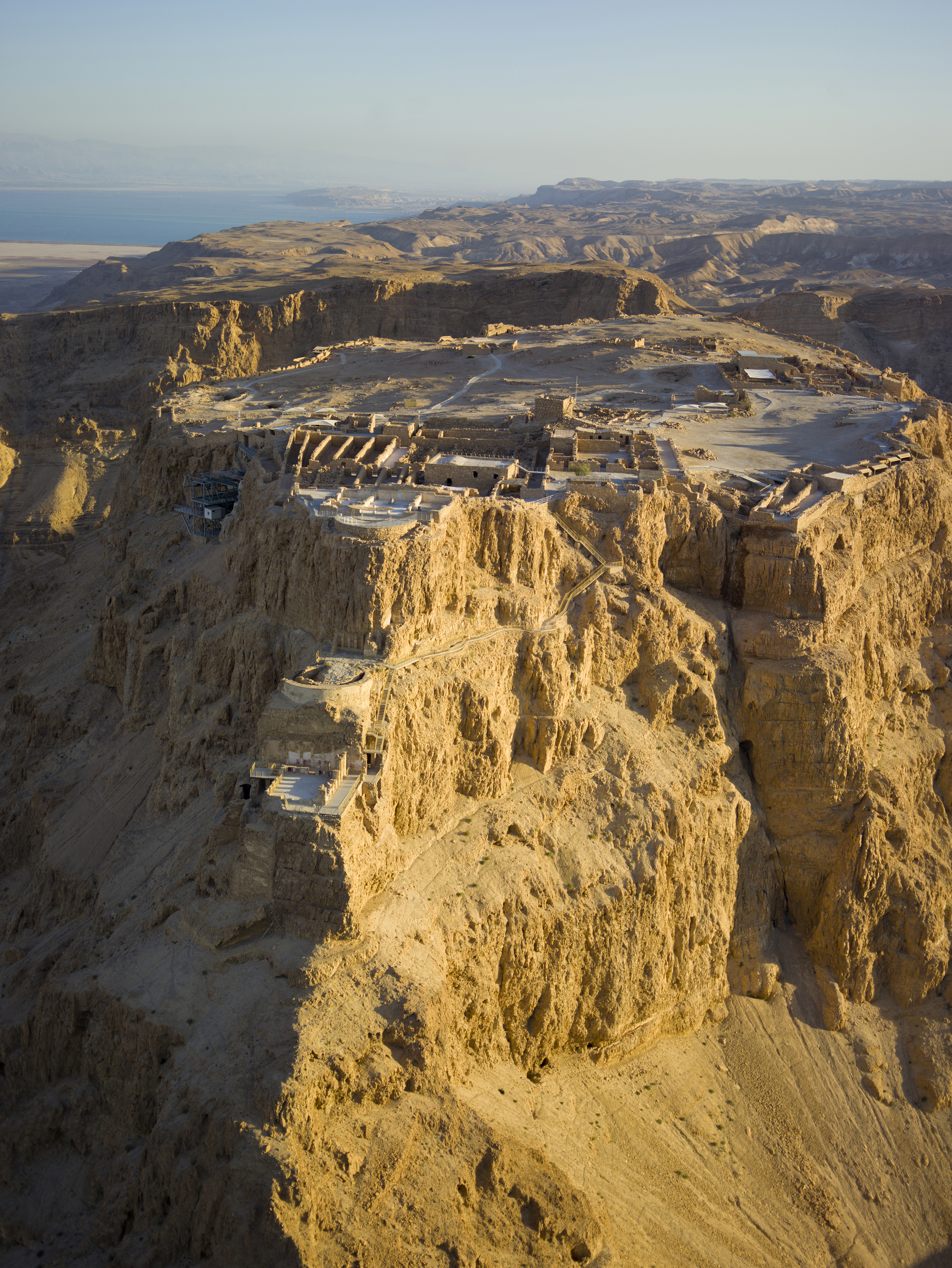
The plateau appears without warning. One moment you are flying over the bleached, crumpled terrain of the Judaean Desert, and the next a flat-topped mesa rises more than 400 meters above the Dead Sea's western shore like a table set for some ancient reckoning. This is Masada, whose name means simply "fortress" in Hebrew -- though the word barely captures what Herod the Great built here, or what happened after he was gone. Isolated, sheer-walled, and visible for miles in every direction, the site was chosen precisely because it looks impossible. That was always the point.
Herod's Desert Refuge
Herod the Great began fortifying Masada around 35 BCE, transforming a natural plateau into one of the most ambitious desert strongholds of the ancient world. He enclosed the summit with a casemate wall punctuated by towers, then filled the interior with storerooms, bathhouses fed by an ingenious water system, and two palaces that remain among the finest examples of Herodian architecture ever uncovered. The Western Palace served as the administrative center, with its throne room, reception halls, and elaborate mosaic floors. But the Northern Palace was the showpiece: a three-tiered structure cascading down the cliff face on narrow rock terraces, its frescoed walls and Corinthian columns offering views across the Dead Sea to the mountains of Moab. Herod never had to use Masada as a refuge. He built it as insurance against threats both foreign and domestic, then largely abandoned it to garrison troops.
The Last Holdout
In 66 CE, as the First Jewish-Roman War erupted across Judaea, a group of Jewish rebels known as the Sicarii seized Masada from its small Roman garrison. Led by Eleazar ben Ya'ir, they held the fortress for years while Jerusalem fell, the Second Temple was destroyed, and the war ground toward its conclusion. By 73 CE, Masada was the last point of organized Jewish resistance. The Roman governor Lucius Flavius Silva marched the Tenth Legion to the base of the plateau, surrounded it with a circumvallation wall, and began constructing a massive siege ramp against the western face. Geological surveys in the 1990s revealed that the Romans built their 114-meter ramp atop a natural spur of bedrock -- engineering pragmatism as much as brute force. By spring, the ramp was complete. On April 16, Roman battering rams breached the fortress wall. According to the historian Josephus, what the soldiers found inside was silence: the defenders had chosen death over capture, with 960 men, women, and children dead by their own decision.
What Josephus Wrote, and What Scholars Question
Nearly everything known about the siege comes from Flavius Josephus, a Jewish-Roman historian writing for a Roman audience. His account in The Jewish War provides the dramatic narrative -- Eleazar's speeches urging collective death, the final lottery among ten chosen men, the two women and five children who survived by hiding in a cistern. But Josephus was not present at Masada, and scholars have spent decades questioning his details. Archaeological excavations led by Yigael Yadin in the 1960s confirmed the fortress's layout, the Roman camps, and the siege ramp, but the physical evidence for a mass suicide remains ambiguous. Pig bones found among the ruins suggest Roman habitation after the siege. Twenty-five skeletons discovered in a cave below the southern cliff have been disputed -- some scholars argue they may be Roman soldiers, not Jewish defenders. The story Josephus told is powerful, but the archaeological record tells a more complicated one.
A Symbol Remade
In the early twentieth century, Masada was largely forgotten -- a ruin visited by few, known mainly to scholars of Josephus. That changed with the rise of Zionism. The story of Jewish fighters choosing death over Roman slavery became a founding narrative for the emerging state of Israel. "Masada shall not fall again" became the declaration sworn by Israeli Armoured Corps soldiers during ceremonies held atop the plateau by torchlight, a tradition initiated by IDF Chief of Staff Moshe Dayan. The Israeli archaeologist Yigael Yadin, who led the major excavations from 1963 to 1965, was himself a former military chief of staff, and his work at Masada carried national as well as scholarly significance. In recent decades, Israeli historians have reexamined this narrative. The Sicarii were not mainstream Jewish fighters but a radical splinter group accused by Josephus of terrorizing other Jews. The "Masada myth," as scholars now call it, reveals as much about modern Israel's need for founding stories as it does about the ancient siege itself.
The Plateau Today
UNESCO designated Masada a World Heritage Site in 2001, recognizing both the archaeological remains and the site's symbolic importance. Visitors reach the summit by cable car or by climbing the Snake Path, the winding trail that ascends the eastern face -- the same route the Roman-era inhabitants used. At the top, the outlines of Herod's palaces, storerooms, and bathhouses are clearly visible, along with the casemate wall and the remains of a Byzantine-era church built centuries after the siege. From the summit, the Roman siege camps and circumvallation wall are still traceable on the desert floor below, one of the best-preserved examples of Roman siege warfare anywhere in the world. The Dead Sea shimmers to the east, and on clear days the mountains of Jordan rise beyond it. Masada endures not because its walls still stand, but because the questions it raises -- about resistance, sacrifice, memory, and myth -- have never been fully answered.
From the Air
Located at 31.32N, 35.35E on the western shore of the Dead Sea in the Judaean Desert, southeastern Israel. The flat-topped mesa is unmistakable from the air, rising sharply above the surrounding terrain. Best viewed from 3,000-5,000 feet AGL approaching from the east over the Dead Sea. The Roman siege ramp and camp outlines are visible from altitude. Nearest airports: LLMZ (Masada Airstrip), LLAR (Arad). Be Sheva/Nevatim (LLNV) is roughly 40 nm to the southwest. Note the Dead Sea surface is approximately 430m below sea level.