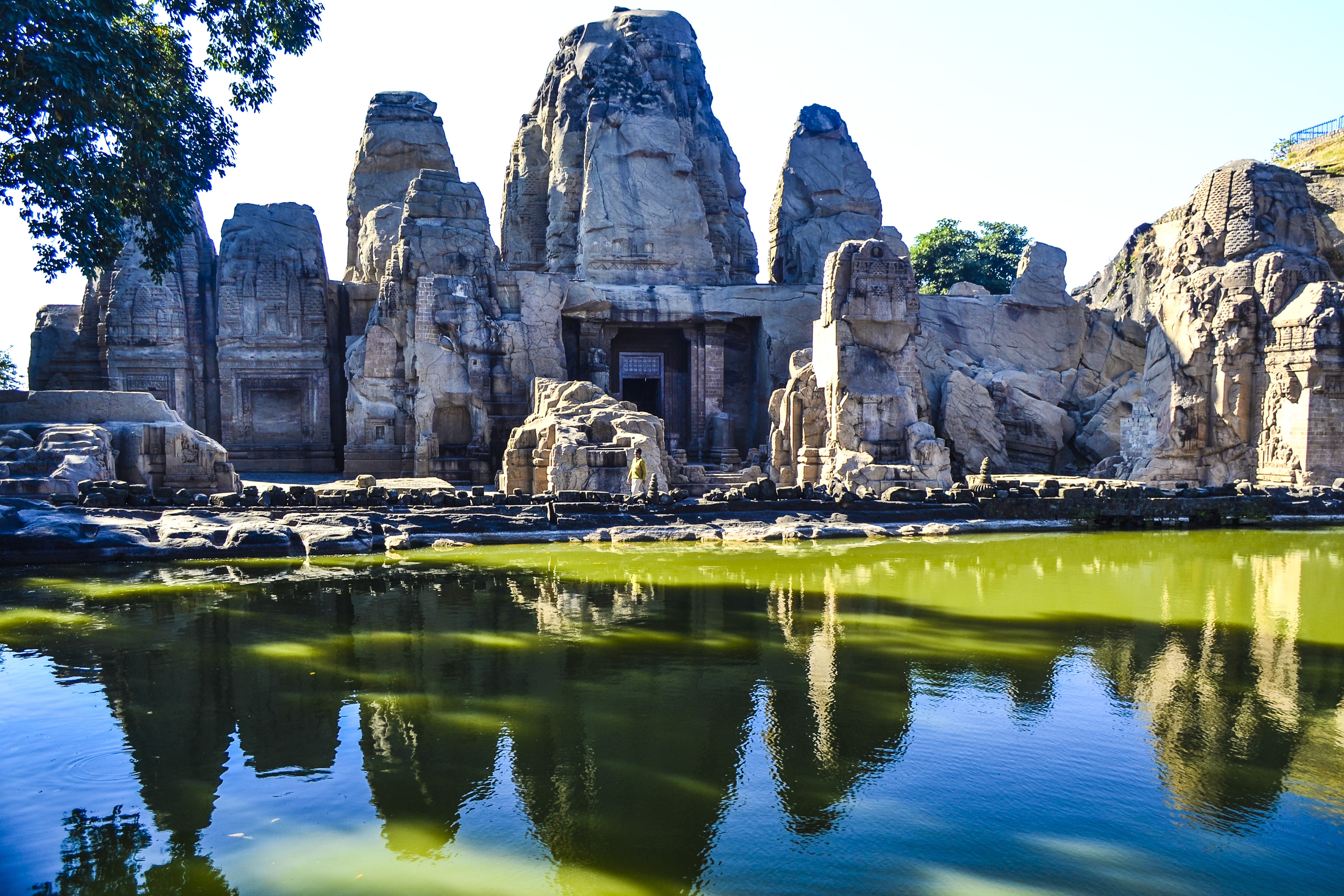
Masrur Temples
Someone carved an entire mountain into a temple. Not on the mountain, not beside it -- into it. In the Kangra Valley of Himachal Pradesh, a sandstone ridge was hollowed and sculpted in the mid-8th century to produce one of India's most ambitious feats of rock-cut architecture. The Masrur Temples are rarely mentioned alongside Ellora or Elephanta, yet the ambition behind them rivals both. Fifteen monolithic shrines emerge from living rock, their curvilinear spires arranged in a mandala pattern that ancient Hindu texts called the Kailasa design -- a symbolic recreation of the cosmic mountain at the center of the universe.
A Mountain Made Sacred
The temples follow a blueprint described in the Visnudharmottara, an 8th-century Sanskrit text whose manuscripts survived among Hindu communities in the Kashmir valley. The text catalogs 101 temple designs, and scholars like Stella Kramrisch and Michael W. Meister identified the Masrur plan as matching the Kailasa type: a central shikhara symmetrically surrounded by four smaller spires aligned to the four cardinal directions. Each entrance faces outward along a compass axis, turning the entire complex into a three-dimensional diagram of Hindu cosmology. The Visnudharmottara also prescribed principles for image-making and painting, and traces of both survive in the temple's mandapa and inner sanctum -- evidence that the builders followed the text's instructions with remarkable fidelity.
Spires That Climb Like Vines
Every spire at Masrur belongs to the Nagara tradition, the dominant temple architecture of central and northern India. More precisely, they employ the latina sub-style, named for the Sanskrit word lata, meaning grapevine. The effect is unmistakable: each tower rises as a rhythmic series of superimposed horizontal stone slabs, each slightly smaller than the one below, with offsets that curve inward like tendrils on a vine. The result suggests organic growth frozen in stone, as though the mountain itself were reaching skyward. Comparable towers appear at the Mahua Hindu temple and the Alampur Navabrahma Temples, both datable to the 7th and 8th centuries. After the 8th century, this particular style disappears from firmly dated Indian temples, which helps scholars place Masrur around 750 CE. All symmetrically positioned spires share the same design, while the stairway spire introduces a variation: four turned squares supporting eight rotating lata spines that alternate with eight right-angled projections.
Rediscovery and the Priest's Other Job
The temples drifted into obscurity for centuries before Harold Hargreaves of the Archaeological Survey of India visited in 1913. What he found was not a ruin but a living place of worship. The complex included a dharmashala -- a pilgrim's resthouse -- along with a kitchen and small living quarters for a resident priest. That priest's situation captured something essential about Masrur's quiet persistence: temple service was his part-time work. His main livelihood came from maintaining cattle and working the surrounding farmland. The central shrine, locally known as the Thakurdvara, had been continuously venerated without the institutional support that sustains more famous sites. Hargreaves documented the architecture in the Archaeological Survey's annual report, and subsequent scholars gradually recognized Masrur as one of northern India's most significant surviving examples of monolithic temple construction.
Stone Against Time
Earthquakes have taken a toll. The 1905 Kangra earthquake, one of the deadliest in Indian history, damaged several of the spires and collapsed portions of the rock-cut chambers. Yet enough survives to convey the original vision: a complex where architecture, sculpture, and landscape merge into a single devotional statement. The carved panels in the mandapa still depict Hindu deities with the fluid naturalism characteristic of 8th-century Indian sculpture. Walking through the temples today, with Dhauladhar peaks visible beyond the ridge, you begin to understand the Kailasa concept not as abstract theology but as spatial experience. The builders chose this particular ridge because its profile already suggested a sacred mountain. They simply finished what geology had started.
From the Air
Located at 32.07N, 76.14E in the Kangra Valley of Himachal Pradesh, India, at approximately 800 meters elevation. The temples sit on a sandstone ridge visible from low altitude against the backdrop of the Dhauladhar range. Nearest airport is Gaggal Airport (VIGG) at Kangra, roughly 30 km southeast. The Kangra Valley stretches east-west below the snow-capped Dhauladhar mountains, making the ridge formation identifiable from the air. Best viewed on clear days when the contrast between the carved sandstone and surrounding green valley is sharpest.